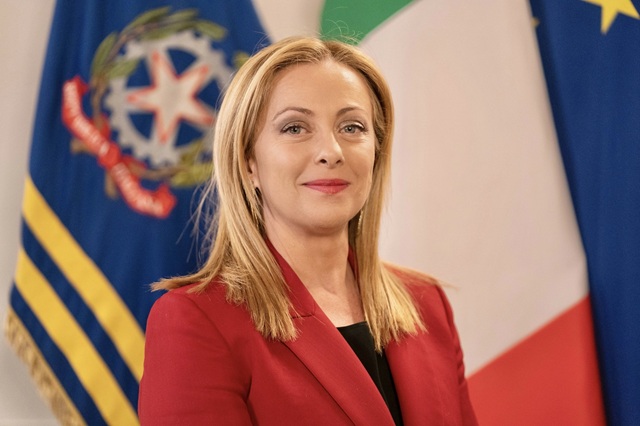
In an exclusive interview with the Financial Times (FT), Italy’s Prime Minister Giorgia Meloni rejected the notion of Italy having to choose between the United States and Europe, calling it “childish” and “superficial.” Meloni emphasized that her government would prioritize Italy’s national interests, while also working to maintain strong transatlantic relations, especially given the complexities of the current international landscape.
Meloni, who assumed office in October 2022, has become one of Europe’s most prominent nationalist conservative leaders. In the interview, she made it clear that despite Italy’s historical allegiance with the United States, she does not view President Donald Trump or any U.S. administration as an adversary. Instead, Meloni acknowledged her ideological proximity to Trump, noting, “I’m conservative. Trump is a Republican leader. Surely I’m nearer to him than to many others, but I understand a leader that defends his national interests.” However, she was adamant that Italy would continue to respect the United States as its “first ally.”
Her comments come at a time of rising concerns in Europe regarding Trump’s protectionist policies and confrontational stance, particularly towards European trade practices and defense spending. Meloni, however, observed that many of the criticisms raised by Trump regarding Europe’s economic practices were not new, echoing complaints from previous U.S. administrations. She also stated that the U.S. has long pursued protectionist strategies, pointing out that this trend was not solely the work of Trump but was also seen under President Joe Biden, particularly with initiatives like the Inflation Reduction Act.
Addressing the growing divide between Europe and the U.S., Meloni expressed a desire to avoid a transatlantic rift. “Italy can have good relations with the United States, and if there is something that Italy can also do to avoid a confrontation with Europe and to build bridges, I will do that,” she said. This was part of her broader strategy to help bridge gaps between Europe and the U.S., especially as Trump’s approach to European defense has raised concerns across the continent. Meloni saw Trump’s confrontational stance as a potential “stimulus” for Europe to take more responsibility for its own security, a message she framed as one of opportunity rather than confrontation.
Throughout the interview, Meloni maintained her pragmatic stance on foreign policy, especially regarding European security. While other European leaders like French President Emmanuel Macron and British Prime Minister Keir Starmer have focused on strengthening ties with the U.S. to support Ukraine, Meloni has been more measured in her approach. She rejected the idea of a European “reassurance force” in Ukraine, cautioning that it could provoke Moscow. Instead, she suggested extending NATO’s Article 5 mutual defense clause to Ukraine without formally admitting the country into the alliance, a proposal that has raised eyebrows in European capitals and has not been fully embraced by the U.S.
Moreover, Meloni underscored Italy’s longstanding commitment to NATO and its defense obligations. However, she noted that Italy, like many other European countries, has struggled to meet NATO’s defense spending targets, which remain a point of contention, particularly with the U.S. In this context, Meloni acknowledged the increasing pressure for Italy to raise defense spending, but she also expressed concerns over the long-term impact of the European Union’s fiscal rules on Italy’s finances. With Italy’s national debt standing at over 135% of GDP, Meloni has had to balance fiscal responsibility with the need to invest in defense and security.
Meloni’s leadership has been characterized by a blend of nationalism, political stability, and fiscal prudence. Since taking office, she has consolidated her position as Italy’s fifth-longest-serving postwar prime minister. Her government has worked to reassure financial markets about Italy’s debt, even as the country grapples with a challenging global economic environment. At the same time, Meloni has pushed for Italy to become a more influential player on the international stage, notably by fostering greater energy imports from Africa, which she sees as key to Italy’s future stability and economic prospects.
In the Financial Times interview, Meloni also took aim at Europe’s so-called “woke politics,” criticizing a loss of direction in Europe’s approach to free speech and democracy. She aligned herself with U.S. Vice President JD Vance’s critique of Europe, which she described as having “lost itself.” The remarks were indicative of her broader criticism of European elites and institutions, which she has often accused of being out of touch with the concerns of ordinary citizens.
Meloni’s strong stance on national sovereignty and her ability to navigate the complex dynamics between the U.S. and Europe have made her a unique figure in European politics. She has also emerged as a vocal supporter of Ukraine, distancing herself from some far-right counterparts in Europe who have historically been sympathetic to Russia. Meloni’s government has maintained Italy’s commitment to NATO, but with a distinct emphasis on Italy’s own national interests, particularly in the context of defense spending and security.