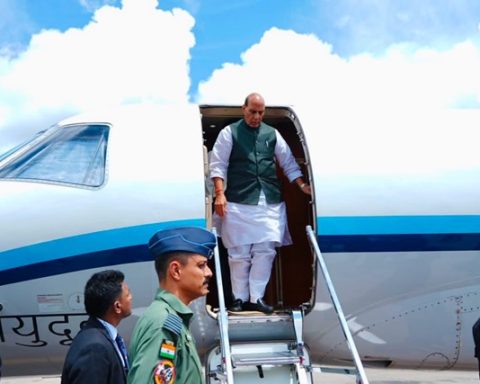
In a historic move, Sri Lanka declared the Anuradhapura Airbase—a key military installation operated by the Sri Lanka Air Force (SLAF)—as an international airport for a single day to facilitate the departure of Indian Prime Minister Narendra Modi. This extraordinary step was taken to allow the Indian leader to depart directly from Anuradhapura to Rameswaram in southern India, following his religious and diplomatic engagements in the ancient Sri Lankan capital.
The temporary elevation of the base’s status was authorized by a special gazette notification issued the previous Friday. It granted the airbase the legal standing of an international airport solely for the purpose of emigration clearance of the Prime Minister and his core delegation. Under standard regulations, Sri Lanka permits international flights only through its five officially designated international airports: Bandaranaike International Airport (BIA), Ratmalana, Mattala Rajapaksa International Airport, Jaffna International Airport (Palali), and Batticaloa Airport.
The decision to bypass these established ports in favor of a military base reflects both logistical and symbolic motivations. Anuradhapura, steeped in religious significance and historically central to both Sri Lankan and South Asian Buddhism, was a fitting location for Prime Minister Modi to conclude his visit. However, the logistical realities of operating a military airstrip for international departure required swift and exceptional measures. The Anuradhapura Airbase is not outfitted with civilian aviation infrastructure. It lacks customs, immigration terminals, commercial aircraft handling facilities, and large runways suitable for wide-body jets. Despite these limitations, Sri Lanka’s Civil Aviation Authority (CAA), immigration officials, and military personnel coordinated closely with Indian diplomatic and security teams to ensure the seamless departure.
Director General of the Civil Aviation Authority, Sagara Kotakadeniya, confirmed that the airbase was officially designated for international operations for one day only. “This is an airport with no facilities to conduct international travel arrangements. Even big aircraft cannot operate from there,” he said. “The immigration and emigration authorities approved clearance for the departure of the Indian leader and his team. For that purpose, a gazette notification was issued.”
Interestingly, the Anuradhapura Airbase is located approximately 197 kilometers by road—or about 156 kilometers in a straight line—from Jaffna’s Palali Airport (Jaffna International), which is the closest designated international airport in the northern region of the country. While it might seem more practical to route international travel through Palali, especially for northern departures, doing so would have required the Prime Minister to travel several hours overland from Anuradhapura, potentially complicating security logistics and altering the ceremonial narrative of the visit. The choice to use the airbase, therefore, reflects not only convenience but also the diplomatic choreography that often accompanies high-level international visits.
Historically, the Anuradhapura Airbase has played a critical role in Sri Lanka’s military defense structure. It was notably attacked by the Liberation Tigers of Tamil Eelam (LTTE) on October 22, 2007, during the peak of the civil conflict. The attack included a rare coordinated ground and aerial assault, marking one of the few times a Sri Lankan military base had come under such a sophisticated rebel operation. Despite its strategic importance, the base was never targeted during either of the Janatha Vimukthi Peramuna (JVP) insurrections in 1971 or 1987–1989, which were more focused on urban disruption and police targets rather than high-security military installations.
The Prime Minister’s departure from Anuradhapura also holds cultural resonance. His destination, Rameswaram, is one of the most sacred pilgrimage sites in India and is closely linked with the Ramayana—a shared cultural epic revered across South Asia. The decision to fly directly from Anuradhapura to Rameswaram served as a symbolic bridge between two ancient spiritual capitals, emphasizing the deep historical and religious ties between the two countries.
While Prime Minister Modi departed via the Anuradhapura Airbase, other members of his delegation, including Indian External Affairs Minister Dr. S. Jaishankar, took the conventional route out of the country through Bandaranaike International Airport in Katunayake. The split departure underscores the level of logistical and diplomatic planning required to support such high-profile international visits, and the unique status afforded to a visiting head of government.
This brief transformation of a restricted military zone into a legally recognized international airport marks a rare moment in Sri Lanka’s aviation history. Globally, such instances are uncommon but not unheard of. In emergency situations or for diplomatic convenience, military airfields have occasionally been temporarily declared ports of entry—for example, during the 9/11 emergency landings in Canada or during military operations in Iraq and Afghanistan. However, this appears to be the first time Sri Lanka has enacted such a measure for a foreign leader’s official departure.
Whether this extraordinary measure will be repeated for future high-level visits remains to be seen. For now, the one-day internationalization of the Anuradhapura Airbase stands as a unique blend of ceremony, symbolism, and statecraft—where history, diplomacy, and aviation intersected for a single flight across the Palk Strait.