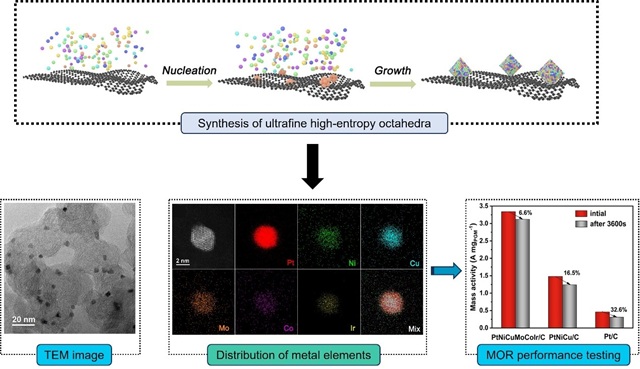
A research team led by Professor ZHANG Tierui at the Technical Institute of Physics and Chemistry, Chinese Academy of Sciences (CAS), has developed a novel catalyst that dramatically improves the performance of direct methanol fuel cells (DMFCs). The innovation, published in Matter on April 8, could pave the way for more efficient and durable fuel cells powered by methanol—a safe, high-energy-density liquid fuel.
Fuel cells are among the most promising technologies for replacing traditional fossil fuels, offering efficient conversion of chemical energy into electricity without harmful emissions. Methanol, in particular, has garnered attention due to its ease of storage and transport. However, a long-standing challenge has been the rapid deactivation of catalysts during methanol oxidation, primarily due to poisoning by reaction intermediates such as carbon monoxide. These species adhere to catalyst surfaces, blocking active sites and reducing overall efficiency.
Addressing this challenge, Prof. ZHANG’s team engineered a new class of ultrafine platinum-based high-entropy alloy (HEA) octahedra—nano-sized particles with precisely controlled shape and composition. These HEA catalysts, composed of six different metal elements, exhibit outstanding resistance to poisoning and enhanced catalytic activity, marking a breakthrough for the practical deployment of DMFCs.
“By incorporating multiple metal elements into the catalyst structure, we effectively lowered the surface energy of platinum-based nano-octahedra,” said Prof. ZHANG. “This enabled us to stabilize ultrafine particles with edge lengths under 3 nanometers, making the catalyst both highly active and structurally stable.”
Compared to conventional ternary alloy catalysts or commercial platinum-on-carbon (Pt/C) materials, the senary HEA catalyst demonstrated superior performance in electrochemical tests. The catalyst’s multimetal composition not only minimized aggregation of particles—an issue that typically plagues high-surface-energy nanomaterials—but also fine-tuned the electronic structure of platinum, optimizing its interaction with methanol molecules and intermediates.
The results confirmed a clear trend: as the number of metal elements increased, the size of the nano-octahedra decreased. The six-element (senary) alloy achieved an average edge length of just 2.8 nanometers—considerably smaller than previous efforts—maximizing exposure of active catalytic sites while maintaining structural integrity.
The study also involved theoretical calculations that supported the experimental findings, showing how the synergy among multiple metal elements enhances electron distribution and boosts both activity and anti-poisoning capabilities.
“This research not only advances our understanding of multi-elemental catalyst design, but also brings us closer to practical, high-performance methanol fuel cells,” Prof. ZHANG added.
This work received support from several key national initiatives, including the National Key Projects for Fundamental Research and Development of China, the National Natural Science Foundation of China, the Beijing Natural Science Foundation, and the Youth Innovation Promotion Association of the Chinese Academy of Sciences.