
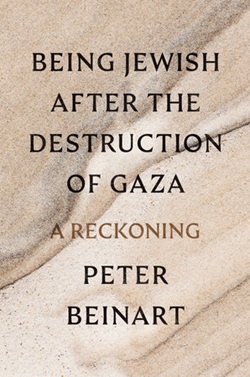
In Being Jewish After the Destruction of Gaza Peter Beinart engages in a rigorous and unsparing interrogation of the foundational pillars upon which contemporary Jewish identity and statehood rest, following the 2023 hostilities between Israel and Hamas. In this brief yet seminal work, Beinart ventures into a juridico-ethical labyrinth, parsing the complexities of ethno-nationalism, the moral boundaries of self-defense, and the jurisprudential paradoxes of sovereignty and occupation.
The book is more than a polemic. It is an epistolary submission—both to the Jewish people and to the global community—citing what might be termed a “breach of normative ethics” by the modern nation-state that represents the Jewish diaspora. Beinart, by juxtaposing prophetic Judaism against the praxis of militarized Zionism, effectively invokes the legal equivalent of a moral amicus curiae brief: a friend of the soul speaking on behalf of justice, if not of law.
The Principle of Proportionality and Jus in Bello
One is immediately struck by Beinart’s implicit invocation of jus in bello, or the law governing the conduct of war, especially in the context of the principle of proportionality under International Humanitarian Law (IHL). While the author refrains from invoking the Geneva Conventions per se, his exegesis leads the reader to question whether the conduct of hostilities by Israel—in particular the disproportionate use of force against civilians and civilian infrastructure in Gaza—meets the test of legality under Article 51(5)(b) of Additional Protocol I to the Geneva Conventions of 1977, which prohibits attacks expected to cause incidental loss of civilian life excessive in relation to the concrete and direct military advantage anticipated.
Beinart goes further to suggest that beyond legal culpability lies moral transgression. The Jewish ethical canon, he argues, has been subordinated to a sovereign prerogative that justifies force as an instrument of existential preservation. This sovereign exceptionalism, to borrow Carl Schmitt’s terminology, has rendered tzelem Elohim—the sanctity of all human life—a casualty of political expediency.
Zionism, Ethno-Nationalism, and the Doctrinal Collapse of Liberal Judaism
Beinart’s analysis, though theological in nature, resonates with doctrinal elements of constitutional theory and political jurisprudence. His critique of liberal Zionism can be likened to an assessment of the failure of a constitutional system to maintain checks and balances on the exercise of executive power. In this case, liberal Zionism, as a form of internal jurisprudence within the Jewish diaspora, has failed to delimit the scope of the Israeli state’s coercive apparatus.
In the hands of Beinart, Jewish nationalism becomes analogous to an illiberal constitutional order: one that elevates raison d’état above tzedek (justice). This deviation, he implies, is not only a moral aberration but a jurisprudential malfunction, where the grundnorm (or foundational norm, to invoke Hans Kelsen) of justice is overridden by the operational norm of state survival.
Reconstructing Identity: From Sovereignty to Solidarity
The most compelling part of Beinart’s thesis is his effort to reconstruct Jewish identity not through the prism of sovereignty but through the lens of solidarity. Here, one may draw parallels to the international legal concept of erga omnes obligations—those owed toward all, particularly in matters involving fundamental human rights. Beinart subtly implies that Jewish ethics entail an erga omnes responsibility toward the suffering of the Palestinian people, regardless of geopolitical enmities.
This shift from sovereignty to solidarity mirrors what, in international law, would be a movement from state-centric to human-centric paradigms. Beinart’s exhortation that Judaism reclaim its prophetic voice parallels the role of non-state actors—such as civil society and religious communities—in filling the normative void left by the inaction or overreach of states.
Legal Exceptionalism and the Rhetoric of Security
Beinart’s meticulous deconstruction of the rhetoric of security, often invoked to justify military excesses, echoes the doctrine of necessity as articulated in international law. However, as with Article 25 of the International Law Commission’s Draft Articles on State Responsibility, necessity cannot be invoked if the act in question seriously impairs an essential interest of the international community as a whole. The wholesale destruction of Gaza, and the resultant humanitarian crisis, must be viewed in this light—not merely as a military action, but as a challenge to the fabric of international norms and the conscience of the Jewish people.
In Being Jewish After the Destruction of Gaza, Peter Beinart accomplishes what legal scholars and theologians alike rarely do: he excavates the substrata of moral, legal, and communal identity in a time of war. The book is a necessary reckoning, demanding both introspection and jurisprudential recalibration. It serves as a timely reminder that statehood does not confer moral infallibility, and that survival without justice may secure borders, but not the soul.
For readers engaged in the intersection of international law, ethics, and identity politics, this book is not merely a reflection—it is a reckoning. As a Jewish public intellectual, Beinart may have raised uncomfortable questions for his community, but for legal scholars and ethicists, he has illuminated an enduring truth: that legitimacy is not only founded on legal recognition, but on the ethical exercise of power.
A Comparison
In reading Being Jewish After the Destruction of Gaza by Peter Beinart alongside Ari Shavit’s My Promised Land: The Triumph and Tragedy of Israel, one is confronted not only with two markedly different narratives, but with two legal-philosophical approaches to the same existential question: what does it mean to be Jewish in the context of Israeli statehood, and what legal and moral legitimacy does that statehood carry in light of its treatment of Palestinians?
Beinart writes in the aftermath of catastrophe, as a witness to what he considers a moral inflection point that demands not strategic re-evaluation, but ethical rupture. Shavit, by contrast, writes with a tone of elegy and tragic pride, seeking to reconcile Zionism’s violent beginnings with its democratic aspirations. If Shavit is a jurist of moral realism—embracing what one might call the “doctrine of tragic necessity”—then Beinart is the advocate for a higher jurisprudence, rejecting necessity when it obliterates proportionality and human dignity.
In Shavit’s account, the nation-state of Israel is a historical imperative. He does not deny the atrocities of 1948 or the displacement of Palestinians, but he folds them into a narrative of justified survival. It is a form of raison d’État framed in terms of existential continuity. His legal analogy, though implicit, is aligned with the principle of territorial integrity and the foundational right of a people to self-determination under the UN Charter, Article 1(2). Yet, his reading of these rights is insular, excluding or minimizing the co-equal Palestinian claim to those very principles.
Beinart, by contrast, challenges whether such rights can remain legitimate when pursued through force so disproportionate as to violate the tenets of International Humanitarian Law. Whereas Shavit normalizes the exceptionalism of Jewish statehood through the logic of survival, Beinart deconstructs this exceptionalism as a breach of jus cogens norms—non-derogable principles such as the prohibition on targeting civilians, collective punishment, and racial discrimination.
Both authors confront the trauma of Jewish history, but Beinart draws a legal and moral distinction between memory and justification. The Holocaust, for Shavit, is the enduring rationale for Jewish power; for Beinart, it is a sacred memory whose invocation to defend acts of contemporary aggression risks instrumentalizing suffering. The Nuremberg Principle that “crimes against humanity are punishable whether committed in peace or war” is not lost on Beinart. He posits a form of post-sovereign Jewish ethics, akin to a lex humana, where justice transcends the prerogatives of statehood.
Shavit’s narrative adheres more closely to what might be termed a “domestic constitutionalism” of Jewish nationalism—wherein the Law of Return, the Basic Laws, and the IDF’s self-styled code of ethics create a sovereign bubble of normative legitimacy. Beinart, conversely, is working within a transnational human rights framework. His appeal is closer to a cosmopolitan jurisprudence that would hold Israel accountable not only to its citizens, but to a universal moral court of conscience. His use of prophetic Judaism can be analogized to the erga omnes obligations under international law—moral duties owed to all humanity, irrespective of political allegiance.
Where Shavit constructs a lament for lost innocence, Beinart issues a brief for moral reinvention. If we were to cast their arguments into the structure of legal pleadings, Shavit would plead necessity and historic victimhood as mitigating factors, while Beinart would submit that complicity, when ignored, becomes a form of dereliction of moral duty.
Ultimately, the divergence between the two works reflects a broader split in Jewish thought and global jurisprudence: the debate between sovereignty and universality, between identity and accountability. Shavit wants the world to understand Israel; Beinart wants Jews to re-understand themselves. In doing so, Beinart’s work presents not merely a book but a writ—an appeal to conscience, with standing granted not by nationalism, but by the higher law of justice.