


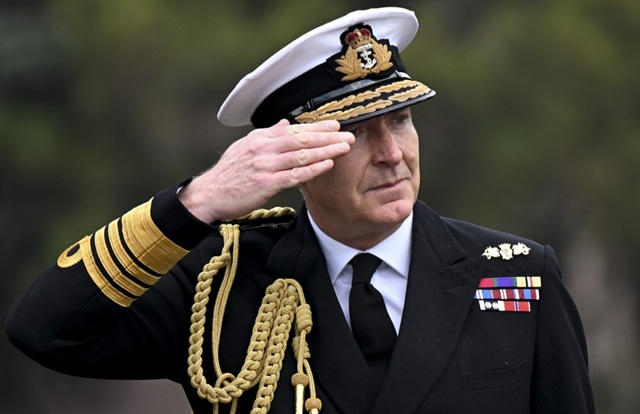
The head of Britain’s armed forces, Admiral Sir Tony Radakin, has made the first visit by a British chief of defence staff to China in a decade. The visit, which marks a significant moment in UK-China military relations, comes amid rising global tensions, particularly between China and the United States over issues ranging from trade to military competition.
Admiral Radakin’s trip to Beijing focused on “strengthening military co-operation,” according to China’s Ministry of Defence. During his visit, Radakin delivered a groundbreaking speech at the People’s Liberation Army (PLA) National Defence University, addressing future Chinese military commanders. This was the first time a British defence chief had spoken at the university, which is considered the backbone of China’s military leadership training.
In addition to his speech, Radakin held high-level talks with General Liu Zhenli, a prominent member of China’s Central Military Commission (CMC) and the chief of staff of the CMC joint staff department. These discussions centered on enhancing military-to-military relations, global security concerns, and the increasing need for international cooperation in the face of rising geopolitical challenges.
The British Ministry of Defence did not publicly disclose details about the visit, but it is understood that Radakin’s remarks highlighted the importance of strengthening global alliances in an era of heightened state-on-state conflict and the rapid advancement of military technology. Radakin also emphasized the growing trend of European nations increasing defence spending, reflecting the rising security threats in the region.
This diplomatic engagement follows a visit by UK Foreign Secretary David Lammy to Beijing and Shanghai in October of last year, where he outlined Britain’s intention to adopt a stable, consistent, and pragmatic approach toward China. The visit is notable given the sharp deterioration in UK-China relations in recent years. In 2020, the UK banned Chinese telecom giant Huawei from its 5G networks due to national security concerns, and more recently, China has been accused of providing support to Russia amid the ongoing conflict in Ukraine.
The UK’s military relationship with China had been at its peak in 2015 when General Sir Nicholas Houghton, the then British Chief of Defence Staff, visited China during a period of strong diplomatic ties. However, since then, the relationship has soured, especially with the rise of concerns over China’s role in the Ukraine war, as President Volodymyr Zelenskyy accused Beijing of being complicit in Russia’s military actions by allegedly turning a blind eye to the recruitment of Chinese citizens to fight for Russia.
In recent months, there have been increasing tensions over China’s growing influence in global military affairs, particularly as China continues to expand its naval presence and its strategic influence in the Indo-Pacific region. The Royal Navy’s flagship, HMS Prince of Wales, is expected to depart for the Indo-Pacific later this month, leading a deployment involving 12 nations. While the UK military has not confirmed whether the carrier will transit the Taiwan Strait, it marks another potential flashpoint in the fraught relationship between China and the UK, especially as Britain has been critical of Beijing’s actions in the region.
The UK’s stance on its relationship with China remains unclear, as the previous government characterized Beijing as a “systemic challenge” while calling for more robust measures to counter China’s global influence. Furthermore, the UK government has raised concerns over Chinese efforts to recruit former British military personnel. In 2022, an intelligence alert was issued regarding the recruitment of British military pilots to train members of the PLA, raising alarm over potential security risks.











