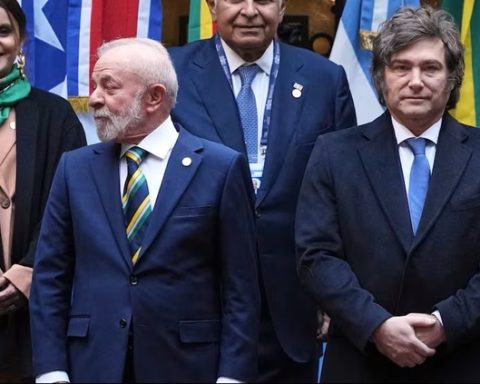
Argentina’s libertarian president, Javier Milei, made a bold and high-risk shift in his economic strategy this week, dismantling a long-standing currency policy that had been central to his battle against the country’s chronic inflation, but had raised concerns among investors.
For months, Milei had relied on Argentina’s stringent currency controls to curb price increases and stabilize the peso, a move that saw the currency strengthen in real terms, albeit at the cost of depleting the country’s already scarce dollar reserves. However, after securing an unexpectedly large $20 billion loan from the International Monetary Fund (IMF), Milei took the dramatic step of loosening these controls, partially floating the peso and easing restrictions on Argentinians’ ability to purchase dollars.
Milei’s decision caught many by surprise, as analysts had expected him to maintain the strict currency policies until the country’s crucial midterm elections in October. The reduction in inflation had been a cornerstone of Milei’s political campaign, and any perceived economic instability could have undermined his chances at the polls.
Responding to the unexpected move, Milei spoke with his trademark bombast, saying in a radio interview, “I always promised that if I had [a lot of dollars] in my hand, I’d lift the controls. How could I not if it means liberating Argentines? What does an election year have to do with it?”
While the IMF-backed move to ease the currency controls has temporarily relieved pressure on Argentina’s central bank, the peso’s value still fell by 6% in the first week of its partial float, although this was much less than economists had feared. The central bank’s new upper limit for the peso remains at 1,400 to the dollar, and maintaining that limit will be crucial for the government.
Even small fluctuations in the peso’s exchange rate can have a significant impact on inflation in Argentina, where businesses often raise prices to protect their margins when the currency weakens. As a result, most economists expect a slight uptick in inflation over the coming months, following the sharp rise in the monthly inflation rate from 2.4% in February to 3.8% in March.
Cristián Buttié, director of the pollster CB Consultora, warned, “This is the big challenge. If we do see more inflation, can the government maintain the sense that things are improving? Or will a climate of doubt start to emerge?”
Milei does have some favorable factors on his side, including Argentina’s seasonal soy harvest from April to June, which typically brings in an influx of dollars that can boost the country’s reserves. Additionally, Milei has pushed for exporters to sell their crops quickly by announcing that a recent export tax cut will expire in June. Financial investors are also expected to bring dollars into the country as a result of Argentina’s high interest rates.
The president’s economic strategy shift follows a turbulent few months for his administration. In February, Milei found himself embroiled in a scandal over his promotion of a memecoin whose value skyrocketed and then collapsed, sparking allegations of fraud. Further controversy arose when Milei’s attempt to install a controversial judge on Argentina’s Supreme Court by decree ended in failure, souring relations with lawmakers.
Despite these challenges, Milei remains hopeful about his political future. Recent polls show a slight decline in his popularity, with support falling from a high of 51.8% in December to 46.1% in March. However, the libertarian president still enjoys considerable backing, particularly among voters dissatisfied with the economic crisis exacerbated by the previous left-leaning Peronist government.
The $20 billion IMF loan, along with a renewal of a $5 billion loan from China and a pledge of support from U.S. Treasury Secretary Scott Bessent, has somewhat restored confidence in the Argentine economy. However, political analysts warn that Milei’s unorthodox economic policies could face significant challenges as the October elections approach.
Tomás Tagle, a strategist at Bull Market Brokers, highlighted the risks ahead: “Market actors in Argentina normally convert pesos to dollars before elections, and we can’t forget that many traders had been arguing the peso was overvalued before Milei floated the currency this week.”
The shift in economic policy also comes at a time when Milei’s political standing faces mounting pressure. His approval ratings have dipped, especially in low-income areas where austerity measures and inflation are felt the hardest. With the midterm elections fast approaching, Milei faces the dual challenge of maintaining investor confidence while demonstrating tangible economic improvements to the Argentine people.
“If he can show results that improve people’s lives, then Milei has a chance to keep his reformist agenda on track,” said Sergio Berensztein, an Argentine political consultant. “But the pressure is on. A poor electoral performance could quickly unravel the progress he has made with the IMF.”