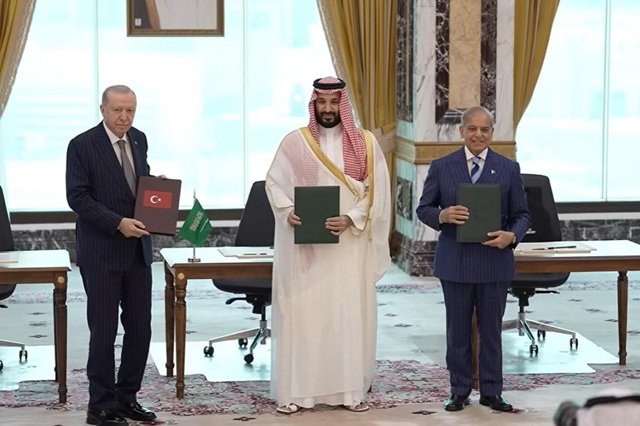
The Mecca Accord, signed in August 2026 by Saudi Arabia, Türkiye and Pakistan, represents a striking recalibration of power within the Islamic world. It is not merely a defence pact but a political declaration of shared vulnerability, shared ambition and shared deterrence. The three nations, each carrying distinct military strengths and geopolitical weight, have chosen to bind themselves in a collective-security framework at a moment when the region’s old certainties are dissolving. The accord’s most consequential clause is its simplest: an attack on one shall be considered an attack on all. In a region where alliances have historically been fluid and hedged, this is a rare moment of clarity.
The necessity of the accord lies in the shifting sands of West Asian security. Saudi Arabia, long accustomed to the protective umbrella of the United States, has found that the American shield is no longer absolute. The Iranian missile and drone strikes of 2026, which repeatedly penetrated Saudi airspace even as Washington and Tel Aviv launched operations against Iran, exposed a harsh truth: American bases and American aircraft do not automatically translate into American intervention. Riyadh’s confidence in its traditional guarantor has been shaken, not by hostility but by American fatigue. The Mecca Accord is therefore a hedge against uncertainty, a diversification of security partnerships and a recognition that the kingdom must anchor itself in a broader Islamic defence architecture.
The strategic logic of the pact rests on the complementary strengths of its members. Pakistan brings the weight of being the only nuclear-armed Muslim nation, with decades of combat experience and a long history of military cooperation with Saudi Arabia. Türkiye contributes the dynamism of a rapidly expanding defence industry, NATO-honed operational capability and a political willingness to project power. Saudi Arabia itself offers immense financial muscle, advanced American air platforms and the symbolic centrality of being the custodian of Islam’s holiest sites. Together, they form a composite force of more than a million active personnel, thousands of aircraft and tanks, and a combined defence expenditure exceeding $120 billion. It is a coalition built not on identical strengths but on complementary ones: Pakistan’s nuclear ambiguity, Türkiye’s industrial depth and Saudi Arabia’s air dominance.
The accord’s provisions, though not exhaustively detailed in public, revolve around collective defence, joint deterrence, intelligence cooperation, interoperability and coordinated political messaging. The choice of Mecca as the venue lends the pact a religious gravitas that no other city could provide. It signals that this is not merely a military arrangement but a statement of Islamic solidarity at a time of regional upheaval.
The question of expansion naturally arises. Egypt stands as the most plausible candidate. Its military size, strategic geography and historical leadership in the Arab world make it a natural fit for a broader Sunni defence framework. Cairo has already held consultations with the signatories, and its inclusion would transform the accord from a triangle into a quadrilateral of formidable weight. Kuwait, Bahrain and Qatar may follow, though their participation will depend on Gulf political dynamics. The UAE, with its deepening ties to Israel and its own evolving security posture, is less likely to join. If expanded, the accord could evolve into a pan-Islamic security bloc, though its architects insist it is not aimed at any sectarian or ideological rival.
For Iran, the accord introduces a new layer of deterrence. While neither Türkiye nor Pakistan seeks confrontation with Tehran, Saudi Arabia’s vulnerability to Iranian missiles has been the primary catalyst for the pact. The combined military strength of the trio complicates Iran’s strategic calculus, especially in the Gulf and Arabian Peninsula. Yet the deterrent value remains ambiguous because Pakistan has not formally extended its nuclear umbrella to the other members. Without a defined nuclear guarantee, the accord’s ability to counter Iran’s missile and drone capabilities remains limited to conventional means.
India must assess the Mecca Accord with sobriety rather than alarm. Pakistan’s participation in a major Islamic defence bloc may embolden its strategic posture, but the pact is not designed for South Asian contingencies. Türkiye’s growing military role and its political positions on Kashmir are factors New Delhi must watch, yet Ankara’s NATO obligations and its own regional priorities limit its appetite for involvement in Indo-Pak tensions. Saudi Arabia’s new defence posture may reduce India’s leverage in Gulf security matters, but the kingdom’s economic and energy ties with India remain robust and mutually beneficial.
The clause that an attack on one is an attack on all should not be interpreted as a binding commitment in the South Asian context. The pact lacks joint command structures, integrated planning or defined response mechanisms. It is, at present, more a political signal than an operational alliance. India should therefore avoid assuming automatic intervention by Türkiye or Saudi Arabia in any future conflict involving Pakistan.
New Delhi’s course should be measured and strategic. It must deepen bilateral ties with Saudi Arabia and Türkiye, ensuring that the accord does not evolve into an anti-India platform. It should expand maritime security cooperation with Gulf states, strengthen intelligence sharing and maintain a balanced posture by engaging Iran, Egypt and the UAE. India must monitor Pakistan’s military gains from the pact, particularly in training, technology transfer and joint exercises. Above all, India should maintain strategic ambiguity, avoiding public commentary that frames the accord as hostile while quietly reinforcing its own regional partnerships.
The Mecca Accord is a declaration of intent, a signal of Islamic unity and a response to a moment of profound regional insecurity. It is not yet a fully operational military alliance, but it is a significant political gesture that may evolve into something larger. For India, the accord is a development to watch with vigilance, engage with diplomatically and interpret with nuance. In a region where alliances shift with the winds of conflict and ambition, India’s best posture is one of steady diplomacy, strategic foresight and an unwavering commitment to regional stability. The sands of West Asia are moving, and the Mecca Accord is one of the first signs of a new landscape taking shape.