by Durga Velayutham
In post-war Sri Lanka, few periods have been as morally disorienting and civically corrosive as the one we currently inhabit. A festering malaise has taken root, not merely within the spheres of political discourse or economic recovery, but in the very marrow of our public conscience. The rise of self-proclaimed “digital creators” — charlatans disguised as investigative journalists — has introduced a new dimension of societal entropy. They do not wield rifles nor bombs, yet their weaponisation of narrative is equally pernicious, insidious, and in some ways, irreparably more destructive.
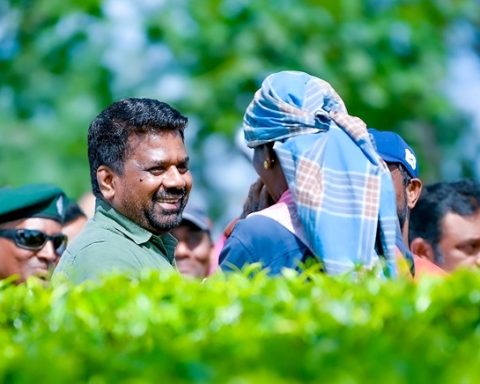
President Dissanayake’s recent pronouncement in Badulla, “We cannot make guilty those who are in our mind, without substantive evidence,” rings out not just as a statement of principle, but a clarion call amidst the cacophony of conjecture. It is a voice of sanity in an asylum where vitriol has replaced verification, and digital distortion is lionised over legal due process.
This pronouncement gains further legitimacy through the Cabinet Spokesman’s rational insistence that the solemn task of identifying the orchestrators of the 2019 Easter Sunday massacre be relegated to the Criminal Investigation Department (CID) and the judiciary — institutions, though imperfect, still underpinned by procedural integrity. Yet, against this backdrop of institutional appeal for evidentiary rigour, a parallel reality unfolds — grotesque in its moral abandonment and outrageous in its audacity.
Former Cabinet Ministers, and an alarming cohort of senior politicos, have, with an alarming lack of circumspection, taken to insinuating that the CID is now compromised. Not through evidence, but through implication. They allege manipulation, not by the rule of law, but by YouTubers — glorified gossip-mongers who weaponise Wi-Fi connections and broker chaos for clicks.
Let us not mince words. These are not journalists. They are parasites. They are digital delinquents with an unholy union to the politics of disruption. They operate not in pursuit of truth, but of traffic — not for justice, but for monetised notoriety. Cloaked in the garb of investigative rigour, their arsenal is not facts, but fabrications; not reportage, but rumour.
Their modus operandi is as reprehensible as it is methodical. They acquire dormant or monetised YouTube channels — oft inflated through synthetic subscriber counts manufactured in troll farms. These digital chimera then morph into echo chambers of orchestrated defamation. Their targets are seldom random; they are methodically curated — senior government officials, intelligence officers, and judiciary members. In turn, a select cadre of state actors — intoxicated by revenge or self-preservation — serve as informants, leaking classified documents to curry favour or vendetta.
What follows is a simulacrum of journalism. Videos are published; clickbait titles mask virulent conjecture. The troll farms are reactivated. Comments sections become digital lynch mobs, meticulously curated to simulate public outrage. The result? A manufactured consensus masquerading as organic civic indignation.
This is not merely reprehensible — it is subversive. It is anti-state, anti-societal, and anti-human.
The Easter Sunday carnage of 2019 — a wound still festering in our collective memory — has now become their grotesque theatre. These digital opportunists, in a stunning display of moral depravity, exploit the tragedy not to honour the victims, but to promote their agendas. Their videos, devoid of evidentiary substantiation, conjure phantoms and shadowy conspirators, attributing culpability through edited montages, ominous music, and faux-authoritative narration. It is theatre. A grotesque one. The blood of innocents is diluted into a backdrop for monetisation.
Worse still, these influencers are not lone actors. They are buttressed by foreign patrons, ideologically-motivated donors, and geopolitical actors who recognise the strategic advantage in destabilising Sri Lanka’s post-conflict equilibrium. They are conduits of chaos, and in the eyes of their sponsors, infinitely expendable.
Sri Lankan society, ever susceptible to conspiratorial thinking, has become the ideal petri dish for their virality. The algorithmic architecture of social media — designed to reward outrage and punish nuance — ensures their content achieves virality while legitimate journalism languishes in obscurity.
What’s even more dangerous is the complicity of silence. The current administration, albeit slowly awakening to this peril, is caught in a conundrum. On one hand, it must honour the sanctity of free speech. On the other, it must draw a decisive line between expression and exploitation. Between journalism and cyber-lynching. Between civic engagement and digital vandalism.
It is no longer a philosophical dilemma. It is a national security imperative.
Let us be brutally candid. The moment has arrived for the government to cast aside the paralysis of political correctness. These self-anointed digital inquisitors are not sacred cows. They are malevolent actors engaged in information terrorism. Their liberties must not supersede the collective dignity and safety of the Republic.
A national protocol must be established. A digital media oversight framework, informed by international best practices but locally rooted, must emerge. Foreign-hosted content that incites division, defames individuals without substantiation, or leverages classified data to stoke public unrest must be taken down. The Ministry of Foreign Affairs must activate Sri Lanka’s missions abroad to liaise with their counterparts in hosting countries — to flag, deplatform, and prosecute when necessary. Freedom of expression cannot be an alibi for digital extortion.
Furthermore, content creators who masquerade as investigative journalists must be legally mandated to register under a verified civic registry — one that subjects them to the same ethical and legal obligations as traditional media. They must disclose funding sources, adhere to editorial standards, and face punitive repercussions for publishing demonstrable falsehoods.
Let us not forget — these content creators are not merely expressing opinions. They are declaring verdicts. They are, in effect, supplanting the judiciary, hijacking investigative institutions, and manipulating public sentiment through an unholy union of theatrics and deceit.
To be clear: this is not a war against social media. It is a war against its perversion.
If the government fails to act, it will find itself not merely outmanoeuvred but overthrown — not through tanks and coups, but through tweets and YouTube thumbnails. The sovereignty of the State cannot be allowed to become a victim of monetised malice.
Let the message be clear and unambiguous. The State must not tolerate these parasitic profiteers any longer. President Dissanayake must act with conviction. These provocateurs must be dried out of their digital cesspools and brought into the cold light of accountability. Not through violence, not through censorship — but through law, through scrutiny, and through principled governance.
Let them speak — but let them prove.
Let them accuse — but let them substantiate.
Let them publish — but let them pay the price when found fraudulent.
Sri Lanka cannot, must not, and shall not be held hostage by conspiracies, digital extortion, and voyeuristic vigilantism masquerading as civic duty. This island, already burdened with wounds from within and without, must shield itself from the marauders of modern media.
Let us not weep later for a republic digitally dismantled. The time to act — is now or never.