


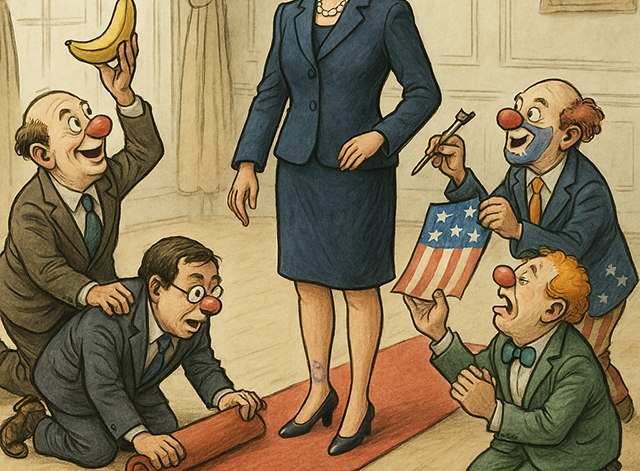
Let it be written in the annals of tropical theatre: while Sri Lanka’s political gladiators were lobbing coconuts in a coliseum of conspiracy, Ambassador Julie Chung sat calmly at the edge of the ring, sipping Ceylon tea and winning—quietly, efficiently, and in good diplomatic heels. If this were chess, she checkmated a board full of squabbling pawns using only a bishop and a press release.
Bravo, Ambassador. As the politicians growled at invisible enemies, demanded thunderous investigations, and then, as usual, vanished into thin air like promises during campaign season, you navigated the whole storm like Odysseus—if Odysseus had to deal with backbench MPs and internet memes instead of sirens and cyclopes.
The game was USAID, and the gambit? A $7.9 million journalism training programme and a few politically inconvenient questions about whether democracy comes with a price tag—or just a per diem.

As soon as whispers began—“My Lord, Madame, don’t think too much; we are trying to get media attention”—one knew this was less about truth and more about performance. And what a performance it was.
Sri Lanka’s finest political thespians emerged in tragicomic unison. USAID funded a protest! USAID taught journalists to be woke! USAID promoted… gender sensitivity! One almost expected someone to accuse USAID of causing the power cuts with gay windmills.
Wimal Weerawansa, ever the oracle of paranoia, emerged from political hibernation to denounce rainbow conspiracies and foreign-funded syllabi. “Seven-point-nine million dollars!” he cried. “What are we teaching? Shakespeare in drag?” No Wimal, just basic journalism—something our parliamentarians fear more than a tax audit.
Then came the cry: “We demand an investigation!”
Cue press conference.
Cue X (née Twitter) posts.
Cue complete and utter silence.
The opposition, having whipped the people into a frenzy with their improvised Macbeth impressions, promptly forgot the plot and exited stage left. The calls for inquiry, for accountability, for transparency—poof—vanished like a budget report at a procurement committee.
Meanwhile, the Communist Party, bless its nostalgic heart, turned to Uncle Sam like a betrayed lover. “We suspect foul play!” cried Comrade G. Weerasinghe, with all the gravitas of a Shakespearean ghost who’s just realised he forgot his lines. Apparently, their concern is that America is funding regime change across the globe. This, from a party whose biggest export is irony.
And let us not forget Namal Rajapaksa, the prince of postponed accountability. “Transparency!” he demanded, staring deeply into the phone camera, as if expecting it to explain who approved the last stadium contract. The very regime that gave us economic heartbreak now asks: “Was it the NGOs?”
One must marvel at the poetic symmetry: the same hands that once clutched at development grants now tremble with suspicion over gender workshops. One minute they beg for dollars, the next they interrogate them. It’s a diplomatic remix of that great Oscar Wilde quip:
“To lose one development fund may be regarded as a misfortune; to lose them all looks like carelessness.”
Of course, Ambassador Julie, ever the composed envoy, swatted these accusations away with the gentle power of diplomatic understatement. “No regime change,” she said. “Just community empowerment, media literacy, and a few workshops on how not to write like government press releases.” In other words, USAID gave Sri Lanka something truly revolutionary: grammar.
And still the politicians bluster. Former minister Sarath Weerasekara led protests outside the US Embassy. “This is foreign manipulation!” he cried, under the shadow of banners printed on Western-donated printers, beside megaphones powered by USAID-charged batteries.
It’s a strange revolution, this. One where nobody resigns, nothing is proven, and the most powerful tool is the press statement. For all the sound and fury, we are left not with inquiry—but with a few red-faced men yelling at a cloud.
What we see here is not corruption, but cowardice in ceremonial robes. They shouted, and then they ran. The allegations were serious—seditious, even—but no files were opened, no subpoenas sent, no forensic accountants summoned from the shadows. Just a passing storm in a diplomatic teacup.
Even George Orwell would be impressed. Political language, he warned us, “is designed to make lies sound truthful and murder respectable.” In Sri Lanka, it’s also designed to disappear the moment you ask for a receipt.
And so, the USAID saga ends not with a revelation but with a whimper. No mass investigation. No parliamentary inquiry. Just a few reused hashtags, a vague sense of déjà vu, and yet another reason for the average citizen to wonder: What do these people actually do?
Let us return, then, to Ambassador Julie—who, despite all the noise, kept to her script. She was accused of interfering, subverting, manipulating—but remained unshaken. She smiled. She hosted tea. She tweeted an inspirational quote and moved on. In a country of ghost investigations and political theatre, she played the long game—and won.
And what of the politicians? They return now to their real jobs: attending opening ceremonies, kissing babies on Instagram, and blaming invisible foreigners for everything from petrol queues to potholes.
It’s a classic case of he who shouts loudest runs fastest—especially when an audit is involved. The USAID funding gambit was never about truth. It was about distraction. A diversion. A dramatic plot twist in a nation too exhausted to care.
But the people remember. They always do. For though the circus changes its clowns, the audience grows wiser. They’ve learned to spot the sleight of hand, the vanishing act, the pantomime of patriotism performed by men with one eye on the donor file and the other on the election calendar.
In the end, perhaps the USAID story wasn’t about foreign funding at all. Perhaps it was just another cracked mirror reflecting the only real regime change we need: one from pantomime politics to actual accountability.
Until then, Ambassador Julie sails on—her ship steady, her waters calm—while Sri Lanka’s political class wrestles not with power, but with its own reflection.
And somewhere, in a forgotten filing cabinet, the investigation sleeps.









