


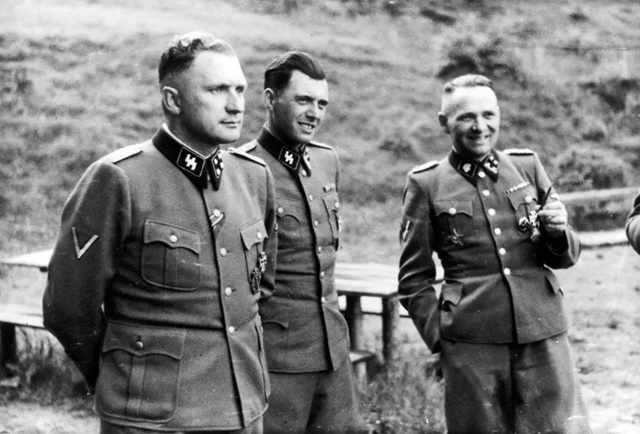
Argentina has officially released hundreds of previously hard-to-access documents confirming its long-suspected role in sheltering senior Nazi war criminals after the Second World War, fulfilling a campaign promise made by President Javier Milei to reveal the extent of the country’s complicity in aiding fugitives from justice.
Among the 1,850 documents now publicly available online are intelligence and police files, internal government memos, and historic news clippings. They detail how infamous Nazis, including Auschwitz doctor Josef Mengele — known as the “Angel of Death” — and Adolf Eichmann, one of the key architects of the Holocaust, were able to enter and live freely in Argentina under false identities in the years following the war.
Mengele arrived in Argentina in 1949 using a Red Cross refugee passport and a fake name, “Helmut Gregor.” By 1956, he felt secure enough to request that police issue him an ID card under his real name. The newly released documents include this request. Mengele would later flee to Brazil, where he died in 1979. Eichmann, meanwhile, lived and worked in Buenos Aires until his dramatic abduction by Israeli Mossad agents in 1960. He was tried and executed in Jerusalem in 1962.
Another file reveals the case of Erich Priebke, an SS officer responsible for the massacre of more than 300 Italians during WWII. Priebke lived for decades in Bariloche, a scenic Argentinian ski town, before his extradition to Italy in 1995 — nearly 50 years after arriving in the country with help from the Vatican.
Also documented is a 1960s investigation into a man believed to be Martin Bormann, Hitler’s close aide, who was suspected of hiding in Argentina. The man, who had an amputated arm, was later proven to be someone else after Bormann’s remains were identified in Berlin.
President Milei’s decision to release the archives represents both a moral reckoning and a political maneuver. While he has positioned the move as a gesture of transparency and a show of solidarity with Israel, it also tarnishes the legacy of former President Juan Domingo Perón, whose administrations (1946–1955 and 1973–1974) are widely believed to have facilitated the escape and settlement of many Nazis in Argentina. Perón’s name remains central to the country’s dominant populist political tradition, which Milei — a self-declared libertarian and opponent of Peronism — is determined to dismantle.
Milei’s chief of staff, Guillermo Francos, said the release was overdue and necessary: “There is no reason to continue withholding it.” However, the files do more than confirm Argentina’s past; they may provide a roadmap to uncovering the broader networks — known as “ratlines” — that helped Nazis escape Europe. These networks often involved clergy, diplomats, and bankers.
The Simon Wiesenthal Center, which continues to investigate Nazi fugitives and their enablers, welcomed the release. Their ongoing work also includes tracking Nazi-linked bank accounts. A recent U.S. Senate investigation into Credit Suisse found that at least 70 Argentina-based Nazi accounts were opened after 1945, with one believed to have remained active as recently as 2022.
While the Nazi fugitives themselves are long dead, the political, financial, and institutional systems that enabled their evasion of justice continue to face scrutiny. President Milei’s declassification initiative may open new avenues of accountability — not just for Argentina’s past, but also for the global legacy of postwar impunity.









