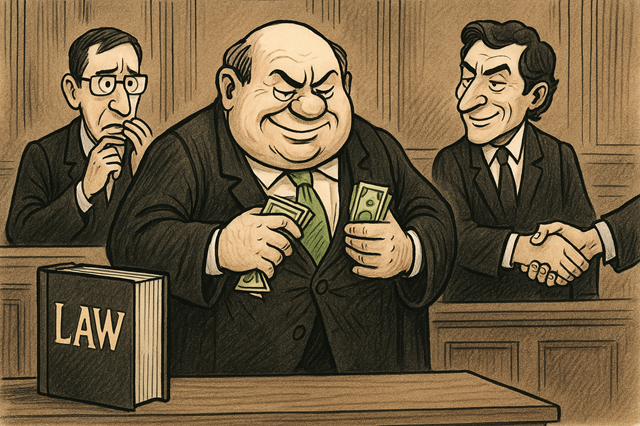
The first thing we do, let’s kill all the lawyers ~VShakespeare, Henry VI (Act IV, Scene II )
Current Relevance
In a characteristically incisive manner, Shakespeare—through the infamous line “The first thing we do, let’s kill all the lawyers”—offers not an indictment of the legal profession, but rather an affirmation of its indispensable role in the preservation of civilized society. Far from portraying lawyers as parasitic or obstructionist, the playwright, through the conspirator Dick the Butcher, underscores the fact that tyranny and chaos can only flourish in the absence of legal order and its vigilant custodians. Dick’s proposed purge of lawyers is a strategic prerequisite for dismantling justice and empowering a person’s grotesque bid for populist dominance.
This interpretation, endorsed by none other than U.S. Supreme Court Justice John Paul Stevens, suggests that Shakespeare understood with great prescience that the legal profession—often the first line of defense against autocracy—would be the initial target of any totalitarian uprising. Without lawyers to uphold rights and contest arbitrary power, society would be laid bare to the will of the unscrupulous and the violent. Thus, rather than a denigration, Shakespeare’s line is in fact a paradoxical tribute: a recognition that those who would destroy freedom must first silence its defenders in court.
On Friday 2nd May 2025, in an atmosphere charged with constitutional tension and political overtones, the United States federal judiciary was compelled, in its exercise of judicial review, to scrutinize an executive order issued by President Donald Trump—an order which, on its face and in its application, allegedly bore the hallmarks of personal vendetta rather than principled governance. At the heart of the matter was the law firm Perkins Coie, historically linked to Democratic causes, and now the apparent target of retaliatory presidential ire.
During proceedings held in the District of Columbia, U.S. District Judge Beryl Howell demonstrated pronounced skepticism toward the executive action, ultimately ruling in favor of a temporary restraining order that halted the measure’s enforcement. The order, bearing the presidential seal but lacking the gravitas of impartial statecraft, sought to revoke security clearances of Perkins Coie employees, deny them access to federal facilities, sever their interactions with federal officials, and dissolve any extant contractual arrangements with government entities. Judge Howell accused President Donald Trump of trying to metaphorically “kill all the lawyers” in a scathing ruling that declares his assault on a top law firm unconstitutional.
Judge Howell was unequivocal in her assessment. She observed that Executive Order 14230 was “retaliatory on its face”—a thinly veiled attempt to punish a private law firm for the exercise of its professional duty in representing clients whose views diverged from or challenged those of the sitting president. Such action, she implied, struck at the core of the American constitutional order, where the adversarial system of justice serves as a cornerstone, and where legal representation—regardless of political consequence—must remain sacrosanct.
The Protection of the Law
In democratic societies, the law serves as both sword and shield: a dynamic frontier where individual justice is protected and fundamental rights are preserved against the encroaching tides of despotism, arbitrariness, and majoritarian excess. The essence of democracy is not merely in the ballot cast but in the institutional arrangements that ensure the weak have recourse against the powerful, and the dissenting voice is not drowned by the roar of populist applause. Central to this architecture is the law, administered not only through its statutes and codes, but through the living judgments of courts and the solemn pledges of constitutions.
To say that the law is the frontier of individual justice is to acknowledge its role as a bulwark between the citizen and the potentially overbearing authority of the state. It is the line that demarcates power from overreach, liberty from repression. This is particularly evident in the jurisprudence of constitutional courts around the world, where principles once abstract are rendered concrete through interpretation and enforcement.
One does not need to look far to find persuasive illustrations of this phenomenon. In the United States, the Supreme Court’s judgment in Gideon v. Wainwright (1963) is a classic example of how the law upholds individual justice. Clarence Earl Gideon, accused of felony theft in Florida, was denied legal counsel because he could not afford a lawyer, and the state did not provide one for non-capital cases. From his prison cell, Gideon petitioned the Supreme Court, which ruled unanimously that the Sixth Amendment guarantees the right to counsel in criminal cases for defendants unable to afford their own attorneys. That decision transformed criminal justice across the United States, reinforcing the notion that justice must not be the exclusive preserve of those with means.
A similar tone reverberates through India’s constitutional jurisprudence. In Kesavananda Bharati v. State of Kerala (1973), the Supreme Court of India, in a moment of sublime legal reasoning, ruled that while Parliament may amend the Constitution, it could not alter its “basic structure.” This basic structure doctrine has since acted as a legal firewall against legislative attempts to erode democratic principles, including the separation of powers, the rule of law, and the independence of the judiciary. By protecting the Constitution’s core values, the Indian judiciary enshrined the law as a living, breathing shield against the tyranny of transient parliamentary majorities.
Across the Atlantic, the United Kingdom—although lacking a codified constitution—has seen its judiciary reinforce the idea that law is the final protector of the individual. In R (on the application of Miller) v. Secretary of State for Exiting the European Union (2017), the UK Supreme Court ruled that the government could not trigger Article 50 (to begin Brexit) without an act of Parliament. The judgment was not about politics, but about the limits of executive authority. It reaffirmed the constitutional principle that even in times of great political urgency, the rule of law must prevail. Parliament, as the representative of the people, must sanction decisions of profound constitutional consequence—not the executive alone. It was a powerful reminder that in a democracy, procedure is not a mere formality—it is the embodiment of collective restraint and fairness.
Turning to South Africa, the role of the law in reconstructing a post-apartheid democracy cannot be overstated. The Constitutional Court of South Africa, in S v. Makwanyane (1995), abolished the death penalty, declaring it inconsistent with the right to life and dignity enshrined in the new democratic Constitution. The judgment underscored that the legitimacy of the legal system in a democracy must rest on moral foundations, and that the state must model restraint and respect even in punishing those who have violated the rights of others. In doing so, the court elevated the law from an instrument of authority to a guardian of humanity.
The philosophical underpinning of such judgments finds expression in the writings of Ronald Dworkin, who postulated that in a society governed by the rule of law, individuals have a “right to be treated as equals,” which means that state coercion must be justified by principles that respect each person’s moral worth. This foundational idea—that law must embody reason and justice—has been upheld in countless jurisdictions where judges have reminded governments that democratic governance is not about unchecked mandates but about the ethical deployment of authority.
In Canada, the Supreme Court’s ruling in Vriend v. Alberta (1998) is a luminous example. Delwin Vriend, dismissed from his job at a private religious college for being gay, was unable to seek redress because Alberta’s Individual Rights Protection Act did not prohibit discrimination based on sexual orientation. The Supreme Court held that the exclusion was unconstitutional and that equality under the law must be substantive, not just formal. The judgment expanded the meaning of human dignity and confirmed that the law must evolve to include those previously consigned to the margins of society.
In the European context, the European Court of Human Rights (ECHR) has been a consistent voice in affirming that democratic values are hollow unless accompanied by enforceable rights. In Dudgeon v. United Kingdom (1981), the court held that laws criminalizing homosexual conduct in Northern Ireland violated the European Convention on Human Rights. The judgment affirmed that moral disapproval cannot serve as the basis for penal sanction in a democratic society that respects privacy and autonomy. The ECHR has since become a crucial transnational forum where individuals can claim justice against their own governments—underscoring the idea that law transcends borders when it comes to human rights.
My Take
These cases, among others, affirm that in democracy, the law is not a passive ledger of rules but a proactive force for justice. Yet, this ideal is constantly under threat. The gravest danger to the law is when it is co-opted by those in power—turned into a tool for persecution rather than protection. This is why judicial independence, transparency, and the availability of legal remedy are not luxuries but essential attributes of democratic life. The erosion of these attributes often marks the descent into authoritarianism.
Indeed, history is replete with examples of what happens when the law fails to function as a bulwark. In Nazi Germany, the Enabling Act of 1933 allowed Adolf Hitler to legislate without the Reichstag, effectively neutralizing legal opposition. The law, rather than resisting tyranny, became its facilitator. In apartheid South Africa, racial discrimination was legalized, and the judiciary—though not always complicit—was often bound by statutes that were unjust in their very design. These episodes remind us that the mere presence of legal institutions is not enough; the content, interpretation, and moral orientation of the law matter profoundly.
Even today, the challenges are numerous. In some jurisdictions, anti-terrorism laws have been used to suppress dissent, and national security is frequently invoked to shield governments from scrutiny. Surveillance regimes and limitations on freedom of expression, under the pretext of public order, pose serious threats to the legal frontiers of individual rights. The law, therefore, must remain vigilant against becoming an accomplice to convenience or fear.
To this end, the role of lawyers, judges, and civil society cannot be overstated. Lawyers act as the sentinels who ensure access to justice is not theoretical. Judges interpret the law not merely through the lens of textualism, but through the prism of human dignity and reasonableness. Civil society holds the system accountable when its custodians falter. Together, they sustain the architecture that makes democracy meaningful not just as a system of government, but as a way of life anchored in fairness.
The words of Shakespeare’s Dick the Butcher in Henry VI, Part 2—“The first thing we do, let’s kill all the lawyers”—have often been misunderstood. In truth, the line was an endorsement, albeit ironic, of the legal profession’s role in safeguarding civil order. For a tyrant to rule unchallenged, lawyers—those who stand between the governed and arbitrary rule—must first be eliminated. That line, immortalized in literature, continues to resonate with jurisprudential truth: the legal profession is the last refuge of liberty when all else fails.
In sum, the law is the frontier not merely of abstract ideals but of lived justice. It is where principles are transformed into protection, and where power meets restraint. In democracies, the true measure of the law lies not in its ability to administer but in its capacity to elevate—to dignify the individual, temper authority, and nurture a society in which justice is not a promise but a practice. In the end, when the state turns to coercion, it is the law that must return it to reason; and when society turns to despair, it is the law that must offer hope—not as charity, but as entitlement. This is the solemn, unglamorous, and unyielding vocation of the law: to be the vigilant keeper of freedom when all other sentinels sleep.
Lord Bingham, one of the most authentic scholars on the Rule of Law, says in his book published in 2010 that the fundamental postulate of the Rule of Law is that “all persons and authorities within the state, whether public or private, should be bound by and entitled to the benefit of laws publicly and prospectively promulgated and publicly administered in the courts”. This brings to bear not only the fundamental principle of liberal democracy i.e. transparency of law, but also the compelling need for laws to be clear, accessible and above every individual of society whatever their station in life is, whether gained by election or appointment.
There should neither be oral decrees, nor feckless insouciance toward the welfare of the public.