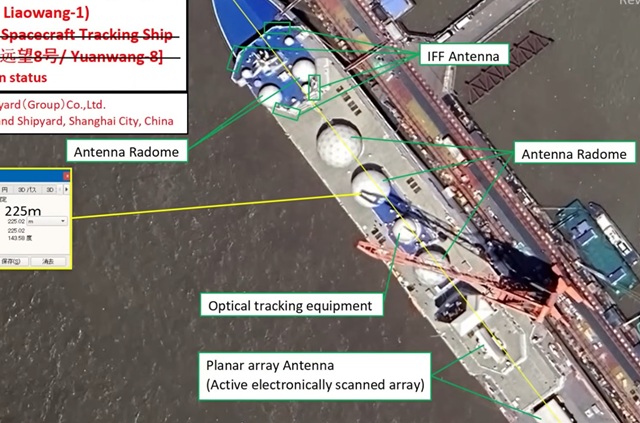
China recently unveiled Liaowang-1, a revolutionary leap in space support technology and the largest ship of its kind in the world. At 225 meters in length and 32 meters in width, with a displacement of 30,000 tonnes, Liaowang-1 dwarfs any other space support vessel globally. Built at the Jiangnan Shipyard on Shanghai’s Changxing Island, the ship was commissioned as part of China’s broader strategy to merge maritime operations with space capabilities. With a crew of 400, this vessel is equipped with cutting-edge technology, enabling it to serve as a multi-mission space operations vessel like no other. Designed to enhance China’s space situational awareness, satellite tracking, and defense capabilities, it marks a new chapter in the nation’s efforts to assert dominance in both the maritime and space domains.
The ship’s massive size is more than just a product of its capacity to hold complex equipment. The sheer scale of Liaowang-1 allows for an exceptional level of functionality. It boasts massive radomes and high-gain antennae, which are essential for monitoring satellite operations, tracking space objects, and even offering real-time support for space missions. Liaowang-1’s radar systems are capable of covering a wide range of tasks, from space surveillance to missile warning. It significantly enhances China’s ability to monitor and support both its own and foreign space assets. The ship’s power supply, driven by large diesel generators, allows it to operate complex systems such as radar arrays, communication links, and sensors, while also making room for potential counterspace capabilities, such as laser dazzling or jamming. This makes Liaowang-1 a mobile and formidable asset for non-kinetic operations, which could play a critical role in a future space conflict.
Liaowang-1 also redefines the role of space support vessels in global space operations. While previous Chinese ships, like the Yuanwang series, primarily focused on telemetry and tracking for rockets and satellites, Liaowang-1 is a significant step forward. The vessel serves as a floating space monitoring command center, capable of supporting multiple missions at once. It enhances China’s ability to provide continuous, real-time communications with spacecraft, satellites, and rockets, improving both operational control and situational awareness. Beyond its primary mission of supporting Chinese space programs, Liaowang-1 is designed to offer early-warning capabilities, capable of tracking missile and aircraft activity. This aspect of the ship’s mission is particularly critical when it comes to detecting complex threats like hypersonic missiles—which are extremely difficult to track by traditional means. Liaowang-1’s ability to monitor up to 1,200 air targets simultaneously, with over 95% accuracy in cluttered environments, positions it as a new global standard for missile and aerospace defense systems.
In addition to its capabilities in monitoring and communication, Liaowang-1 plays an integral role in space defense. The vessel is designed to support kinetic anti-satellite (ASAT) capabilities, providing crucial data for missile defense operations. It could also serve as a platform for non-kinetic counterspace operations, including jamming enemy satellites or dazzling them with lasers to disrupt their functioning. The ship’s advanced sensors and long-range communication systems make it an effective tool for intelligence gathering, not only for Chinese space assets but also for foreign spacecraft. Liaowang-1’s ability to collect electronic intelligence and track foreign launches and orbital systems provides China with critical information for both espionage and military targeting. Its ability to issue telecommands for rocket course adjustments or satellite maneuvers further extends its role in space operations, making it more than just a monitoring platform—it becomes an active participant in space management and defense.
The strategic value of Liaowang-1 cannot be overstated. While China has developed a robust network of ground-based tracking stations and satellites, these are often constrained by geographic limitations and the curvature of the Earth. The addition of Liaowang-1 into China’s space support infrastructure fills the coverage gaps that could exist, particularly in the southern hemisphere. Its mobility is a significant advantage, allowing China to monitor space operations from anywhere on the planet. The ship’s ability to remain operational even if ground stations are compromised or destroyed during a conflict ensures redundancy in China’s space operations. If China’s land-based stations were to be rendered inoperable due to military action or natural disasters, Liaowang-1 could continue supporting satellite communications, rocket launches, and missile tests, making it an indispensable asset for China’s space and defense strategy.
Liaowang-1’s role also enhances China’s strategic autonomy in space operations. Unlike the United States, which relies heavily on satellite relay systems like the Tracking and Data Relay Satellite System (TDRSS) to communicate with spacecraft, China’s reliance on a maritime fleet of space support vessels offers a more independent approach. This strategy reduces China’s vulnerability to disruptions in satellite-based systems and gives it greater control over its space missions. The deployment of Liaowang-1, which functions as a floating space control center, is part of China’s broader space infrastructure development, which includes investments in both space stations and orbital satellites. While the U.S. and Russia have relied on fixed ground stations and satellites for space mission control, China has embraced a different philosophy by investing in a fleet of space support ships. This approach allows China to operate flexibly and more resiliently in the face of potential threats or disruptions.
Despite its impressive capabilities, Liaowang-1 is not without its challenges. Its enormous size makes it vulnerable, especially in a wartime scenario. The ship’s large radar arrays and powerful communication systems generate significant electromagnetic signatures, making it an obvious target for adversaries who wish to disrupt or destroy it. The vessel’s high center of gravity due to its large sensor suites could pose stability challenges, particularly in rough seas. Furthermore, the operation of such advanced systems is a complex undertaking that demands constant maintenance and technical expertise. While Liaowang-1 is designed to operate in a variety of maritime conditions, the performance of its equipment could degrade if subjected to extreme weather, requiring continuous logistical support.
In terms of global space competition, Liaowang-1 places China on par with, if not ahead of, the United States in terms of maritime-based space operations. The U.S. has long used its SBX-1 Sea-Based X-Band Radar as a mobile space support vessel, but Liaowang-1 surpasses it in both size and technological sophistication. While the U.S. has largely relied on its satellite infrastructure to fill gaps in space coverage, China’s heavy investment in maritime platforms ensures that it has a unique edge in space tracking and communication. As the only other country besides the U.S. to operate a substantial fleet of space support ships, China’s approach is seen as a game-changer in the domain of space operations. The Yuanwang series, which served as China’s primary space tracking vessels, will soon be overshadowed by the more advanced and versatile Liaowang-1, a ship designed to handle multi-mission space support in a way that no other vessel currently can.