Saudi Aramco, the world’s largest oil company, has slashed its quarterly dividend by $10 billion after posting a drop in first-quarter profits — a move that could ripple across Saudi Arabia’s ambitious economic diversification plans, according to the Financial Times.
Aramco reported $26 billion in net income for the first quarter of 2025, down 5% from the same period last year. The decline was driven by a drop in the average realised oil price to $76.30 per barrel, compared to $83 a year earlier. Despite outperforming oil majors like BP and Shell, which saw profit declines of 50% and 28% respectively, Aramco cut its total quarterly dividend from $31 billion to $21.4 billion.
This marks a substantial shift for a company that paid $124 billion in dividends in 2024. It had previously signaled in March that its total 2025 payout would fall to around $85 billion. These reduced dividends are expected to intensify budget pressures in Saudi Arabia, where the government and the Public Investment Fund (PIF) — which collectively own over 97% of Aramco — depend heavily on the oil giant’s payouts to fund state operations and strategic investments.
The fiscal strain is particularly acute as Riyadh accelerates work on Vision 2030, Crown Prince Mohammed bin Salman’s flagship plan to reduce the kingdom’s reliance on oil. The program includes several gigaprojects such as Neom, a futuristic mega-city on the country’s north-west coast. However, as oil revenues fell by 18% year-on-year, Saudi Arabia’s budget deficit ballooned to $15.6 billion in Q1 2025 — up sharply from $3.3 billion a year prior, according to the Ministry of Finance.
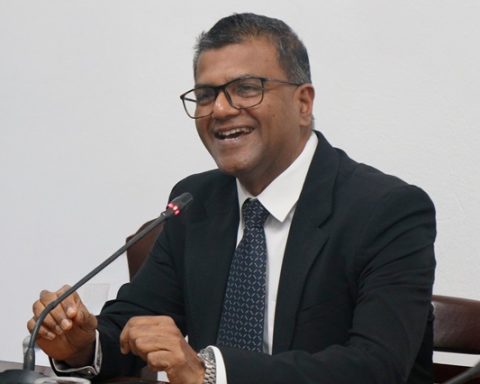
Aramco CEO Amin Nasser attributed the company’s financial pressures to “global trade dynamics” and economic uncertainty, which weighed on oil prices. Since the quarter’s close, oil prices have slid another 15% to around $64 per barrel, amid concerns over a supply glut following Opec+’s unexpected decision to raise production.
Despite the falling prices, Aramco has given no formal guidance on whether further dividend reductions or capital spending cuts are forthcoming. The company merely emphasized the importance of “disciplined capital planning and execution” during periods of price volatility.
Meanwhile, Saudi Arabia’s government has already begun scaling back or delaying certain projects, though it faces fixed deadlines to complete major infrastructure in time for Expo 2030 and the Fifa World Cup in 2034.
The oil market’s instability is further complicated by strategic shifts within Opec+, the Saudi-led producer alliance. At the start of May, eight Opec+ members, including Saudi Arabia and Russia, announced a 411,000 barrels-per-day production increase for June — the second straight month of output hikes. Industry analyst Jorge León of Rystad called the decision a “bombshell,” signaling a potential change in Opec+’s supply strategy despite price weakness.