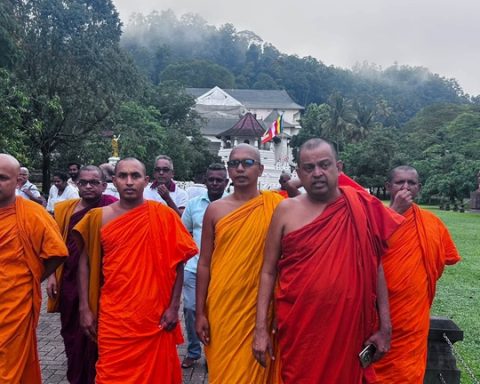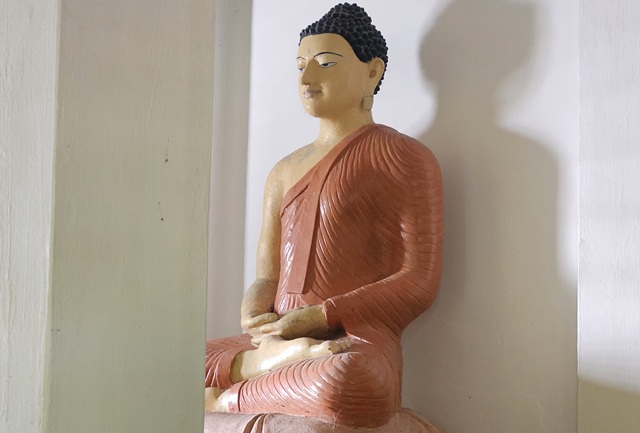
Today we are celebrating Buddha. Streets are adorned with lotus lanterns, incense spirals skyward in serpentine trails, and chants echo through temple halls with a rhythm as old as memory. Vesak—the sacred trifold observance of the Buddha’s birth, enlightenment, and parinibbāna—has arrived. Millions bow in unison, offering flowers that will wither by dusk, lighting lamps that will flicker out by dawn. And yet, amid all the ceremonial pageantry, a troubling question intrudes: are we truly honoring the Buddha, or merely venerating a mythologized echo of him?
In an age where religions have transmogrified into ideologies and spiritualities into consumable products, Buddhism’s apparent immunity to the vulgarities of institutionalization is illusory. Vesak, rather than a solemn existential reorientation toward anattā (non-self) and paṭiccasamuppāda (dependent origination), now often functions as a liturgical spectacle, an instrument of cultural hegemony, and a performance of moral superiority. It is not the noble silence (ariyo tuṇhībhāvo) that echoes, but the cacophony of nationalism, commercialism, and sentimental mythos.
To extricate the Buddha from the mists of posthumous deification is a task as subversive as it is necessary. Contrary to the pacific caricature often paraded in modern discourse, the Buddha was not a metaphysical pacifier, but an epistemological incendiary. His Dhamma was not a balm for collective identity, but a scalpel for the existential tumor of taṇhā—craving. He himself declared, “Sabbe dhammā nālaṃ abhinivesāya” (All phenomena are not worthy of clinging) (Aṅguttara Nikāya 3.134), a statement that, if taken seriously, disembowels not only material obsession but also the veneration of dogma, tradition, and yes—even Buddhism itself.
Modern Vesak celebrations, with their bureaucratically-sanctioned rituals and televised pieties, seem oblivious to this iconoclastic heart of the Dhamma. Instead of facilitating vipassanā—clear seeing—they often reinforce avidyā, or spiritual ignorance, by conflating reverence with understanding. When monks recite suttas in Pāli without translation, when devotees offer flowers without introspection, and when politicians invoke the Buddha to sanctify militarism or ethno-religious supremacy, we must ask: is this homage, or heresy?
It is imperative here to recall the Buddha’s trenchant declaration in the Alagaddūpama Sutta (Majjhima Nikāya 22): “Dhammaṁ vo, bhikkhave, desessāmi. Sā upamaṁ karissāmi. Seyyathāpi nāma puriso…dhammaṁ nissāya dhammaṁ paṭinissajjeyya.” (Monks, I shall teach you the Dhamma by way of a simile. It is like a raft: for crossing over, not for holding on. You must let it go.) How tragic, then, that the raft has become an idol, ferried upon altars rather than abandoned at the far shore.
The Buddha’s own life undermines the very sanctity with which Vesak now drapes it. He eschewed ceremony, distrusted hierarchy, and famously warned against blind faith: “Ehipassiko”—come and see, he said, not “kneel and believe.” And yet, in many contemporary Buddhist contexts, questioning authority—clerical, canonical, or institutional—is tantamount to apostasy. This is not reverence; it is ossification.
Moreover, the commodification of Vesak in globalized contexts—its assimilation into United Nations calendars, its packaging as a day of “peace and compassion”—has further diluted its transformative potential. While such gestures are not malevolent in themselves, they risk reducing the Dhamma to a brand of ethical consumerism, easily digestible by neoliberal palates. The hard truths of dukkha, anicca, and anattā—suffering, impermanence, and non-self—are replaced with bromides about mindfulness apps and cultural tolerance.
To be fair, one must acknowledge that ritual and community can provide scaffolding for ethical living. Yet the Buddha’s model was relentlessly introspective. He pointed inward, not outward. In the Rohitassa Sutta (Saṁyutta Nikāya 2.26), the Buddha asserts, “Na cāhu na ca bhavissati, na cetarahi vijjati, ekantasukho loko, yena na jāyetha na jīyetha na mīyetha…” (Nowhere in the cosmos is there a place where one might escape suffering without transcending the inner world.) The battlefield is within, not among banners and chants.
There is also the historical tendency within Buddhist societies to sacralize the Buddha while marginalizing the very principles he taught. One may note, for instance, the conspicuous absence of bhikkhunī (female monastic) parity in many Theravāda traditions, despite the Buddha’s establishment of a dual monastic order. Likewise, his vociferous rejection of caste as a determinant of spiritual potential—“Na jaccā brāhmaṇo hoti…” (Not by birth is one a Brahmin…)—is forgotten in societies where ethnic and class stratification flourish under Buddhist banners.
Some defenders of traditional Vesak observance argue that the Buddha’s teachings are too profound for the masses and that ritual is a gateway to deeper insight. Perhaps. But is it not also true that every ossified orthodoxy began as a pedagogical compromise? When compromises become conventions, and conventions become dogma, the spirit of enquiry—the very fuel of the Dhamma—is extinguished. As the Buddha warns in the Vīmaṁsaka Sutta (Majjhima Nikāya 47): “Tathāgataṁ pi tumhe, bhikkhave, vīmaṁsitabbaṁ.” (Even the Tathāgata, monks, must be scrutinized.)
If Vesak is to transcend its descent into cultural spectacle, it must reclaim its contemplative ferocity. Rather than lionizing the Buddha as a quasi-divine figure, we must return to his eerie, difficult, and unsettling insights. The Middle Way is not a path of moderation in celebration, but in ontology—it rejects both eternalism and nihilism, both materialism and mysticism. It is, in the Buddha’s own haunting words, “anupubbasikkhā…anupubbacaritā…anupubbapaṭipadā” (a gradual training, a gradual practice, a gradual path) (Udāna 5.5)—not a one-day ceremonial flourish.
Let Vesak, then, be an opportunity not merely for homage but for radical self-reckoning. Let temples fall silent in noble inquiry. Let monks speak plainly of craving, decay, and death. Let the laity ask unsettling questions. Let the Buddha be seen not as a balm, but as a mirror—ruthlessly clear, unsettlingly exacting. In the words of the Buddha from the Udāna (1.10), “Yo ca vassasataṁ jīve, apassaṁ udayabbayaṁ; Ekāhaṁ jīvitaṁ seyyo, passato udayabbayaṁ.” (Better than living a hundred years without seeing the arising and passing away [of phenomena] is one day of life seeing their arising and passing away.)
The truest homage to the Buddha is not to enshrine him but to emulate him. In this light, Vesak can be reclaimed not as a sanctified recurrence, but as a living provocation—a perennial call to awaken from the dream of permanence, identity, and even religiosity itself.