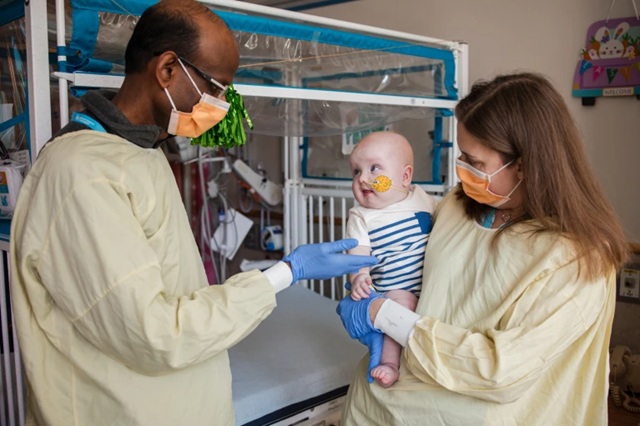
A baby boy named KJ Muldoon has become the first person in the world to receive a bespoke CRISPR gene-editing treatment tailored specifically to his unique genetic mutation. Now nearly ten months old, Muldoon is thriving following three doses of the experimental therapy, which targeted a rare and life-threatening condition called carbamoyl phosphate synthetase 1 (CPS-1) deficiency.
The remarkable treatment — designed in just six months — represents a pioneering step in precision medicine. It was developed through a fast-moving collaboration between clinicians, academic researchers, biotechnology firms, and U.S. regulatory bodies. As reported in Nature, the therapy was described in a study published by the New England Journal of Medicine on May 15.
Muldoon’s condition, caused by inheriting defective versions of the CPS1 gene from both parents, severely limited his body’s ability to process nitrogen from protein breakdown, leading to toxic levels of ammonia in his blood — a condition often fatal in infancy. With the best available treatment being a liver transplant, which was months away, his medical team at the Children’s Hospital of Philadelphia saw an opportunity to try a novel CRISPR-based technique known as base editing.
Dr. Rebecca Ahrens-Nicklas, one of Muldoon’s physicians, emphasized the experimental nature of the approach: “This is still really early days. We know we have more to learn from him,” she told reporters.
The therapy used base editing to make precise, single-letter changes in Muldoon’s DNA, correcting the mutation that prevented his body from producing functional CPS-1 enzyme. Unlike existing CRISPR therapies used in conditions like sickle-cell anemia, which target common mutations across many patients, this therapy was uniquely designed for Muldoon and is unlikely to be used for anyone else.
The team’s rapid progress — from diagnosis to treatment in just half a year — has been hailed as a “remarkable” feat by experts, including Waseem Qasim of University College London, who has used base editing in cancer therapy. Companies contributed key technologies, and the U.S. Food and Drug Administration expedited the treatment’s approval due to the urgent need.
After the first dose, Muldoon could safely consume protein appropriate for his age, though he still required medications to manage ammonia levels. A second and third dose followed, with clinicians now gradually tapering his medication.
Despite the promising results, experts caution that personalized CRISPR therapies remain financially and logistically challenging to scale. “There’s no great answer to this,” said Qasim, acknowledging the difficulty in expanding such bespoke treatments for other ultra-rare diseases.
Still, the success of this individualized therapy opens a hopeful new chapter in genetic medicine. “This truly is the future for all of these gene and cell therapies,” said Arkasubhra Ghosh of Narayana Nethralaya Eye Hospital in Bengaluru, India, in Nature’s report. “It’s really exciting.”
For Muldoon’s parents, each developmental step is nothing short of miraculous. Earlier this week, his mother Nicole was moved to tears when she found him sitting up in his crib for the first time. “We never thought this was going to happen,” she said.