Defining Tamilness in purely national/territorial terms is problematic today, as transnational factors play a crucial role ~ Nira Wickramasinghe, Sri Lanka in the Modern Age: A History of Contested Identities
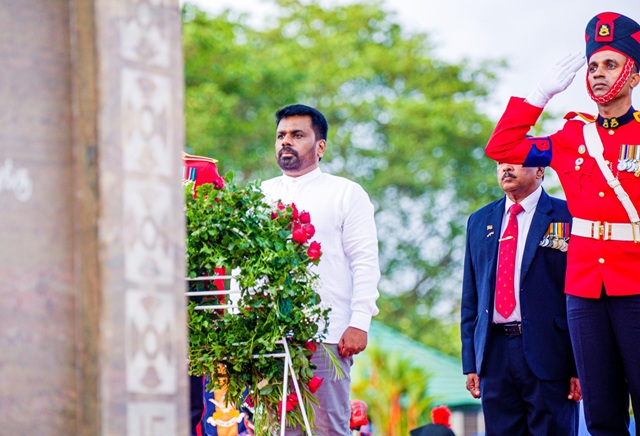
It has been 16 years since the internecine and arduous war against the Tamil Tigers ended in Sri Lanka in May 2009. On 19 May 2025, amidst the tranquil solemnity of the National War Heroes’ Monument in Battaramulla, the sixteenth commemoration of National War Heroes’ Day unfolded as both a tribute and a testament—a reflective moment where the nation paused not merely to honour the fallen, but to reaffirm its unyielding commitment to peace.
In his address, the President transcended the rhetoric of remembrance, calling upon all Sri Lankans to regard the monument not as a static shrine to the past, but as a living covenant—a pledge that unity, compassion, and fraternity must triumph over the pernicious forces of hatred and division. With profound empathy, he acknowledged that grief knows no ethnicity, no boundary—that mothers in Jaffna and widows in Matara alike mourn with the same quiet dignity. The ceremony stood as a symbolic renewal of the national conscience: a collective vow that the horrors of conflict shall not recur, and that the mosaic of communities—Sinhala, Tamil, Muslim, Burgher, and Malay—must coalesce into a shared destiny built upon justice, reconciliation, and an abiding respect for human dignity.
Contemporaneously, in a formal communique underscored by diplomatic gravitas, the Government of Sri Lanka reiterated its unequivocal opposition to the proposed erection of what is termed a “Tamil Genocide Monument” at Chinguacousy Park in Brampton, Ontario. With measured insistence, Sri Lanka has called upon the Federal Government of Canada to exercise prudent oversight and forestall what it considers to be an ill-advised and regrettable course of action endorsed by the Brampton City Council.
The Ministry of Foreign Affairs, in conveying this position, underscored that such a development is deeply injurious not only to the sensibilities of the Sri Lankan polity, comprising all ethnic and religious communities, but also to the broader Canadian society, which has long embraced pluralism and intercultural harmony. The proposed monument, premised upon assertions that Sri Lanka characterizes as unfounded and historically inaccurate, serves not as a beacon of remembrance or healing, but rather as an impediment to the nation’s ongoing and sincere endeavours at reconciliation and the forging of a unified civic identity. The Ministry lamented that the institutionalization of these claims through public memorialization risks entrenching division, misinforming the public discourse, and undermining the difficult but necessary journey toward enduring peace and national cohesion.
End of the War
The prolonged and bitter conflict that engulfed Sri Lanka for nearly three decades, pitting the Government of Sri Lanka against the Liberation Tigers of Tamil Eelam (LTTE), culminated in a denouement in May 2009 that was as controversial as it was militarily definitive. In the aftermath of this conflict, the international community, led by the United Nations, sought to reconcile the sovereign prerogative of the Sri Lankan state with the global moral imperative of accountability for alleged atrocities committed, particularly against Tamil civilians during the final stages of the war. The institutional steps taken by the United Nations, notably the visit of the Secretary-General to Sri Lanka in May 2009, the issuance of a joint statement by the United Nations and the Government of Sri Lanka, and the publication of the 2011 report of the Secretary-General’s Panel of Experts (commonly known as the Darusman Report), collectively constitute a framework through which the aspirations of justice and reconciliation were articulated, albeit with contested efficacy.
In the enduring tapestry of international governance, where sovereignty contends with the imperatives of human rights and humanitarianism, the case of Sri Lanka stands as a disquieting epitome of the limits and potentialities of the United Nations system. The visit of United Nations Secretary-General Ban Ki-moon to Sri Lanka in the immediate aftermath of the cessation of hostilities in May 2009 was a gesture imbued with both symbolism and strategic intent. It signaled the readiness of the international community to engage directly with the Government of Sri Lanka and, concurrently, affirmed the urgency of addressing allegations of massive civilian casualties, displacement, and systemic human rights violations. Ban Ki-moon’s sojourn to the conflict-ravaged areas, particularly the internment camps housing tens of thousands of Tamil civilians, many of whom had fled the relentless bombardment in the conflict zones, offered a visual and political tableau of the humanitarian toll exacted by the final offensive. While the Government of Sri Lanka remained adamant in its triumphalist narrative of having vanquished terrorism, the Secretary-General emphasized the inescapable need for inclusive reconstruction and justice.
In this context, the Joint Statement issued by the United Nations and the Government of Sri Lanka on 23 May 2009 must be examined. Its final paragraph, inserted at the behest of the United Nations, said: “Sri Lanka reiterated its strongest commitment to the promotion and protection of human rights, in keeping with international human rights standards and Sri Lanka’s international obligations. The Secretary General underlined the importance of an accountability process for addressing violations of international humanitarian and human rights law. The Government will take measures to address those grievances”.
The statement, while acknowledging the Government’s right to combat terrorism, clearly reflected an implicit understanding that the conduct of that war, particularly in its terminal phase, raised profound concerns under international humanitarian law. The Statement recorded Sri Lanka’s commitment “to addressing the grievances and aspirations of all communities” and expressed the Government’s intent “to take measures to address those grievances, including the need for accountability.” This signaled a moral concession, if not an overt legal admission, that grave breaches may have occurred and that international scrutiny would follow. However, it also highlighted the UN’s deferential posture vis-à-vis state sovereignty—a reticence that would characterize the Organization’s subsequent actions on Sri Lanka.
The Darusman Report
The most substantive elaboration of international concern over the conduct of the final stages of the Sri Lankan civil war is found in the Report of the Secretary-General’s Panel of Experts on Accountability in Sri Lanka, published on 31 March 2011. This panel—comprising Marzuki Darusman (Indonesia), Steven Ratner (United States), and Yasmin Sooka (South Africa)—was not an investigatory body in the judicial sense, but rather an advisory panel tasked with examining the modalities through which accountability might be pursued. Despite its limited mandate, the report delivered a stark and sober indictment of the conduct of both the LTTE and the Government of Sri Lanka, with the latter receiving particular scrutiny for actions that, according to the panel, could amount to war crimes and crimes against humanity.
It must be noted that the Panel was not a commission of inquiry and therefore did not make formal findings of fact. Panel member Steven R. Ratner, writing in The American Journal of International Law ( October 2012, Vol. 106, No. 4), says: “ Sensing that a full-fledged commission of inquiry would elicit significant opposition from member states, the Secretary General created a panel that was formally to advise him on how Sr Lanka should carry out its own pledge from the May 2009 joint communique in light of international standards and best practices”
Elsewhere in the article Ratner says: “Faced with numerous allegations of abuses, the Panel decided to treat an allegation as serious and to include it in its report if the panel regarded the claim as “credible” in the sense that “there is a reasonable basis to believe that the underlying act or event occurred”.
The Darusman Report’s findings are damning in both scope and tone. It alleges that during the final months of the conflict—between January and May 2009—tens of thousands of civilians, overwhelmingly Tamil, were killed in what the report describes as indiscriminate shelling of No Fire Zones, hospitals, and UN facilities by the Sri Lankan Armed Forces. The report contends that the Government systematically deprived civilians of humanitarian assistance, thereby exacerbating suffering on an unimaginable scale. It further implicates the LTTE for using civilians as human shields, conscripting child soldiers, and executing Tamil civilians attempting to flee LTTE-controlled areas. However, the central gravamen of the report is the disproportionate use of force and the deliberate targeting of civilian infrastructure by government forces, acts which, the panel concludes, warrant a full-fledged international investigation.
What is salient about the Darusman Report is not merely its litany of alleged violations, but its philosophical and juridical underpinning. The panel underscores the principle that sovereignty cannot be a shield against accountability, particularly when the state apparatus is itself implicated in systematic abuses. The report thus embodies the spirit of the “Responsibility to Protect” (R2P), a norm endorsed by the United Nations at the 2005 World Summit, which affirms that sovereignty entails responsibility and that the international community has a duty to act when a state manifestly fails to protect its population from mass atrocity crimes.
Yet, the report also delineates the profound limitations of the UN’s capacity to act decisively in such contexts. It laments the failure of the United Nations system—including senior UN officials in Colombo and New York—to adequately respond to the crisis as it unfolded. The concept of a “systemic failure” of the UN in Sri Lanka echoes the Organization’s earlier introspections after the Rwandan genocide and the Srebrenica massacre, revealing a recurring institutional malaise characterized by timidity, bureaucratic inertia, and political expediency.
Among the recommendations proffered by the Darusman Report is the establishment of an independent international mechanism with a mandate to investigate alleged violations, monitor domestic accountability processes, and conduct a mapping of patterns of violations over the entire duration of the conflict. It also calls for the review of UN actions during the final stages of the war, the imposition of a human rights screening mechanism on UN engagement in Sri Lanka, and the protection of witnesses and survivors. Perhaps most strikingly, it recommends that the Human Rights Council reconsider its resolution of May 2009, which commended the Government of Sri Lanka, given the overwhelming evidence of violations.
Position of the Sri Lankan Government
The Sri Lankan Government, for its part, rejected the Darusman Report in toto, dismissing it as an internal advisory note with no legal status and decrying it as a threat to national sovereignty. It mobilized its diplomatic capital to thwart any formal adoption of the report by the Security Council or the Human Rights Council. That such efforts largely succeeded reveals the geopolitical context in which human rights are often subordinated to strategic interests. India, China, and Russia—all wary of the implications of external interventionism—extended tacit or overt support to Sri Lanka, thereby constraining the latitude of multilateral institutions.
Nevertheless, the report galvanized international civil society, diaspora networks, and human rights organizations, serving as a fulcrum around which renewed calls for justice and accountability were articulated. Subsequent resolutions of the Human Rights Council have built upon the foundational concerns expressed in the Darusman Report, culminating in the 2021 resolution (A/HRC/46/1) which mandated the Office of the High Commissioner for Human Rights to collect, consolidate, and preserve evidence of gross violations of human rights and humanitarian law committed in Sri Lanka.
Despite these developments, the practical realization of accountability has been elusive. The Sri Lankan Government’s domestic mechanisms—including the Lessons Learnt and Reconciliation Commission (LLRC) and its successor initiatives—have been criticized for their lack of independence, prosecutorial authority, and victim-centeredness. The UN itself, through its Internal Review Panel led by Charles Petrie, acknowledged in 2012 that its response to the end phase of the war was marked by a “grave failure” of the Organization to act following its own humanitarian mandate.
The International Community
It is in this lacuna—between norm and implementation, between pronouncement and enforcement—that the limitations of the United Nations’ role in Sri Lanka become most pronounced. While the Organization can generate normative frameworks and spotlight abuses, its enforcement powers remain hamstrung by the vagaries of international politics. This is a poignant reminder that justice in the international system is often more a function of geopolitics than of law or morality.
Yet, in an age where impunity continues to embolden both state and non-state actors, the importance of bearing witness cannot be overstated. The UN’s steps—though imperfect and, at times, ineffectual—have at least ensured that the devastation of a war are not erased from the annals of global consciousness. The Darusman Report, with its forensic narrative and moral clarity, has enshrined the significance of counter-memory to the official historiography promulgated by actors on both sides.
The international community, and particularly the United Nations, must therefore recalibrate its approach to accountability not merely as a retroactive response to atrocity but as a proactive architecture of deterrence and justice. This involves embedding accountability as an intrinsic element of peacebuilding, ensuring the primacy of victim-centered justice, and fortifying the capacity of international institutions to transcend realpolitik in the pursuit of human dignity. The Sri Lankan experience offers a cautionary tale, but also an enduring challenge to the conscience of the world: that in the crucible of sovereignty and justice, it is the latter that must ultimately prevail.
My Take
In the juridical and humanitarian architecture of global governance, where the convergence of international law and state conduct is measured against the crucible of mass suffering, the Sri Lankan experience — encapsulated most vividly in the findings and recommendations of the Darusman Report — offers a profound lesson to contemporary actors embroiled in the wars of our time. Whether one gazes upon the unfolding tragedy in Gaza or the protracted and bitter conflict in Ukraine, the spectre of Sri Lanka’s denouement in 2009 looms as a clarion call against impunity, selective indignation, and the abdication of moral responsibility by the international community.
Were I to offer a reflection in the spirit of jurisprudential sobriety and principled pragmatism — in the manner I have attempted throughout my writings — I would submit that the primary lesson from the Darusman Report lies not merely in the enumeration of atrocities or the cataloguing of civilian suffering, but in the elemental assertion that law divorced from accountability is but a hollow incantation. The Darusman Panel reminded us that when military triumph is pursued at the expense of civilian protection, when sovereignty is wielded as a shield for systemic abuse, and when international institutions falter in their mandates for fear of political reprisal, what remains is a global order that betrays its own normative foundations.
In Gaza, where the asymmetry of power between an occupying force and a besieged population has become the subject of forensic scrutiny and visceral outrage, the relevance of the Darusman framework is unmistakable. The indiscriminate bombardment of civilian infrastructure, the destruction of hospitals, schools and UN facilities, and the reported obstruction of humanitarian corridors mirror the factual matrix described in the Darusman Report. Similarly, the invocation of terrorism by state actors to justify unrestrained force and the counter-allegations of civilian endangerment through human shields find their analogues in the conduct of both the Sri Lankan government and the LTTE.
Yet, what makes Gaza uniquely tragic is not only the scale of destruction but the international community’s desultory approach to accountability. The lessons of Sri Lanka would enjoin upon the United Nations and its Member States a far more resolute and consistent engagement — one that does not oscillate between censure and complicity. One that does not regard geopolitical alliance as a surrogate for moral clarity. If the Darusman Report taught us that no state, however triumphant, is above the demands of international humanitarian law, then the same standard must be applied, mutatis mutandis, to all parties in Gaza.
Turning to Ukraine, the Darusman experience yields a different, though equally salient, lesson: that prolonged inaction by the international community, in the face of manifest violations, only entrenches impunity and prolongs suffering. Here, too, we encounter the scorched earth tactics, the siege of civilian populations, and the deliberate targeting of energy and food systems that sustain life. While the international response to the war in Ukraine has been more immediate, with referrals to the International Criminal Court and a raft of sanctions, there is a danger that such responses become bifurcated between realpolitik and principle. The Darusman precedent reminds us that it is not enough to act against those who are geopolitically expendable; rather, the standard of accountability must be universal and consistent.
Indeed, the United Nations itself must revisit the lessons of its own failures in Sri Lanka. The Organization’s internal review, under the leadership of Charles Petrie, exposed systemic shortcomings in early warning, political courage, and operational resolve. If similar failures are to be avoided in Gaza and Ukraine, the Secretariat and its agencies must ensure that their presence on the ground does not become a mere instrument of optics but a conduit for truth-telling, protection, and principled diplomacy.
In my writings, I have often emphasized that the architecture of air law, though largely technical and neutral in application, contains within it the same normative challenge: the balance between sovereignty and the greater good. Whether it be in civil aviation or in armed conflict, the principle remains immutable — that no power is absolute, and no authority is exempt from the imperative of accountability.
It is here that I return to the teleological underpinning of the Darusman Report: that justice must not only be done but must be seen to be done. And to be seen, it must be institutionalized through independent inquiries, access to affected populations, and the full deployment of international legal instruments. The failure to do so in Sri Lanka did not merely delay justice; it betrayed the survivors and emboldened those who now wage war with the confidence that the world will, once again, look away.
To the actors in Gaza and Ukraine, then, my exhortation — drawn from the Darusman experience — would be this: that military might without moral restraint is a temporary victory, and that history has no patience for triumphalism stained with the blood of innocents. To the international community, I would urge not selective engagement, but principled consistency. And to the United Nations, I would entreat a reaffirmation of its own Charter — that peace is not merely the absence of war, but the presence of justice.
As we navigate a world replete with conflict, let us not repeat the errors of the past. Let us not allow the Darusman Report to become a solitary monument to our failures. Rather, let it be a guidepost — however sobering — for a more accountable and humane international order.