


by Our Defence Affairs Editor
The most revealing part of Sri Lanka’s latest drug seizure may be the story behind the seizure rather than the 463 kilograms of crystal methamphetamine itself. The United States says its Drug Enforcement Administration’s New Delhi Country Office worked with Sri Lanka’s Police Narcotics Bureau to break a Pakistan-based trafficking network and that intelligence developed between 14 and 29 August helped identify suspicious containers moving towards Colombo. Yet the first Sri Lankan accounts presented the operation as a success arising from information received locally, with no public reference to the American role. Then Washington spoke. The US Embassy in Colombo issued its own account, explicitly describing the operation as a joint US-Sri Lankan counternarcotics action. That intervention matters. It leaves an obvious question hanging over the original narrative.
Why was the American contribution absent? One possible explanation is the sensitive world of informants, intelligence ownership and financial rewards, where agencies can have powerful reasons to protect the identity and status of an information source. But there is no public evidence establishing that Sri Lankan officials manipulated the story to secure reward money, and it would be reckless to state that as fact. What can be established is simpler and more troubling. A major international intelligence operation was initially portrayed largely as a domestic success, and the American government later had to put its own version on the record.
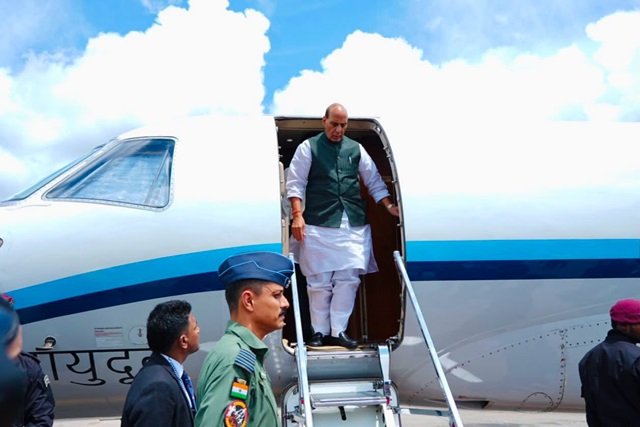
That small episode opens a much larger window onto Sri Lanka’s position in the Indian Ocean. Rajnath Singh arrives in Colombo today for a three-day official visit, leading a high-level delegation from India’s Ministry of Defence and Ministry of External Affairs. He is not coming merely to exchange ceremonial pleasantries. India’s Defence Minister is visiting at a moment when maritime security, defence cooperation, narcotics trafficking, ports, energy routes and foreign military activity are becoming inseparable questions. Singh’s own political history makes the visit more interesting. He entered public life through the Jana Sangh and the RSS network, was imprisoned during the Emergency, became a senior BJP organiser, served as Chief Minister of Uttar Pradesh and later became India’s Home Minister before taking charge of Defence. He now arrives in Sri Lanka as the first Indian Defence Minister to make an official visit here since K. C. Pant in 1988, when the Indian Peace Keeping Force was still operating on Sri Lankan soil. India officially describes the present visit in the language of friendship, regional security, maritime cooperation and the Neighbourhood First and MAHASAGAR initiatives.
The strategic vocabulary is diplomatic. The geography is not. India has spent years building a network of interests in Sri Lanka that reaches well beyond conventional defence exchanges. Trincomalee remains the prize that cannot be discussed merely as another development project. Its harbour, location and energy infrastructure give it a strategic value that far exceeds the immediate economics of oil storage or industrial development. India and Sri Lanka have been working towards making Trincomalee an energy hub, while discussions have extended to connectivity, power links and a proposed multi-product petroleum pipeline. India’s own documents identify energy, ports, shipping and defence supplies as priority sectors in the bilateral relationship.
Then there is Colombo Dockyard, where the story becomes considerably more concrete. Mazagon Dock Shipbuilders Limited, an Indian Government defence public-sector undertaking under the Ministry of Defence, completed the acquisition of a controlling 51% stake in Colombo Dockyard. The transaction made the Sri Lankan shipyard an Indian subsidiary and was described by Mazagon Dock as its first international acquisition. The new board includes senior Mazagon Dock nominees. This is a commercial transaction, legally and formally. But pretending that the identity of the buyer is irrelevant would be naïve. An Indian defence enterprise directly controlled by the Indian state now controls the largest shipyard in Sri Lanka. Colombo Dockyard is not an abstract financial asset. It is a shipbuilding, ship-repair and maritime engineering facility situated in Colombo, beside one of the most important ports in the Indian Ocean.
China demonstrated why such locations matter more than balance sheets when Chinese submarines entered Colombo in 2014. Two publicly reported submarine visits that year triggered serious concern in New Delhi. Sri Lankan officials described the calls as routine refuelling and crew-rest visits, while Indian officials regarded the frequency of Chinese naval activity with suspicion. China has since retained a major economic position through Hambantota, Colombo Port City and other infrastructure projects. India is now responding through a different method. It does not need to plant a military flag at every strategic location. Ownership, contracts, energy facilities, shipyards, maritime surveillance, training, defence agreements and connectivity can produce strategic reach without the political visibility of a foreign base.
Sri Lanka now sits at the centre of competing security interests. With America, India and China expanding their influence, the island is becoming a strategic battleground in the Indian Ocean. Strategic influence rarely arrives with a declaration of ownership. It accumulates through contracts, intelligence exchanges, port access, energy infrastructure, defence cooperation and institutional dependence. Sri Lanka has every right to work with any power it chooses. But every partnership has a price, and Colombo must know exactly what it is giving away in return.










