


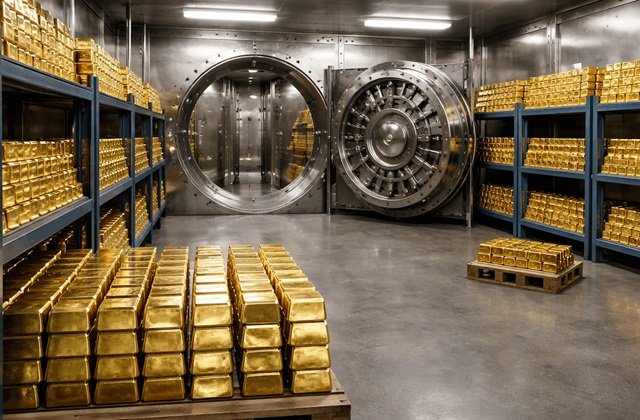
As European central banks rethink where their gold should be held, Madrid faces a strategic choice over reserves stored in New York amid growing concerns about geopolitical uncertainty and financial autonomy.
Spain is confronting a question that other major European economies have already begun to address: whether gold held in the United States should remain there or be brought closer to home.
Several eurozone central banks have recently repatriated or relocated gold reserves held abroad, reflecting a wider effort to strengthen strategic autonomy at a time of growing global volatility. The Netherlands publicly announced last week that it was moving part of its gold from the United States and Canada to the United Kingdom, while France and Germany have also made recent changes. Italy, meanwhile, is facing growing public pressure to bring its reserves home.
The Banco de España acknowledges that part of Spain’s gold reserves is held in the United States but, citing confidentiality, does not disclose what proportion is stored there or whether it plans to change its arrangements.
The debate extends beyond concerns about Donald Trump’s presidency. The freezing of Russian assets abroad in 2022, following the invasion of Ukraine, raised questions among countries outside the Western alliance about the security and accessibility of reserves held overseas. India subsequently repatriated large quantities of gold held by the Bank of England in 2024 and later extended the move to reserves held in Basel.
Spain holds nine million troy ounces of gold, equivalent to 281 tonnes and valued at about €33.2 billion in 2025. Most is known to be stored in the Banco de España’s Gold Chamber, while an unspecified portion is held at the Bank for International Settlements, the Bank of England and in New York.
Luis Garvía, a professor at the Instituto de Estudios Bursátiles, argues that bringing Spanish gold home would not simply be an act of national sovereignty but part of the European Union’s broader strategic autonomy. Spain is the eurozone’s fourth-largest economy but ranks sixth in gold holdings, alongside Austria.
Spain’s relationship with gold also reflects a distinctive history. During the Civil War, the Banco de España sent gold to Moscow and Paris to finance the Republican war effort, leaving reserves depleted by the end of the conflict. Years later, Spain rebuilt its gold and foreign-exchange holdings before joining the International Monetary Fund in 1958.
Gold subsequently lost its formal role at the centre of the international monetary system after the world abandoned the gold standard, but central banks continued to hold it alongside foreign currencies, particularly dollars, and government debt. Garvía describes gold as fundamental to monetary policy and the management of confidence.
Spain’s comparatively modest holdings partly reflect a decision taken in 2007, shortly before the effects of the Great Recession were felt, when Madrid ordered the sale of almost one-third of its gold because it considered the asset insufficiently profitable.
Although each eurozone capital manages its own reserves, national gold holdings form part of the wider Eurosystem buffer. The European Central Bank has its own gold reserves and also relies on those held by national central banks in supporting the common currency. The ECB says it has issued no recommendation on repatriating national reserves.
Santiago Carbó, a professor at CUNEF, argues that a coordinated Eurosystem approach would be preferable to abrupt national repatriations. Market sources, meanwhile, say the amount of Spanish gold held at the Federal Reserve is likely to be small. Miguel Ángel Rodríguez, an analyst at the Willybit platform, therefore believes it would be better left untouched, arguing that the possibility of seizure or confiscation is remote and that the symbolic impact of moving it could outweigh the practical benefits.
The stakes are considerably higher for Germany, the world’s largest gold holder, which still keeps about one-third of its reserves in Manhattan. Together with Italy, whose gold repatriation has become a matter of state importance, Germany holds around €210 billion of gold in the United States, according to the Financial Times.
As central banks continue to increase their purchases of gold as a safe-haven asset, particularly in emerging markets such as Brazil, the question of where reserves should be stored is becoming increasingly strategic. Washington’s intention to reduce the dollar’s role as the currency of last resort adds another factor, potentially pushing gold further from US custody and closer to the centre of global monetary calculations.










