The latest PISA assessment presents an unusually stark picture of educational performance. More than 760,000 15-year-old students across 91 participating countries and economies were assessed, producing evidence of broad declines in some of the foundational skills on which modern education depends. Across OECD countries, average performance in science, reading and mathematics reached its lowest recorded level, extending a decade-long deterioration in reading and mathematics.
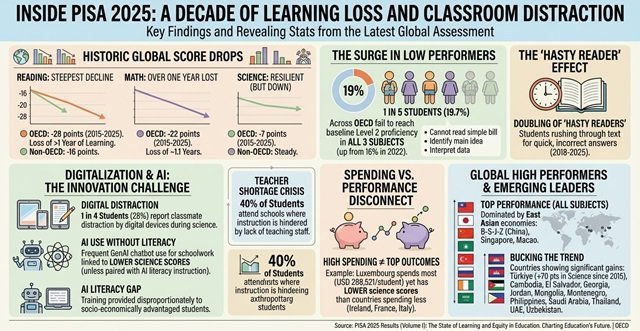
Reading has suffered the most severe decline. Between 2015 and 2025, OECD reading scores fell by 28 points, compared with a 16-point decline among non-OECD participating countries. With a 20-point fall roughly equivalent to a year of formal schooling, the OECD decline represents more than 1.4 years of lost reading capacity relative to students assessed in 2015. Between 2018 and 2025 alone, the decline was 25 points.
The nature of the deterioration is as important as its scale. PISA recorded a near doubling between 2018 and 2025 in the proportion of students described as “hasty readers”: those who rush through texts and submit rapid, incorrect answers. The steepest losses occurred in advanced reading tasks requiring students to evaluate source credibility, connect information across multiple texts and draw critical inferences.
Mathematics has followed a similarly troubling trajectory. OECD mathematics performance declined by 22 points between 2015 and 2025, with the sharpest component of the reduction occurring immediately after 2018. Science, by comparison, proved considerably more resilient. The OECD average declined by seven points, from 489 in 2015 to 482 in 2025, while non-OECD countries remained virtually unchanged, moving from 436 to 437.
The result is a growing concentration of students struggling with basic proficiency. Across the OECD, 19.7 per cent of students now fail to attain Level 2 in all three domains, up from 16 per cent in 2022. Roughly one in five teenagers therefore lacks basic operational competencies such as understanding a utility bill, interpreting basic data or identifying the main idea in a short text.
The findings also point towards changing relationships between students, technology and learning. Twenty-eight per cent of students across OECD countries report that classmates are distracted by phones, tablets or laptops during most or every science lesson. Digital devices used for academic purposes can be associated with positive outcomes, but leisure use inside classrooms is associated with lower overall scores. Schools enforcing clear and consistent restrictions on leisure-device use recorded lower levels of classroom distraction and more focused learning environments.
Artificial intelligence presents a more complicated picture. Students who frequently use AI chatbots to complete schoolwork scored lower in science on average than students who did not use them. Greater reliance on generative AI was also associated with reduced help-seeking behaviour, suggesting that some students may be turning directly to software rather than working through difficult problems themselves.
Yet the findings do not establish that AI itself is inherently harmful to learning. The students who showed performance gains while using AI were the comparatively rare group whose schools provided explicit instruction in AI literacy and critical evaluation. The distinction is therefore between technology used within a structured learning process and technology used without such guidance. Disadvantaged students are significantly less likely to receive formal AI literacy training, creating an unequal exposure to the risks and benefits of these tools.
The deterioration in performance is occurring alongside persistent institutional pressures. Around 40 per cent of students attend schools where principals report that instruction is hindered by a lack of teaching staff. An equivalent proportion are in schools where learning is hindered by shortages of administrative, special education or teaching support personnel. These shortages are considerably more severe in public and socioeconomically disadvantaged schools than in private or wealthier counterparts. Educators and principals also identified shortening attention spans as a primary challenge in delivering the curriculum.
Socioeconomic disparities provide another measure of the crisis. In some regions, the performance gap between advantaged and disadvantaged students narrowed between 2022 and 2025. But the narrowing was driven by declining performance among advantaged students rather than improvements among disadvantaged groups. The result is a convergence produced partly by deterioration rather than progress.
The relationship between spending and educational performance is similarly uneven. Luxembourg spent more than USD 288,521 per student, the highest cumulative amount among participating systems, yet recorded a lower average science score than countries spending less than half that amount. By contrast, middle-income economies such as Türkiye and Estonia demonstrated higher efficiency ratios, producing high or rapidly improving proficiency at lower levels of spending.
Despite the broad deterioration, PISA 2025 also identifies systems moving in the opposite direction. East Asian systems, notably B-S-J-Z (China), Singapore and Macao (China), occupied leading positions across the three principal domains. B-S-J-Z (China) recorded the highest scores in science, at 597, and mathematics, at 612. Singapore led reading with 535 points, although its mathematics and reading scores declined slightly compared with 2022.
Türkiye recorded one of the largest ten-year improvements, increasing its average science score by nearly 70 points since 2015. Cambodia, El Salvador, Georgia, Jordan, Mongolia, Montenegro, Philippines, Saudi Arabia, Thailand, UAE and Uzbekistan also recorded gains in science literacy.
Finland illustrates the complexity of the results. Its science score of 504 remained above the OECD average of 482, but its longer-term performance trend was downward, including a 16-point decline in reading relative to previous assessments. Across the Nordic countries, Finland and Sweden remained above OECD averages in the reported measures, while Norway and Iceland recorded below-average results in reading and mathematics. Finland also recorded substantial differences in science performance between non-immigrant students, who averaged 517 points, and second-generation and first-generation immigrant students, who averaged 444 and 417 points respectively.
The assessment’s new computational problem-solving domain provides another measure of how students are adapting to a digital world. PISA 2025 established an OECD average of 500 points for tasks requiring students to build, debug and execute digital solutions. Macao (China) led with 572 points. Test tasks included programming a robotic claw to sort items and identifying broken logic in code blocks. Finland scored 507, compared with 503 for Sweden and 506 for Denmark. Unlike traditional domains, the gender difference was minimal: girls averaged 509 points across OECD countries, compared with 505 for boys.
Gender differences remain much more pronounced elsewhere. Girls continued to outperform boys substantially in reading across almost all participating countries and maintained a statistically significant advantage in science. In mathematics, however, the average OECD gap has narrowed to near statistical parity. The declines in reading and mathematics between 2022 and 2025 were also broadly symmetrical between male and female students.
The assessment reveals some more positive developments. Seventy-four per cent of 15-year-olds reached baseline Level 2 proficiency in environmental science. More than 90 per cent of students in Viet Nam and Indonesia expressed a personal commitment to careers that protect the environment, compared with an OECD average of 62 per cent. Yet curiosity remains under pressure: although 57 per cent of OECD students said that learning new things is not boring, curiosity metrics declined across 60 education systems.
At the same time, students reported stronger social connections within schools. A sense of school belonging improved across 39 education systems between 2022 and 2025, while reported loneliness at school declined in 48 participating systems.
PISA 2025 therefore captures an education system under simultaneous pressure and transformation. Reading and mathematics have suffered sustained losses, critical reading skills have weakened, classrooms are contending with digital distraction, AI is changing how students approach schoolwork, and shortages of teachers and support staff continue to constrain instruction. Yet the same assessment records systems making substantial gains, students developing new computational abilities and improvements in school belonging.
The central finding is not simply that students are performing worse. It is that the conditions under which learning takes place are changing rapidly, while educational systems are producing sharply different results in how they respond. The PISA data place that divergence alongside an unprecedented decline in foundational performance, making the question of how students learn—and what schools must now teach them to learn effectively—central to the future of education.