


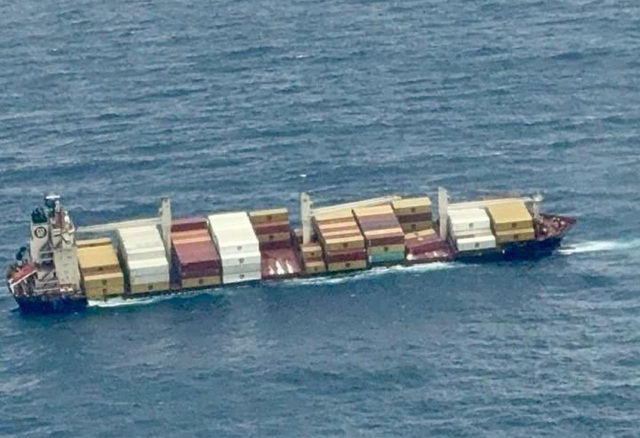
The Liberian-flagged container vessel MSC Elsa 3 capsized 38 nautical miles off the coast of Kochi on Saturday, triggering a large-scale rescue and emergency response operation across Kerala’s coastal districts. All 24 crew members have been reported safe, thanks to swift action by the Indian Navy and Coast Guard, although concerns over hazardous cargo, environmental fallout, and navigational safety in monsoon-prone waters continue to mount.
The ship, a converted cargo vessel originally built in 1997 at Poland’s Stocznia Szczecińska Shipyard, was en route from the newly operational Vizhinjam International Seaport to Kochi. Maritime experts are raising alarm over whether adverse weather conditions and vessel aging may have contributed to the disaster.
Weather Ignored?
Initial reports suggest MSC Elsa 3 had developed a dangerous 26-degree list, most likely due to water ingress—possibly from aging seawater cooling pipes—compounded by rough seas linked to an incoming monsoon system. Maritime authorities are probing whether the vessel’s captain ignored cyclone warnings issued for the Arabian Sea.
“Vessels routinely adjust course to avoid storm systems. A failure to do so is serious and must be investigated,” said a senior maritime safety expert. Compounding concerns, at least nine containers, some reportedly containing very low sulfur fuel and marine gas oil, have fallen into the sea, prompting an environmental alert for the coasts of Kollam, Thiruvananthapuram, Alappuzha, Thrissur, and Kochi.
The Kerala State Disaster Management Authority (KSDMA) has urged residents and fishermen to avoid any washed-up cargo and to report sightings immediately. The risk of oil slicks remains high.
Questioning the Safety of Vizhinjam Route
The incident also puts a spotlight on India’s newly inaugurated Vizhinjam Port, hailed as a transformative deep-sea transshipment hub. While its strategic location near international shipping lanes was considered a major advantage, experts warn that the surrounding seas—especially during the monsoon—are historically accident-prone and unpredictable.
In fact, colonial maritime records from the British East India Company era reveal that the British deliberately avoided constructing major ports on Kerala’s southern tip due to the ferocious seasonal swells, unpredictable currents, and difficult navigation around Cape Comorin. Archival documents housed in the British Library and Indian National Archives describe the waters off modern-day Vizhinjam as “functionally inhospitable during the monsoon months” and “liable to dangerous swells unsuitable for anchorage or berthing.”
Old Ship, New Burden
Adding to the complexity is the nature of MSC Elsa 3 itself—a retrofitted vessel. Originally launched as Jan Richter, the ship has undergone at least nine name changes and conversions in its nearly three-decade service. Retrofitted cargo ships like this, used as feeder vessels to serve smaller ports, are known to have limitations in rough sea conditions.
“Feeder vessels are often older, less stable, and operate on tighter margins. They are not always best suited to routes that demand resilience against severe weather,” said a port operations analyst.
What Comes Next?
Salvage operations are underway. The priority is to pump out seawater, transfer the containers, and stabilize or tow the vessel. However, due to the age of the ship and the nature of its cargo, profitability of a full salvage remains uncertain. If sunken, the site may need to be declared a navigational hazard.
This latest mishap raises vital questions about safety protocols, the integrity of retrofitted vessels, and the implications of scaling up port operations in monsoon-exposed regions. As India eyes greater prominence in global shipping through ports like Vizhinjam, balancing ambition with environmental and navigational realities will be critical.
Public Advisory: If any containers are sighted along the Kerala coast, residents should immediately notify local police or call 112. Avoid contact with any floating or beached cargo, especially those leaking fluids.











