


Deep in the Berkshire countryside, behind razor wire fences and watched over by armed guards, Britain’s most secretive nuclear facility quietly operates. The Atomic Weapons Establishment (AWE) at Aldermaston, a sprawling 700-acre complex, holds within its vaults decades-old stockpiles of enriched uranium and plutonium — core ingredients in the UK’s independent nuclear deterrent.
As The Times UK reports in its rare and exclusive visit, this is the first time journalists have been granted access to the facility in over ten years. The visit comes amid heightened global tensions and a renewed political focus on Britain’s sovereign nuclear capabilities.
Decades of Secrets Beneath Armed Watch
The secure vaults that house fissile materials are some of the most protected places in the country. Armed officers with C8 Carbine rifles patrol rooftops while cameras scan every angle and 56 trained dogs roam to detect any sign of chemical or radioactive breach.
“The guards and guns are not here to protect us — they are here to protect the material,” one scientist told The Times UK. Another added: “You can’t get anywhere near them even if you tried.”
Security precautions extend beyond just human threats. Buildings are designed to minimize fallout in the unlikely event of an airliner crash, though officials view terrorism as a greater risk than deliberate air assault.
A $15 Billion Transformation
Once a World War II air base, AWE Aldermaston is now undergoing a £15 billion modernization to bring it into the next nuclear age. With more than 9,500 employees — up 1,000 in just two years — the site is at the forefront of Britain’s nuclear future.
Central to that future is Astraea, or the A21/Mk7, Britain’s next-generation nuclear warhead. It is intended to replace the current Holbrook warheads aboard the UK’s Trident-armed Vanguard-class submarines. Unlike previous generations, the Astraea warhead is being designed without real-world testing, in line with Britain’s nuclear non-proliferation commitments.
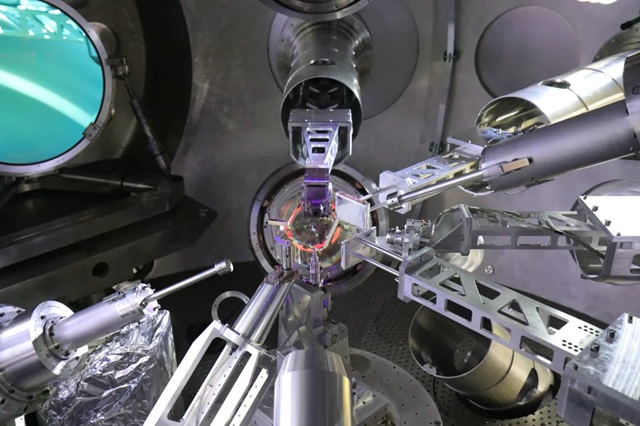
This differs from the nuclear testing of the 20th century, including the U.S.’s first atomic test in New Mexico in 1945. Instead, British scientists simulate nuclear detonations using cutting-edge tools such as the Orion laser, which can replicate the high-energy, high-density conditions of a nuclear explosion — without the radioactive fallout.
“This isn’t a giant death ray,” one scientist joked during the tour. “It’s a bespoke scientific tool.”
A Supercomputer That Thinks Like a Bomb
Complementing Orion is a dedicated building housing a supercomputer capable of performing four trillion calculations per second. The machine is used to validate warhead designs, model detonations, and store legacy data from decades of nuclear research.
These innovations are not just about scientific discovery — they are central to Britain’s nuclear posture. The new warheads must be reliable, even though they will never be tested live. “This is a new era of threat and there’s a sense of urgency,” said Marina Dawes, director of science at the site.
The Assembly Line of Deterrence
At Aldermaston, components such as high explosives are manufactured. They are then transported in heavily guarded convoys — sometimes with 50 support vehicles — to AWE Burghfield, a facility less than 10 miles away. There, the components are assembled and weaponized.
Just down the road is Blacknest, a monitoring site tasked with detecting seismic activity that may indicate clandestine nuclear tests by other nations — a vital task as global threats evolve and new state actors pursue nuclear capability.
A New Generation, A Heavy Responsibility
The workforce at AWE is changing too. With salaries averaging £45,500 — 20% above the UK average — the site is actively recruiting, especially targeting women, neuro-diverse individuals, and underrepresented communities in STEM. Only 20% of the workforce is female, and diversity is seen as key to building the next generation of nuclear scientists and engineers.
“We are proud of what we do,” one senior employee said. “Being a nuclear weapons state is an awesome responsibility. It is the most serious of serious things.”
Political Support in a Time of Uncertainty
During a recent visit to the site, Secretary of State for Defence John Healey praised the work of AWE’s scientists and engineers, stating, “The technology being developed here is keeping us all safe every minute of the day.” With the Astraea warhead expected to come online in the 2030s, Britain is betting heavily on innovation to maintain its deterrent power.
Healey’s visit comes at a tense moment globally, as speculation swirls around potential U.S. strikes on Iran’s nuclear sites — an action that could trigger broader instability in the Middle East. In that context, Britain’s secure and modernized nuclear infrastructure becomes even more critical to its strategic posture.
As The Times UK notes, recent polling by YouGov shows that public support for maintaining the UK’s independent nuclear deterrent stands at 65%, the highest since records began in 2018.
In a world entering what analysts call the “third nuclear age,” Aldermaston stands as both a fortress of secrecy and a crucible of innovation — ensuring that Britain remains ready, resilient, and responsible in the face of evolving global threats.









