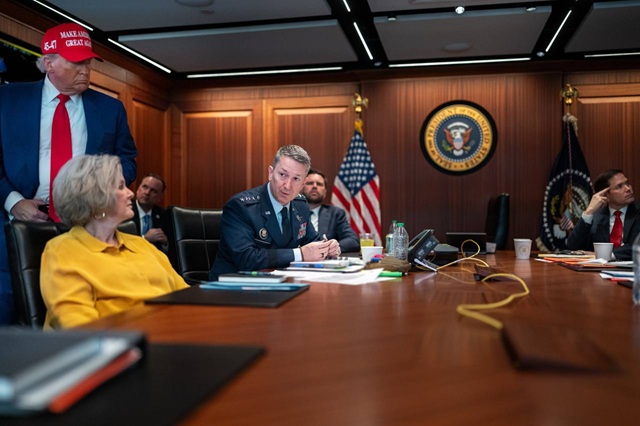
The recent US air strikes on Iranian nuclear facilities — the most powerful non-nuclear strikes ever conducted by Washington — are being viewed by analysts as a powerful warning to Beijing about the unpredictability of the Trump administration and the real potential for US intervention in conflicts involving Taiwan or the South China Sea.
According to reporting from the South China Morning Post, diplomatic experts suggest the bombings may deepen Beijing’s suspicions that the United States, under President Donald Trump, is willing to act unilaterally and forcefully, even at the risk of escalation. The attack was followed by a swift Iranian retaliatory strike on the largest US airbase in the region, underlining the volatility of the situation.
Trump, who campaigned on promises of avoiding foreign entanglements and ending “forever wars,” now faces scrutiny for what critics say is a shift away from his anti-war rhetoric. Despite a ceasefire announcement posted to his social media, Israel’s defense minister soon ordered renewed strikes against Iran, accusing Tehran of breaching the truce — a charge Iran has denied. Trump later blamed both countries for the breakdown in ceasefire.
Experts quoted by the South China Morning Post argue that this episode is not only reshaping dynamics in the Middle East but also altering strategic calculations in Beijing.
Isaac Kardon, a senior fellow for China studies at the Carnegie Endowment for International Peace, said the US escalation “sent a strong and clear signal” to Chinese analysts watching closely for clues on Washington’s willingness to intervene in Asia. “Massive use of force actually is ‘on the table’ and may be employed very quickly and even impulsively,” Kardon noted.
Josef Gregory Mahoney of East China Normal University emphasized that while the Chinese leadership may not have been surprised, the events served as a “wake-up call” to those who had previously viewed Trump as a non-interventionist. “It shatters the illusion of Trump as a ‘president of peace,’” he said.
For China, the strikes validate long-standing concerns about US unpredictability. James F. Downes, an international relations scholar at Hong Kong Metropolitan University, said the attack “fuels China’s long-term efforts to boost military readiness and deterrence,” especially with a sharper focus on Taiwan and the South China Sea.
Downes argued that while China has already prepared for worst-case scenarios, the need for “concrete deterrence” in its immediate region has now become more urgent.
Still, some experts caution against overstating the strategic shift. Kardon pointed out that the balance of power in East Asia is significantly different from the Middle East, noting that Trump has so far avoided testing escalation with China directly. “China poses a far more credible and formidable threat, capable of protracted conflict,” he said.
Zhao Minghao of Fudan University noted the contradiction between Trump’s “America First” vision and the potential for deeper military entanglement in the Middle East. He suggested that although the US wants to pivot to the Asia-Pacific, it remains bogged down in Middle Eastern conflicts — a distraction China may see as to its advantage.
Chong Ja Ian from the National University of Singapore added that the strikes reinforce Beijing’s image of Trump as erratic, complicating efforts to gauge Washington’s true strategic intentions. “Beijing will have to factor in this possibility at least in the short run,” he said, noting that further escalation in the Middle East could pull US focus away from Asia and reduce pressure on China.
In the wake of these developments, Beijing may now proceed with greater caution in managing ties with Washington, all while accelerating military and diplomatic efforts to prepare for any future confrontations. Whether Trump’s actions were a one-off or a new doctrine remains to be seen, but for China, the message is already clear: US unpredictability remains a central strategic risk.