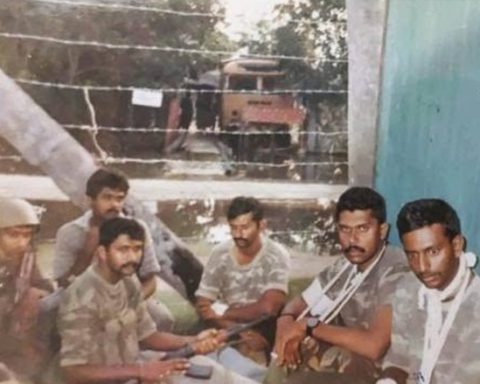
During the JVP’s second insurgency, various foreign intelligence services took notice, and from early 1989, the Israeli Mossad intelligence agency began providing military advisory support to the Sri Lankan government to suppress the uprising. Three individuals, including a colonel from the Israeli Security Advisory Committee operating in Sri Lanka at the time, were involved in this effort. By then, the American CIA, British MI6, Indian RAW, and Russian KGB intelligence services were also operating in Sri Lanka, directly or indirectly, to varying degrees.
Some representatives of these foreign intelligence services met me and several professional journalists at annual parties and special events. Often, they attended as embassy representatives. Mossad began investigating the JVP insurgents on the morning of 7 June 1987, following attacks on the Katunayake Air Force Base and the Kotelawala Defence College in Ratmalana.
In the early 1980s, the Mossad operated from the 9th floor of the Oberoi Hotel in Colombo. At that time, its head was Mataniya. On 21 January 1984, Tamil separatist Tigers detonated a bomb at the Oberoi Hotel, although the attack failed. However, a hotel maid was killed.
The Mossad office was later relocated to Liberty Plaza in Kollupitiya. When the JVP insurgency began, the office was coordinated by an operative known as ‘Monica’. The head of the Mossad Security Advisory Committee in Sri Lanka was Colonel ‘Carlos Levi’.
The book By Way of Deception by Victor Ostrovsky and Claire Hoy revealed that the Israeli government’s Mossad intelligence agency provided weapons training not only to Sri Lankan soldiers but also to Tamil separatist groups such as the EPRLF and LTTE in Israel. According to the book, Tamil separatists were trained at one end of a Mossad camp, while Sri Lankan soldiers were trained at the other, with the setup preventing any interaction between the two groups.
Phil Miller’s 2015 research disclosed that British intelligence provided military advice to the Sri Lankan government during the JVP’s April 1971 uprising. Similarly, Israeli intelligence secretly advised selected top security officials—via Sri Lanka’s political leadership—on counterinsurgency operations during the second JVP uprising.
Under this arrangement, Mossad provided the Sri Lankan government with specialised training in early 1989. This included guerrilla warfare tactics, planning military operations, capturing and interrogating insurgents, extracting intelligence, and deploying propaganda effectively. The interrogations reportedly involved extreme physical and psychological techniques to obtain the “necessary” information. These brutal yet efficient methods contributed to the suppression of the JVP, particularly through the ‘removal’ of key rebels who were arrested and sent to secret detention centres.
As the second JVP rebellion intensified, on 2 October 1989, U.S. President George Bush appointed Marine V. Creekmore Jr. as the new ambassador to Sri Lanka. After taking up the post, Ambassador Creekmore stated in Washington that although the Sri Lankan government had closed the North Korean embassy on 17 April 1971 due to allegations that JVP rebels had received documents from North Korea, there was no evidence that the JVP leading the second insurgency was receiving foreign support. In further remarks, the ambassador stated that the rebels aimed to paralyse the government, plunge the country into anarchy, and seize power. He praised President Ranasinghe Premadasa’s decision to expel the Indian army from Sri Lanka—a decision that had stirred controversy in the South.
A Russian delegation led by journalist Yuri Kulikoch of the Moscow weekly Lithara Thurgaya Gasita toured Sri Lanka’s Southern and North Central Provinces for two weeks from 15 July 1989. The delegation, sponsored by the Russian government, met with a JVP Politburo member—H. B. Herath—and other regional leaders, government officials, and military commanders. Their discussions, held at the Wellawatte Wadiya Restaurant, were later broadcast by Moscow Radio on 5 August 1989 under the title Meetings and Conversations. Herath, using the alias Perera, said the imperialists feared the JVP’s growing influence and that the party sought to create a revolutionary situation. He stated that there was no path to socialism without it.
On 21 September 1989, Matara District UNP MP H. R. Piyasiri alleged in Parliament that Meholt, the Second Secretary of the U.S. Embassy in Colombo, was paying lawyers US$5,000 each to represent the rebels in legal actions against the security forces. He further claimed that Meholt had used diplomatic privileges to escort lawyer Prince Gunasekara from Katunayake Airport in an embassy vehicle on 2 September 1989. Deputy Speaker Gamini Fonseka inquired if the statement was made responsibly, to which Piyasiri replied affirmatively. Prince Gunasekara later relocated to the UK, where he continued to advocate for human rights until his death on 29 December 2018, aged 94.
The then British High Commissioner, David Gladstone, assisted several human rights activists—including Gunasekara—in leaving Sri Lanka during and after the JVP’s defeat. Later, Gladstone filed a complaint at the Dickwella police station regarding electoral fraud during the 11 May 1991 local elections. President Premadasa subsequently declared that Gladstone would no longer be recognised as a diplomatic representative, accusing him of interfering with Sri Lanka’s sovereignty. The British government appointed a replacement, and in July 2008, Gladstone told BBC Sinhala’s Sandesha programme in London that he had acted on clear instructions from the British government to safeguard human rights.
India’s Research and Analysis Wing (RAW), its most powerful intelligence agency, was involved in covert operations in Sri Lanka. Its objective was to intervene whenever Sri Lanka’s political decisions conflicted with India’s interests. In the late 1980s, Gurujit Singh—a Sikh Political Secretary for the seven southern provinces—and Hardeep Puri, the First Secretary for Political Affairs, handled JVP affairs. Hardeep was also married to Lakshmi Puri, the First Secretary to Indian High Commissioner J. N. Dixit. JVP leaders D. M. Ananda, Somawansa Amarasinghe, H. B. Herath, and Central Committee member Upali Jayaweera occasionally met Indian High Commission officials, with these interactions coordinated by senior journalist Richard de Zoysa.
In the mid-1980s, ‘Saxena’ served as RAW Secretary in India. S. I. Shankar, a Tamil Brahmin, was the Indian High Commission’s Political Secretary for the North and East. First Secretary Joseph Tarilal, a Catholic from Kerala, handled RAW coordination. Security coordination was led by Captain Gupta, while Pimros Sharma headed the Political and Information Division. Nirupan Sen was Deputy High Commissioner. On 25 October 1987, rebels bombed the Indian High Commission in Kandy.
In 1988, RAW channelled funds to political groups in Sri Lanka: LKR 80 million to the Sri Lanka Mahajana Party in two tranches, LKR 20 million to the Muslim Congress, LKR 5 million each to three leftist parties, and INR 52 million to the LTTE. Nevertheless, the LTTE boycotted provincial council elections.
On 14 May 1989, the JVP launched a boycott of Indian goods and ordered all Indian businessmen to leave Sri Lanka. On 12 May 1989, a landmine exploded under an Indian army truck in Kantale, killing 13 soldiers, including a major. Subsequently, RAW representatives held discussions with JVP leaders. In September 1989, a secret agreement reportedly allowed for the delivery of weapons—including nine tractors full of arms transported via an Indian aircraft to Trincomalee—to rebels in Nilaveli. This plan was abandoned after the government was informed on 7 November 1989, and Defence Secretary General Sepala Attygalle publicly disclosed the details on 9 November 1989.
Meanwhile, the Hindustan Times reported on 14 September 1989 that JVP activity had declined following President Premadasa’s decision to expel the Indian army. The paper quoted an Indian official stating that the Indian army had not been deployed in Sinhalese-majority areas as a tactic to support the insurgency.
In October 1989, multiple discussions occurred between JVP military commander Saman Piyasiri Fernando and a Muslim businessman at a house on Maligawatta Road in Maradana. The talks focused on acquiring weapons from the Eastern EPRLF to be delivered to Negombo. The plan fell through after disagreements arose within the JVP Politburo at the end of October. Participants included Piyasiri and leaders of the Ilukkumbura and Sampath zonal groups.
Despite attempts to establish international links during the second rebellion, the JVP’s efforts largely failed. Foreign countries and organisations viewed it not as a Marxist or revolutionary party, but as a Sinhala nationalist rebel group from the South. The JVP’s outreach in 1985/86 to the ruling party in Cuba, the Leninist Communist Party of Algeria, the Palestine Liberation Organization, and the Communist Party of Tunisia bore no fruit.
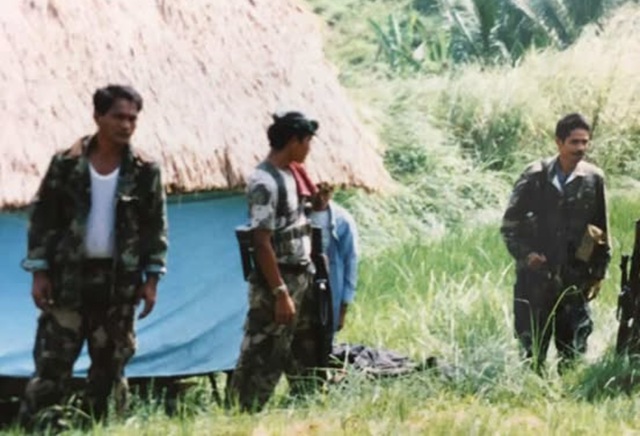
Nevertheless, in 1985, H. B. Herath and another individual underwent training in Lebanon via the PLOT organisation. Two other JVP groups received training from armed factions on Mindanao Island in the Philippines in November 1989 and 1995. The JVP initially received bomb-disposal training at the LTTE’s Kunjikulam camp. Sixteen rebels were trained there, and all services were reportedly paid for by the JVP.