


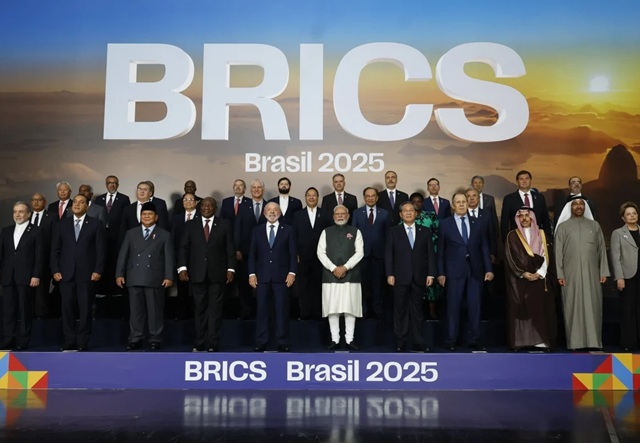
Brazilian President Luiz Inácio Lula da Silva has sharply criticized U.S. President Donald Trump for threatening punitive tariffs on Brics nations, calling the move irresponsible and disrespectful. Speaking at the close of the Brics leaders’ summit in Rio de Janeiro on Monday, Lula emphasized the sovereignty of the bloc’s member states and warned against economic intimidation.
“I don’t think it’s very responsible and serious for a president … of a country the size of the US to threaten the world over the internet – it’s not right,” Lula said at a press conference. He stressed that Brics members are “sovereign countries” and not subject to an “emperor,” adding, “Respect is good – we like to give it, and we like to get it in return.”
Trump ignited controversy on Sunday by announcing plans to impose an additional 10% tariff on imports from Brics members and aligned countries. He accused the bloc of promoting “anti-American policies” without specifying which actions he deemed hostile. In January, Trump had declared Brics “dead” and criticized its push toward “de-dollarisation.”
While Brics as a group refrained from issuing an official response, individual nations reacted. China’s foreign ministry dismissed Trump’s comments, emphasizing that Brics “is not a bloc for confrontation.” Spokeswoman Mao Ning warned that trade wars and protectionism “have no winners.” Russia, via Kremlin spokesperson Dmitry Peskov, simply noted that Trump’s remarks had been “noticed.”
The latest threats come as Brics continues to expand its influence. This year’s summit included full members Brazil, Russia, India, China, South Africa, Egypt, Ethiopia, Indonesia, Iran, and the United Arab Emirates, as well as high-profile attendees like UN Secretary-General António Guterres and WHO Director-General Tedros Adhanom Ghebreyesus.
In their leaders’ declaration, Brics condemned tariffs, unilateralism, and protectionism without directly naming the U.S. The statement also called for the withdrawal of Israeli forces from Gaza and criticized recent military strikes on Iranian nuclear facilities as violations of international law. Though the U.S. and Israel were not mentioned explicitly, the timing raised eyebrows, given Trump’s scheduled meeting with Israeli Prime Minister Benjamin Netanyahu on the same day.
Despite Trump’s skepticism, experts say the bloc’s relevance is growing. “The U.S. would have to be far more aggressive than it has been so far to really reduce that level of interest in Brics,” said Gustavo de Carvalho of the South African Institute of International Affairs. He suggested that Trump’s threats are aimed at gaining negotiating leverage rather than disrupting the bloc’s cohesion.
Farwa Aamer of the Asia Society warned that while current Brics members are unlikely to leave the bloc, Trump’s aggressive stance could deter some Global South nations from joining. “We’re more likely to see a muted or fragmented response, if any,” she said, citing the uncertainty in global trade and diplomacy.
Meanwhile, the U.S. appears to be hedging its bets with outreach to Brics partner nations. Secretary of State Marco Rubio is set to visit Malaysia this week for a series of high-level regional meetings. Malaysian Prime Minister Anwar Ibrahim recently urged Brics to take cues from Asean in challenging Western dominance and reducing reliance on the U.S. dollar.
“We’re not talking about de-dollarisation, because there’s a long way to go,” Anwar said at the Brics business forum. “But even beginning with 10 or 20 per cent [local currency trade], it makes a difference.”
As the summit concluded with a new group photo symbolizing Brics’ growing footprint, Lula downplayed the potential fallout from Trump’s threats. “Some people are rattled by our unity,” he said. “But we’re not here to threaten anyone. We’re here to be respected.”









