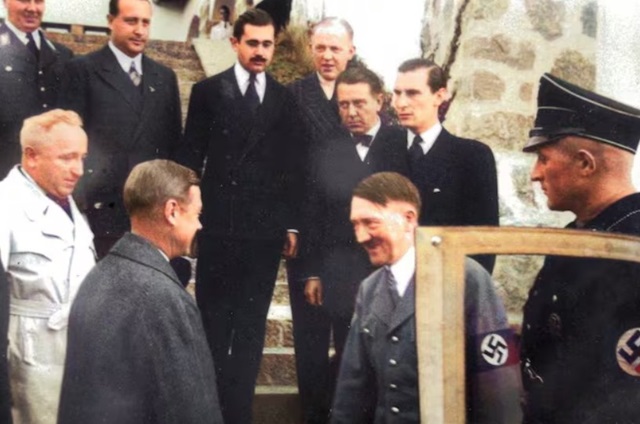
A century after Adolf Hitler’s Mein Kampf was published, an unsettling reflection published by The Independent UK challenges long-held assumptions about Britain’s moral immunity to fascism and raises troubling parallels with today’s global political discourse.
Written as part of a BBC radio documentary project, the deeply personal and analytical piece revisits Hitler’s notorious manifesto — a 700-page amalgam of narcissism, pseudo-science, and racial hatred — and examines how many of its core ideas remain alarmingly relevant in the 21st century.
The author, whose own Jewish father fled Czechoslovakia during Hitler’s rise and lost several relatives in concentration camps, confesses that reading Mein Kampf was both emotionally harrowing and intellectually disturbing. “It took nerves of steel,” they write, describing the task of dissecting the text 30 pages at a time. But what emerged was a chilling realization: Mein Kampf is not an isolated relic of history — it is part of a dangerous ideological continuum that still infects today’s political and digital landscapes.
Germany, the article notes, has spent 80 years confronting its Nazi past with a combination of legal suppression and cultural shame. Yet while Mein Kampf remains taboo there, it continues to sell briskly in countries like India and Turkey. Meanwhile, its rhetoric — warnings about “blood poisoning,” racial purity, and national decline — is echoed in political speeches, viral videos, and social media across the globe.
With the assistance of Dr. Simon Strich of the University of Potsdam, the author draws striking parallels between Mein Kampf and statements from modern-day political figures. Hungarian Prime Minister Viktor Orbán, for instance, declared in 2022 that Europeans should not mix with “those arriving from outside,” closely mirroring Hitler’s own words in Chapter 11: “Blood mixture and the resultant drop in the racial level is the sole cause of the dying out of old cultures.”
Similarly, U.S. President Donald Trump, speaking at a 2023 campaign rally, said: “They’re destroying the blood of our country.” He then added, “And I never read Mein Kampf.” But the echoes are unmistakable.
Even Elon Musk enters the frame. At the time a close ally of Trump, he conducted an interview with Germany’s far-right AfD leader Alice Weidel, during which Hitler was criticized only for supposedly being a “Communist.” An AI chatbot on Musk’s platform X (formerly Twitter) has even been observed praising Hitler — a reflection, perhaps, of the platform’s failure to moderate the same toxic content that Mein Kampf helped normalize a century ago.
But perhaps the most startling revelation in The Independent UK’s investigation is Hitler’s admiration for Britain. While the dictator despised France, he saw in Britain a natural ally — a fellow empire-builder with whom he hoped to align. He wrote: “For such a policy, there was but one ally in Europe: England.” Elsewhere, he claimed, “No sacrifice should have been too great for winning England’s willingness.”
The article does not suggest that Britain ever embraced Hitler’s vision. In fact, it highlights Winston Churchill’s defiance as a turning point in world history. But it also warns against the comforting myth that Britain — or any nation — is inherently resistant to fascism. In the 1930s, prominent figures such as Oswald Mosley, leader of the British Union of Fascists, drew significant support. The line between democratic order and authoritarian collapse was — and remains — far thinner than many would like to believe.
As the author warns, Mein Kampf is not special in its ideology — it is just one formulation of a set of ideas that refuse to die. “There are a million different versions of the same material, the same ideology out there,” says Dr. Strich.
The article ends on a sobering note. If history is too often remembered in black-and-white, with clear villains and heroes, the truth is far more complex. The resurgence of ultra-nationalism, racial pseudoscience, and political extremism across the globe suggests that the ideas Hitler championed never truly went away. They’ve simply adapted — finding new platforms, new voices, and, disturbingly, new audiences.