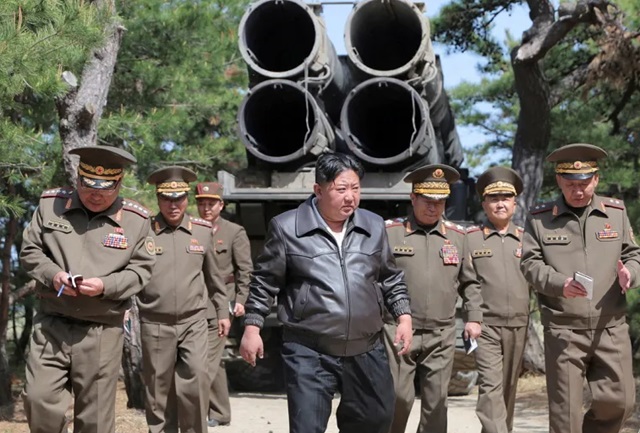
North Korea has significantly enhanced its nuclear and conventional military capabilities over the past six months through direct involvement in the war in Ukraine, according to an intelligence assessment obtained by The Times UK. The report, compiled by Ukraine’s military intelligence agency (HUR), warns that Pyongyang now poses a greater threat to South Korea, Japan, and U.S. forces in the region than ever before.
According to the assessment, thousands of elite North Korean troops, particularly from the 11th Assault Corps and military intelligence units, have fought alongside Russian forces, mainly in Russia’s Kursk region. These troops have endured heavy casualties—up to 4,000 killed or wounded—but gained vital experience in modern warfare, including the use of drones, camouflage under aerial surveillance, and advanced missile systems.
Military analysts believe the war has served as a brutal proving ground for North Korea’s evolving arsenal. “North Korean forces have rapidly improved the accuracy of their ballistic missiles, boosted their drone warfare capabilities, and accelerated modern arms production with assistance from top Russian scientists,” the HUR report noted.
One senior Ukrainian air force officer told The Times UK that North Korea’s KN-23 ballistic missiles—initially inaccurate—have become markedly more precise following the integration of Russian guidance systems, likening them to Russia’s Iskander missiles in both performance and threat level. “They are not Iskanders yet, but already close,” he warned.
The strengthening of the Pyongyang-Moscow alliance was underscored this past weekend during Russian Foreign Minister Sergey Lavrov’s visit to North Korea, where Kim Jong-un offered Russia his “unconditional support.” Their strategic alignment now includes the potential for Russian troops to be deployed to the Korean Peninsula in the event of renewed hostilities—an alarming scenario for Seoul and Washington.
The HUR believes another 30,000 North Korean troops are expected to join Russian and Belarusian forces for the Zapad 2025 military exercises in September. Notably, the previous Zapad exercise in 2021 preceded Russia’s full-scale invasion of Ukraine.
South Korean intelligence estimates that North Korea has already shipped over 12 million artillery shells to Russia, with another 1.5 million expected in the coming months. The arms trade, funded by Kremlin cash, has reportedly supercharged North Korea’s military-industrial complex.
Furthermore, The Times UK reports that Pyongyang’s contributions to Moscow go beyond troops and ammunition. Russian assistance is believed to have accelerated North Korea’s development of nuclear-capable missile systems, including improvements in decoy technology and final-stage maneuverability, which experts warn could challenge even advanced U.S. missile defense systems like the Patriot.
There is also growing concern about technological transfers from Russia to North Korea, including nuclear submarine secrets and drone warfare tactics. According to missile expert Oleksii Yizhak of Ukraine’s National Institute for Strategic Studies, the missile upgrades now allow North Korea to execute combined attacks alongside Russia using advanced Iskanders and Iranian-designed Shahed drones.
The deepening military ties between North Korea and Russia have sparked anxiety across Asia. Yurii Poita, a Taiwan-based analyst with Ukraine’s Centre for Army, Conversion and Disarmament Studies, told The Times UK that policymakers in Japan and South Korea are actively debating whether to pursue independent nuclear deterrents, amid doubts over the reliability of the U.S. nuclear umbrella.
“There are now very hot discussions at a high level in government,” Poita said. “This suggests they have access to intelligence on the significant progress of North Korea’s nuclear programme.”
Strategic experts warn that China, too, stands to benefit from this trilateral alignment. Poita suggested that Beijing encouraged Pyongyang’s involvement in the war, seeing it as a way to distract and overstretch NATO and U.S. resources, particularly if it moves to act against Taiwan.
As North Korea returns battle-hardened troops to the Korean Peninsula and continues to modernize its forces, regional tensions are expected to escalate. Analysts warn that the implications of this Russia–North Korea alliance could fundamentally alter the security architecture of East Asia and beyond.