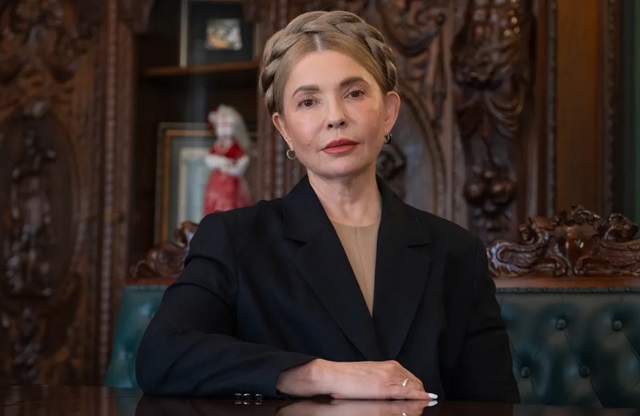
Yulia Tymoshenko, Ukraine’s former prime minister and one of the most recognisable figures of the 2004 Orange Revolution, has delivered a stinging rebuke to Kyiv’s Western allies, accusing them of betraying her country by weakening its sovereignty under the guise of support. In a candid interview conducted at her Batkivshchyna (Fatherland) party headquarters in Kyiv — and reported by The Times UK — Tymoshenko warned that Ukraine is in danger of becoming a “disenfranchised colony” despite its continued battle for freedom on the front lines of Europe.
Tymoshenko, who rose to power after the pro-democracy uprising that reversed a Kremlin-backed electoral fraud, said the West’s failure to offer Ukraine a clear pathway to NATO membership in the years leading up to Russia’s 2022 invasion was a “fatal mistake” that emboldened the Kremlin and opened the door to war. “For today’s war — for the lives lost and broken, for the destruction of Ukrainian cities and villages, for the suffering of millions — responsibility also lies with those [Western] leaders who voted against granting Ukraine a Membership Action Plan,” she stated, referencing the pivotal 2008 NATO summit in Bucharest.
Her disillusionment with Western partners, however, extends beyond that historic blunder. Tymoshenko now argues that since the invasion began, Western governments have imposed sweeping and undue control over Ukraine’s internal affairs — from judicial appointments to anti-corruption agencies and economic oversight — often by leveraging much-needed financial aid. “This is cruel and unjust toward a nation at war,” she said, insisting that Ukraine is not a failed state and should not be treated as such. “We are not Afghanistan.”
At the heart of her criticism is the role of foreign experts embedded within selection panels for senior state institutions, including the Constitutional Court and High Council of Justice. In several of these panels, Western representatives — among them a senior figure from the UK’s National Audit Office — hold decisive sway. If votes are tied, the foreigners’ votes overrule those of their Ukrainian counterparts. Tymoshenko questioned whether such a model, one typically used in post-conflict or failing states, was appropriate for a nation heroically resisting a full-scale invasion.
Her comments have triggered a fierce backlash. Oleksandr Merezhko, a senior MP from President Volodymyr Zelensky’s party, called Tymoshenko’s allegations “absurd,” noting that Ukraine had willingly agreed to such arrangements in exchange for support. He argued that international oversight was a safeguard, not an imposition, meant to ensure transparency and public trust.
Yet Tymoshenko has doubled down, insisting that the West’s role, however well-intentioned, is eroding national agency. “Do not tell us that Ukrainians can die for peace in Europe, but are somehow unfit to govern their own country,” she said. She compared the situation to the worst forms of conditional aid — a type of “repayment” made not in currency, but in sovereignty.
In recent weeks, her scepticism has found political expression. Tymoshenko and her party abstained from a key vote to restore independence to the very anti-corruption agencies she believes were compromised by foreign influence. While President Zelensky defended the move as a response to suspected Russian infiltration, Tymoshenko hailed the disruption as a “bright day” — one that interrupted what she sees as the slow transformation of Ukraine into a vassal state.
Her rhetoric has raised alarms among reform advocates. The Dejure Foundation, a legal watchdog based in Kyiv, accused Tymoshenko of “openly siding” with Moscow’s talking points. The Kremlin has long claimed that Ukraine is a Western puppet, and Tymoshenko’s remarks risk playing into that narrative, critics say. She rejects the comparison, arguing instead that it is the West’s actions, not her words, that are fuelling Russian propaganda. “Our western friends should not give Putin grounds to say this.”
Tymoshenko’s frustrations also extend to the geopolitical calculations made in Brussels and Washington in the lead-up to war. At the 2008 NATO summit, the US backed Ukraine’s accession to a Membership Action Plan, but France and Germany vetoed the proposal, fearing it would provoke Moscow. At the time, Ukrainian public opinion was divided — only one in four supported joining NATO. Yet Tymoshenko believes the failure to offer clear alignment was ultimately an act of appeasement that encouraged Russian aggression.
Now, nearly two decades since she stood waving flowers in the streets of Kyiv, Tymoshenko finds herself in a more marginal political position. Her Batkivshchyna party holds only 26 seats in Ukraine’s 450-seat parliament, and recent polling shows just 5 per cent of voters would back her for the presidency. Nevertheless, her political reach remains potent, particularly abroad.
This year, she and former president Petro Poroshenko held confidential talks with emissaries of Donald Trump — discussions that only surfaced through a Politico report. The talks reportedly explored wartime elections in Ukraine, though both Tymoshenko and Poroshenko denied any attempt to position themselves against Zelensky. “We did not discuss elections,” she said, emphasising that the conversation focused on military aid and safeguarding Ukraine’s territorial integrity. As for peace, Tymoshenko made clear there could be no compromise: no territorial concessions and no recognition of Russian rule in occupied areas, including Crimea.
Despite the controversy surrounding her latest remarks, Tymoshenko insists her motivation is national survival. Her political ambitions remain on hold, as she puts it: “We will think about this after the war. Right now we are trying to survive.”
Her words, published in The Times UK, have stirred intense debate — exposing deep fractures not just between Ukraine and its enemies, but also between Kyiv and its most vital supporters.