


by Nil
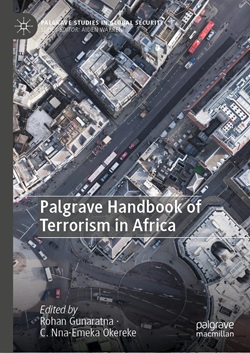
The Palgrave Handbook of Terrorism in Africa, edited by Prof. Rohan Gunaratna and Dr. C. Nna-Emeka Okereke, represents a rigorous scholarly effort to dissect the complex and escalating phenomenon of terrorism across the African continent. Published within the Palgrave Studies in Global Security series, this volume offers a comprehensive and empirically grounded analysis of the structural, socio-political, and transnational dynamics driving terrorist activities in Africa. Comprising twenty-one country-specific case studies, five regional analyses, and a concluding chapter on trends and prognoses, the handbook is distinguished by its thorough examination of terrorism’s evolution, drawing on contributions from African scholars and practitioners. This review evaluates the work’s intellectual contributions, analytical depth, and implications for counterterrorism policy, positioning it as a vital resource for understanding and addressing Africa’s emergence as “the new epicentre of global terrorism” (p. 719).
The handbook’s analytical framework is anchored in a historical contextualisation of terrorism’s trajectory in Africa, tracing its intensification from the late 1990s to the present. It highlights pivotal events such as the 1998 Al Qaeda attacks on US embassies in Nairobi and Dar es Salaam, which resulted in “the death of 224 persons including 12 Americans” (p. 7), and the post-2011 Arab Spring upheavals, particularly the overthrow of Libya’s Gadhafi regime, which “further contributed to the escalation of terrorism across Africa” (p. 17). The text details the proliferation of groups such as Al Qaeda in the Islamic Maghreb (AQIM), Boko Haram, Al Shabaab, and the Islamic State (IS), noting that “the African continent faces more than eighteen active terrorist groups whose collective operations occur in fourteen African countries with another half dozen countries at risk” (p. 7). This spread is attributed to a confluence of structural vulnerabilities, including “porous borders, ungoverned areas, corruption, lack of basic services, poverty and youth bulge, and unconstitutional changes in government” (p. 9), which collectively create a fertile environment for terrorist entrenchment.
A core strength of the handbook lies in its regional and country-specific analyses, which illuminate the diverse manifestations of terrorism across Africa’s five regions: Central, East and Horn, North, Southern, and West Africa and the Sahel. In Central Africa, the text examines how groups like the Lord’s Resistance Army (LRA) and the Islamic State in Central African Province (ISCAP) exploit state fragility, particularly in the Democratic Republic of Congo, where “large areas of territory where formal governments have little influence or presence” (p. 10) serve as terrorist sanctuaries. In East Africa, Al Shabaab’s persistence in Somalia is detailed, despite “multiple counter al Shabaab deployments by the United Nations backed forces of the African Mission in Somalia (AMISOM)” (p. 8). North Africa’s post-Arab Spring environment is marked by the activities of AQIM and IS affiliates in Libya and Egypt, while Southern Africa, previously less affected, now contends with IS operations in Mozambique’s Cabo Delgado region, which “since 2017 assumed centre stage of terrorism attacks” (p. 17). The Sahel, described as a “major terrorism ravaged” region (p. 17), faces violence from groups like Jama’at Nusrat al-Islam wal-Muslimin (JNIM) and IS affiliates, exacerbated by “the state syndrome characterised by weak and ineffective institutions” (p. 17).
The handbook’s contributors provide a penetrating analysis of the socio-political and economic factors sustaining terrorism’s persistence. Porous borders, a legacy of colonial demarcations, enable “fighters, weapons, to easily flow across countries and between regions in Africa” (p. 10), facilitating illicit trafficking that funds terrorism. Ungoverned spaces not only provide safe havens but also allow terrorist groups to fill governance gaps by offering services, leading to scenarios where “several citizens sometimes tend to switch loyalty and allegiance away from the state” (p. 10). Corruption, particularly within security services, is identified as a critical enabler, with the text citing Transparency International’s data that “six African countries are rated as ‘extremely corrupt’ (scores under 20) and another 35 are considered ‘very corrupt’ (scores 20–39)” (p. 11). This pervasive corruption, including “bribery, patronage, nepotism and cronyism, and electoral fraud” (p. 11), erodes public trust, driving disenfranchised populations towards terrorist entities. The socio-economic dimension is equally critical, with the handbook noting that “around 431 million of the 1.2 billion people in Africa were living in extreme poverty” in 2022 (p. 12). This is compounded by a “youth bulge,” where “Africa has a median age of 19.7 years, the youngest population in the world” (p. 13), yet “only about 3 million formal jobs are created” annually against “10 million to 12 million people enter[ing] the labour market” (p. 13).
The handbook’s prescriptive insights advocate for a shift from militarised counterterrorism to holistic strategies. It argues that “governments should work with in the religious, educational, and information domains” to counter extremist ideologies, promoting “moderation, toleration and coexistence” (p. 23). The text also calls for enhanced regional cooperation, urging governments to “build common database, exchange personnel, conduct joint training and operations, share expertise, resources, technology and experience” (p. 23). A notable suggestion, articulated in the foreword by Brigadier General Russell Howard, is to “aggravate [the] competition” between IS and Al Qaeda, whose “different international goals and objectives” (p. 15) could be exploited to disrupt their cohesion. This strategic insight aligns with the handbook’s broader call for innovative counterterrorism approaches tailored to Africa’s unique challenges.
Despite its analytical depth, the handbook has limitations. The breadth of its coverage occasionally results in a somewhat superficial treatment of country-specific nuances, particularly in less-affected regions like Southern Africa. Additionally, while the text excels in identifying causal factors, its policy recommendations, such as fostering regional collaboration, could benefit from greater detail on implementation mechanisms in resource-constrained contexts. The limited focus on non-Islamist terrorist groups, beyond the LRA, also represents a minor gap, given the diverse ideological drivers of terrorism in Africa.
The Palgrave Handbook of Terrorism in Africa stands as a seminal contribution to terrorism studies, offering a robust empirical and historical foundation for understanding the continent’s security challenges. Its comprehensive regional and country-specific analyses, enriched by African perspectives, elucidate the complex interplay of “despair, poverty, hunger, lack of basic services, unemployment, and unconstitutional changes in government” (p. 15) that fuel terrorism. By advocating for collaborative and multi-dimensional counterterrorism strategies, the handbook provides a critical resource for scholars, policymakers, and practitioners. As Africa contends with its status as a global terrorism epicentre, this work’s call for “a deep knowledge and build greater understanding of the developments in the African continent” (p. 23) highlights its enduring relevance in shaping effective interventions.









