


Huawei Technologies has introduced a groundbreaking software tool aimed at reducing China’s dependence on costly foreign high-bandwidth memory (HBM) chips, a critical component for powering advanced artificial intelligence (AI) applications.
The new algorithm, called Unified Cache Manager (UCM), optimizes data allocation across different types of memory—including ultra-fast HBM, standard DRAM, and solid-state drives—to dramatically accelerate inference in large AI models. Huawei executives revealed at the Financial AI Reasoning Application Forum in Shanghai that UCM cut inference latency by up to 90 percent while boosting system throughput up to 22 times during internal tests.
This innovation highlights how Chinese tech companies are increasingly leveraging software advancements to offset limitations caused by restricted access to cutting-edge hardware amid escalating US-China technology tensions. Earlier this year, Chinese startup DeepSeek similarly gained attention for building powerful AI models despite constrained chip availability.
Huawei plans to open-source UCM starting in September, initially through its online developer community before expanding to the broader industry. The move could help China lessen its reliance on HBM chips, a market largely dominated by South Korean giants SK Hynix and Samsung Electronics, alongside US-based Micron Technology.
HBM chips, known for their stacked, high-speed, and low-latency design, are essential for delivering the data throughput AI chips require for optimal performance. The global HBM market is expected to nearly double this year to US$34 billion and reach US$98 billion by 2030, driven largely by the booming AI sector.
However, US export restrictions on advanced HBM products to China—part of a broader strategy under the Biden administration—have complicated China’s semiconductor ambitions. In response, Beijing has aggressively supported domestic memory chip manufacturers such as Yangtze Memory Technologies, Changxin Memory Technologies, and Tongfu Microelectronics.
Despite these efforts, significant gaps remain. Most Chinese firms are still in early production stages for second-generation HBM chips (HBM2), while international leaders like SK Hynix have moved on to fourth-generation HBM (HBM4), offering higher speeds. Furthermore, export controls on advanced semiconductor manufacturing equipment continue to hinder China’s progress.
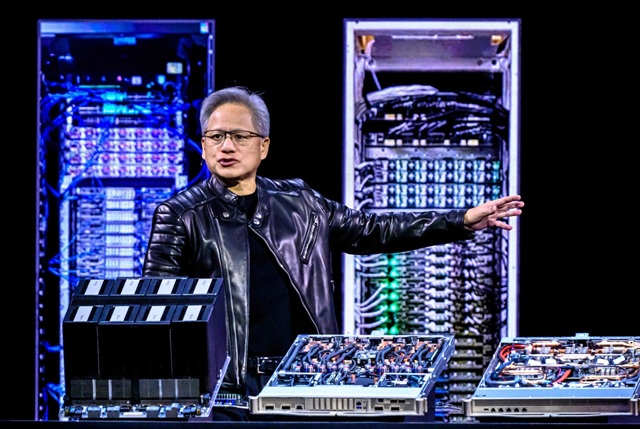
The ongoing tech rivalry also affects major players like Nvidia. The US chipmaker’s H20 AI chip, a downgraded model tailored for China, faces uncertainty amid political tensions, prompting China to encourage local companies to adopt domes-=tic alternatives over products from Nvidia and AMD—especially for government use—citing security concerns.
Despite US sanctions, Huawei remains a key player in China’s semiconductor push, recently unveiling its CloudMatrix 384 AI computing system designed to rival Nvidia’s offerings. Earlier this month, Huawei announced plans to open-source its Compute Architecture for Neural Networks software toolkit, positioning itself as a direct challenger to Nvidia’s dominant software ecosystem.
As tensions between Washington and Beijing persist, Huawei’s UCM algorithm marks a strategic effort by China to boost chip self-reliance through innovation, signaling a shift in the global semiconductor landscape.









