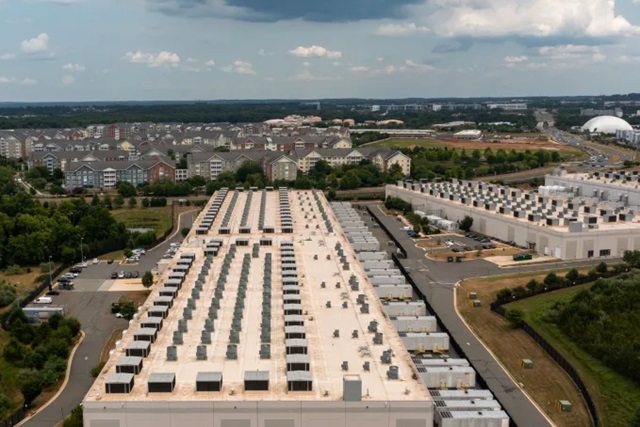
Meta, Elon Musk’s xAI, and OpenAI are racing to build next-generation supercomputers, with projects like “Prometheus,” “Hyperion,” “Colossus,” and “Stargate” each representing investments exceeding $100 billion. Yet the true scale of capital required extends far beyond these headline-grabbing projects: funding the data centres that underpin generative AI is emerging as one of the largest movements of capital in modern history.
“The amount of capital required is absolutely immense,” said Rob Horn, global head of infrastructure and asset-based credit at Blackstone, which manages an $85 billion data centre platform. “The scale of the opportunity is exhausting the capital of [any one financial] market, and is requiring an all-of-the-above approach, with private capital playing a very large role.”
According to industry estimates, Google, Amazon, Microsoft, and Meta will spend more than $400 billion on data centres in 2026, on top of $350 billion in 2025. The AI boom triggered by ChatGPT in late 2022 has transformed data centre construction from a steady cloud and logistics play into a full-blown arms race, with billions poured into servers, chips, and infrastructure.
However, concerns are mounting over overcapacity, long-term profitability, and energy demands. “Lots of people who are trying to build data centres will fail,” said a banker involved in AI infrastructure financing. “We are in that period where the capital markets are crazy enough to throw money at almost anything. I am curious to see the next phase and whether rationality prevails.”
Traditionally, hyperscale cloud providers like Amazon Web Services, Microsoft Azure, and Google Cloud largely self-funded data centre expansion. The scale of generative AI, however, has changed that dynamic. While internal cash flows covered up to $200 billion in data centre spend last year, projected costs are expected to double in 2025 and continue rising, creating a funding gap that investors are rushing to fill.
JLL estimates $170 billion in construction lending or permanent financing will be required this year alone. Between now and 2029, global spending on data centres could reach nearly $3 trillion, with $1.5 trillion expected to come from investors and developers rather than Big Tech’s capital expenditure.
Private equity, venture capital, sovereign wealth funds, and bank loans are increasingly financing these ventures, with debt playing a growing role. Meta, for example, raised $29 billion—including $26 billion of debt—from private investors led by Pimco to fund new data centres in Ohio and Louisiana. Similarly, Oracle’s 2GW data centre in Abilene, Texas, funded by Blue Owl Capital and JPMorgan, will provide 4.5GW of computing power to OpenAI’s Stargate project.
The surge in capital has also transformed the market, with companies like CoreWeave and Crusoe—both former cryptocurrency miners—pivoting to AI data centre operations and attracting multi-billion-dollar investments. “Data centres are just a fraction of the capital needed,” said Horn. “If you have a 1GW data centre, it will cost over $10 billion, but all of the equipment costs another $30 billion plus.”
Despite the frenzy, the rapid pace of development carries risks. Investors are concerned about overbuilding, technological obsolescence, and energy constraints. GPUs, the heart of AI training, can become outdated within years, potentially devaluing assets. “There’s a risk in 10 years you just have a shed with obsolete GPUs and cooling infrastructure that is unfit for purpose,” said an industry insider.
Hyperscalers may weather these risks thanks to their scale, but companies that borrowed heavily to finance build-outs could face severe losses if demand plateaus or forecasts prove too optimistic. As the Financial Times reports, the combination of unprecedented spending, debt-fueled financing, and fast-moving technology has created both immense opportunity and significant uncertainty in the global AI infrastructure race.