A new study reveals that West Germany’s early postwar civil service relied heavily on former Nazi officials, raising questions about the foundations of the young democracy. According to research published in The Chancellery: West German Democracy and the Nazi Past, figures like Friedrich Karl Vialon, a former Nazi administrator deployed to Riga during World War II, transitioned seamlessly into senior government roles after the conflict.
Vialon, whose duties in Nazi-occupied Latvia included confiscating property and supervising forced labourers, faced no consequences for his actions. By 1950, he had been appointed head of the budget department at the West German finance ministry, later advancing to lead the finance and economics unit in Chancellor Konrad Adenauer’s office. Vialon retired in 1966 with a civil-service pension and died in 1990, shortly after the fall of the Berlin Wall.
Historian Gunnar Take, who conducted the first systematic analysis of West German chancellery personnel files, found that of 107 senior officials between 1949 and 1970, 50 were old enough to have served under the Third Reich. Among them, 20 had held mid- or high-ranking posts, ranging from Wehrmacht and Gestapo officers to administrators of occupied territories like Vialon. Another 27 were considered “conformists,” having signalled loyalty to the Nazi regime through party membership or other affiliations. Only three officials had demonstrably resisted or opposed Nazism.
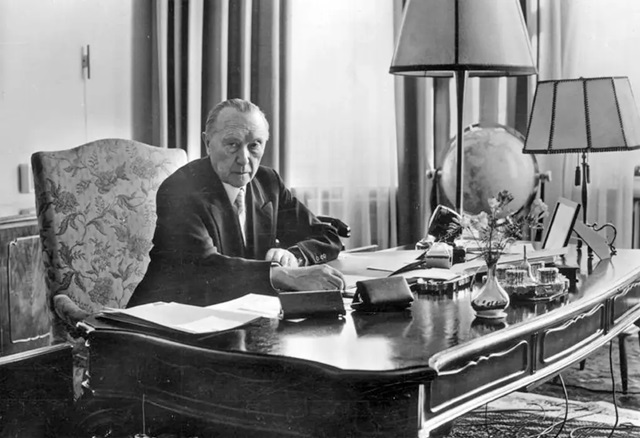
Take’s findings suggest that Adenauer, aided by his right-hand man Hans Globke, deliberately appointed former Nazi-era officials to senior posts. While Adenauer justified these choices as necessary to build a functioning state, the research argues the real motive was securing loyalty and consolidating his power. Many of these officials, Take notes, were socially conservative, Catholic, and upper-middle-class, often from the Rhineland, and their Nazi-era records were frequently obscured during denazification.
Although Vialon faced a belated prosecution in 1969, courts ruled there was insufficient evidence that he had knowledge of mass murders. Take emphasizes that Adenauer’s administration was not attempting to revive Nazi ideology but rather sought stability and control, even at the cost of empowering individuals with compromised pasts—a strategy he likens to modern examples of authoritarian-leaning governance.
The study also highlights broader concerns about the resilience of West German democracy, noting that British officials postwar worried the country could fall back into right-wing extremism. The “economic miracle” of the 1950s, a robust constitution shaped with British input, and historical democratic traditions all contributed to the state’s long-term stability, despite the heavy influence of former Nazis in government.