by Durga Velayudham
When truth falls first to the machinery of war, perhaps beauty must rise first as a whisper of reconciliation.
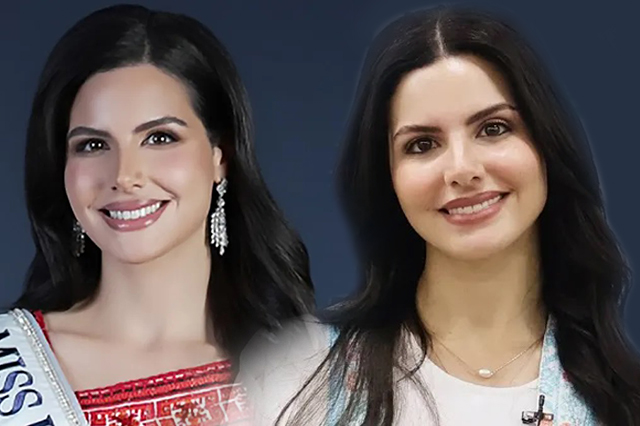
Where borders are etched in memory and mistrust, the Miss Universe stage this year in Bangkok becomes an unlikely domain of encounter. Two women—Nadeen Ayoub of Palestine and Melanie Shiraz of Israel—will meet not merely as contestants seeking a crown, but as embodiments of their nations’ entwined histories, aspirations, and vulnerabilities. Their presence invites reflection on how personal courage and expression can traverse the chasms left by conflict, offering glimpses of shared humanity amid division.
Nadeen Ayoub, 27, carries the distinction of being the first Miss Palestine to enter the competition. She is not merely a figure of elegance but a vessel for her people’s narratives, resilience, and insistence on acknowledgment beyond headlines of suffering. Crowned Miss Palestine in 2022, Ayoub deliberately deferred her international participation to ensure that attention remained on those enduring the violence in Gaza, rather than on herself. Her eventual appearance on the Miss Universe stage is therefore as much an act of advocacy as it is a personal achievement. Through her platform, she seeks to amplify the voices of every Palestinian woman and child whose endurance often remains invisible, embodying a steadfast hope that transcends circumstance.
Melanie Shiraz, crowned Miss Universe Israel in July 2025, represents another facet of commitment: pride, belonging, and connection within her community. An entrepreneur with grounding in innovation, Shiraz envisions her title not as a mere accolade but as a vessel for positive change and mutual understanding. She seeks to demonstrate that representation can extend beyond aesthetics into moral and social spheres, where visibility carries responsibility and the capacity to inspire. While Ayoub speaks from the endurance of adversity, Shiraz articulates aspiration and stewardship within her society. Together, they illustrate how individual presence on an international stage can intersect with the broader tapestry of history, identity, and human ambition.
The juxtaposition of these two women illuminates the complexities of the Israeli-Palestinian conflict in ways that conventional discourse seldom allows. Occupying a stage defined by poise and presence, they become living metaphors for the persistence of hope amid entrenched enmity. Their presence challenges audiences to perceive beyond lines drawn on maps or narratives framed by politics, inviting recognition of the shared dignity, vulnerability, and potential for empathy present on both sides.
Historically, beauty pageants have often been dismissed as superficial exercises. Yet in its contemporary form, Miss Universe has evolved into a platform for cultural exchange, advocacy, and empowerment. Ayoub and Shiraz exemplify this transformation. Here, beauty is inseparable from courage, presence, and narrative; the contest becomes a microcosm of global interaction, where personal history and national identity converge in subtle and meaningful ways.
Their journeys are not without challenge. Ayoub has confronted moral scrutiny for appearing on an international stage amid ongoing conflict, while Shiraz faces the pressures of representing a nation viewed by many as morally contentious. These reactions highlight how individuals can become symbolic surrogates for broader historical and political struggles. Yet both women navigate these pressures with agency and intentionality, asserting that their voices, stories, and resilience are more than instruments of national representation—they are declarations of human dignity.
In choosing to occupy this space, Ayoub and Shiraz transform the pageant into a quiet convergence of witness and reflection. They invite audiences to observe the persistence of hope, the articulation of identity, and the tentative possibility that understanding might emerge where division has long prevailed. Each gesture, each word, carries weight not merely because it is performed, but because it is a testament to survival, selfhood, and ethical clarity amid contested narratives.
As the Miss Universe 2025 contest unfolds, the significance of their presence transcends the trappings of title. This is a moment that reminds us that beauty, in its most profound sense, is inseparable from courage, empathy, and witness. Ayoub and Shiraz illustrate that representation can be a conduit for dialogue, a mirror for reflection, and a subtle instrument for bridging even the most entrenched divides.
In a world where violence and disinformation frequently obscure lived experience, their appearance constitutes a quiet form of resistance and remembrance. Through poise, words, and presence, they insist on recognition for those often reduced to statistics or stereotypes. Their shared stage encourages audiences to look beyond simplified narratives, to encounter the humanity beneath politics, and to acknowledge the enduring pulse of hope that binds communities even amid division.
In the final measure, the Miss Universe stage becomes more than an arena of performance; it becomes a space where dignity, courage, and truth may emerge amidst expectation and tradition. When truth is imperilled by conflict, beauty may serve as an unexpected harbinger of understanding, offering a lens through which empathy, recognition, and the fragile beginnings of reconciliation can be discerned. In Ayoub and Shiraz, the world witnesses not only the resilience of two women but also the enduring possibility that, even amid profound division, acknowledgment of the other and celebration of human dignity can constitute a quiet yet transformative step toward rapprochement.