


A previously undisclosed letter from Chinese President Xi Jinping has emerged as a key factor in the recent thaw of India-China relations, Bloomberg reports, signaling a cautious but meaningful shift in the strategic and economic dynamics of Asia.
According to Indian officials familiar with the matter, Beijing began a quiet outreach to India in March, at the height of U.S. President Donald Trump’s escalating trade war with China. Xi wrote directly to Indian President Droupadi Murmu to test the waters for improving bilateral ties. The letter, Bloomberg reports, expressed concern over U.S. trade deals perceived to harm China’s interests and identified a provincial official to guide Beijing’s engagement, with the message subsequently conveyed to Prime Minister Narendra Modi.
It was not until June, Bloomberg notes, that Modi’s government began taking concrete steps to pursue closer ties with China. At the time, trade talks with the U.S. were becoming increasingly contentious, and officials in New Delhi were irritated by Trump’s claims of brokering a ceasefire between India and Pakistan following four days of fighting in May.
Since then, momentum has built. Last week, India and China agreed to redouble efforts to settle longstanding border disputes, moving beyond the deadly 2020 Galwan Valley clash that claimed 20 Indian lives. Modi is scheduled to make his first trip to China in seven years this weekend, a visit expected to further consolidate diplomatic progress.
Strategic Implications and the U.S. Factor
The rapprochement carries significant implications for U.S. foreign policy. For decades, Washington had cultivated India as a counterweight to an increasingly assertive China. Bloomberg reports that Trump’s abrupt imposition of 50% tariffs on Indian exports, particularly targeting its oil purchases from Russia, disrupted this balance.
Ironically, some analysts suggest that Trump’s confrontational policies indirectly accelerated India-China engagement. “Trump is indeed the great peacemaker — he deserves all the credit for stimulating the incipient rapprochement between Delhi and Beijing,” said Ashley Tellis, senior fellow at the Carnegie Endowment for International Peace, according to Bloomberg. “He has singlehandedly pulled this off by treating India as an enemy.”
Economic Incentives for Rapprochement
Economic considerations have also played a major role in fostering dialogue. China’s economy is slowing and grappling with overcapacity in sectors such as electric vehicles and solar panels, while India’s large and young population represents a growing market. Bloomberg reports that Indian conglomerates, including the Adani Group, Reliance Industries, and JSW Group, are exploring partnerships with Chinese companies, particularly in clean energy and battery manufacturing.
India has also been exploring ways to attract Chinese investment to meet Modi’s goal of increasing manufacturing to 25% of GDP. Bloomberg notes that restrictions and curbs imposed by both sides—ranging from Chinese controls on technology transfers to U.S. tariffs on Indian exports—have constrained growth prospects. Improved ties with China could help offset these pressures.
Incremental steps toward normalization are already visible. Bloomberg reports that direct flights between India and China could resume as early as next month, Beijing has eased curbs on urea exports, and India has begun issuing tourist visas to Chinese nationals after years of restrictions. High-level diplomatic engagement has intensified, with Indian National Security Adviser Ajit Doval and External Affairs Minister Subrahmanyam Jaishankar holding talks with Chinese officials in both 2024 and 2025.
Historical and Political Context
The path to reconciliation has been shaped by decades of territorial and geopolitical disputes. Border tensions date back to the colonial-era McMahon Line of 1914, with subsequent clashes including the 1962 Sino-Indian War, the 1967 skirmishes in Sikkim, the 2017 Doklam standoff, and the 2020 Galwan Valley clash, Bloomberg reports. These confrontations have left lingering mistrust on both sides.
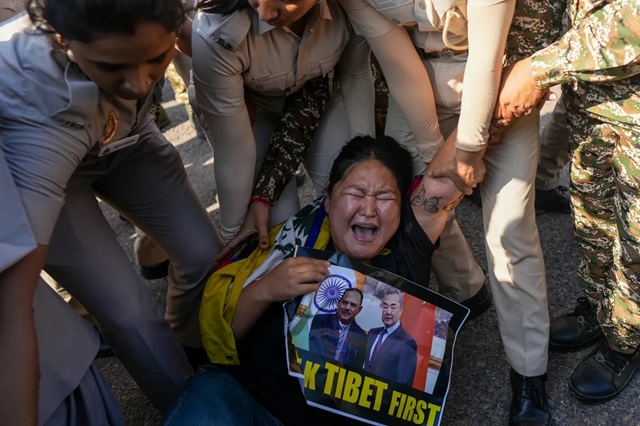
Despite improvements, challenges remain. China’s close relationship with Pakistan, the question of Tibet, and India’s role in the Quad security alliance complicate deeper cooperation. Commercial and people-to-people contacts between India and Taiwan have grown in recent years, adding another layer of complexity in Beijing’s eyes. Analysts caution that normalization will likely be incremental. “China-India relations are on an indisputably positive trajectory, but they are still mostly recovering the losses in their relationship,” said Jeremy Chan, senior analyst at Eurasia Group.
Looking Ahead
Modi and Xi are scheduled to meet on September 1 on the sidelines of the Shanghai Cooperation Organisation summit in Tianjin. While expectations for a major breakthrough within the multilateral forum remain modest, Bloomberg highlights the potential for meaningful side agreements on trade, investment, and border management. Historically, as in the 2017 Doklam resolution, such personal diplomacy has played a key role in de-escalating tensions.
Cui Hongjian, a former Chinese diplomat, told Bloomberg that Xi is likely to maintain a cautious public approach, prioritizing formal mechanisms over personal engagement until bilateral trust improves. Analysts suggest that, while the trajectory is positive, significant economic and political barriers will require careful negotiation and patience on both sides.









