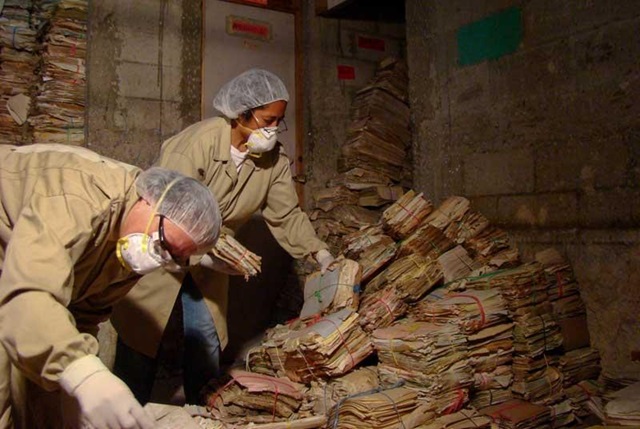
Twenty years ago, a team of human rights investigators in Guatemala made a discovery that would change the course of the country’s reckoning with its violent past. Hidden away in an abandoned warehouse on the grounds of a working police base, they found millions of documents belonging to the now-defunct National Police. With funding from foreign embassies and foundations, guidance from international advisors including the National Security Archive, and support from the government’s Human Rights Prosecutor, these fragile records were rescued, catalogued, and digitised. The result was the Historical Archive of the National Police (AHPN), which became Latin America’s largest public repository of police records and a globally recognised model for historical memory initiatives.
For over a decade, the archive provided unprecedented insight into the Guatemalan state’s role in human rights abuses during the 36-year internal conflict (1960–96). Its records helped illuminate political assassinations, kidnappings, torture, and forced disappearances, and were instrumental in landmark trials that held former military and police officials accountable. The archive also became a vibrant site of memory, hosting cultural events, interreligious ceremonies, and community art projects such as the monumental Angel of Peace and Harmony.
A Promising Start
The archive’s discovery in 2005 occurred against a backdrop of ongoing challenges in post-conflict Guatemala. The country was nearly a decade removed from the 1996 peace accords, and the Historical Clarification Commission had already reported that 93% of documented human rights violations were committed by state forces. Yet, the military and police had largely denied access to their records, making the unearthing of the archive a crucial breakthrough for researchers, prosecutors, and civil society.
Under the leadership of former guerrilla Gustavo Meoño Brenner, a team of dozens worked tirelessly to process and preserve the documents. With support from the United Nations Development Programme (UNDP) and international donors, the archive opened its doors to researchers, officials, and foreign dignitaries, cementing its reputation as both a centre of justice and a living memorial.
The Rise of Threats
However, the AHPN’s prominence and its contributions to human rights prosecutions drew the ire of powerful conservative sectors, including retired military officers and wealthy elites. After Jimmy Morales assumed the presidency in 2016, and with the appointment of Attorney General María Consuelo Porras in 2018, the archive faced severe political hostility. Staff were laid off, the director was forced into exile, and international donors were excluded, leaving the institution financially vulnerable. Although a 2020 Supreme Court ruling affirmed the archive as part of the nation’s cultural patrimony and placed it under the Ministry of Culture and Sports (MICUDE), the AHPN’s independence and operational capacity were significantly diminished.
Reports by Guatemalan civil society groups, including the Association of Friends of UNESCO, show that the archive’s budget plummeted from around $1 million per year in 2016–18 to just $124,000 in 2019–22. Staff numbers fell from 63 in 2017 to 21 in 2023, with crucial investigative teams eliminated entirely. Public use of the archive declined sharply, from nearly 6,000 researchers in 2017 to fewer than 600 in 2022.
On the Ground: 2025
A recent site visit in March 2025 by analysts from the National Security Archive revealed the depth of the AHPN’s current struggles. The archive is difficult to locate, with no clear address, website, or phone contact. Its entrance lies behind a blue gate on a police compound, leading to a building shared with the Department of Investigations and Deactivation of Weapons and Explosives (DIDAE). Inside, empty corridors and sparsely staffed offices stand in stark contrast to the archive’s former vitality.
Only 17 employees remain, including four security guards and one cleaning staff, with just a handful capable of conducting archival investigations. Digitisation continues at a reduced pace, and the public reading room serves few researchers, mostly from government offices. Archivists rely on outdated databases and face overwhelming backlogs of requests for information. Ulda Castillo, the archive’s current coordinator, highlighted that even routine communications and online presence are tightly controlled by the Ministry and the national archives, leaving staff unable to publicise the archive’s work.
A Struggle for Survival
Despite the election of President Bernardo Arévalo in 2023 and the promise of renewed support for human rights, the AHPN remains under-resourced. Political instability, budgetary constraints, and the lack of permanent staffing continue to threaten the archive’s ability to operate effectively. MICUDE officials have acknowledged the need for improvements, but practical support, including ownership of the archive’s buildings and land, remains unresolved.
The National Security Archive, which has long advised and supported the AHPN, underscores the importance of international engagement to protect institutions preserving historical memory. Its report stresses that the archive’s survival owes much to the persistent activism of Guatemalan civil society and international allies, and that renewed public engagement, research, and advocacy are essential to safeguard this crucial repository of truth.
Legacy and Hope
Former staff members, who helped transform a decaying warehouse into a beacon of justice, recall their work with pride. They highlight the archive’s role in empowering victims, informing trials, and keeping the memory of the conflict alive. “Working there was a privilege. When the documents begin to speak…,” one archivist said, trailing off as colleagues nodded in agreement.
The Historical Archive of the National Police remains a treasure of Guatemala’s historical memory. Though presently diminished, its revival and continued protection stand as a testament to the enduring power of truth, civil society, and international solidarity in the face of political adversity.