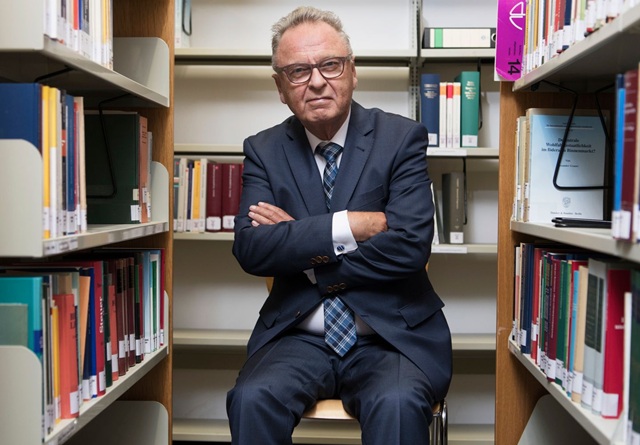
The survival of Western democracies is at risk without fundamental reforms to Europe’s asylum framework, according to Hans-Jürgen Papier, Germany’s former president of the Federal Constitutional Court, The Times UK reports.
Papier, one of Germany’s most eminent legal figures, criticized current rules for allowing what he called “uncontrolled and unconditional immigration,” arguing that the system has become “ossified and rigid” and fails to reflect present-day realities. He called for a radical overhaul of both European Court of Human Rights (ECHR) and national rulings, which have, in his view, expanded the right to asylum far beyond its postwar intent.
The warning comes on the 10th anniversary of Chancellor Angela Merkel’s decision in 2015 to open Germany’s borders to over a million asylum seekers within 12 months, a move that became a turning point in Europe’s migration policies. Since then, Germany has accepted 3.5 million irregular migrants, including around 1.1 million refugees from Ukraine.
While integration outcomes have been mixed—employment rates for the 2015 cohort of working-age asylum seekers now stand at 64%—public frustration has grown over strains on social services and the disproportionate involvement of some first-generation migrants in crime. This discontent has fueled support for the right-wing Alternative for Germany (AfD), which has surged to an average of 25% in recent polls.
Papier suggested that current EU reforms, which aim to tighten borders and redistribute migrants, are insufficient to restore public confidence. He proposed either reforming the ECHR itself or creating a “fundamentally new, precisely formulated law of migration” that limits judicial discretion and restores asylum to the core principles of the 1951 Geneva Convention and the 1953 European Convention on Human Rights.
Among his recommendations, Papier called for electronic asylum visas to pre-screen applicants and for states to have the power to impose annual limits on subsidiary protection—residency permits granted to migrants not meeting full refugee criteria but considered at risk if returned home.
“The citizens expect those with political responsibility to revise asylum policies to suit changed circumstances,” Papier said. “But that is in danger of failing because of the ossification of a body of law that is increasingly rarefied and appears irreversible to many politicians.”
Papier concluded that failure to act threatens public trust in democratic institutions and could endanger the very existence of Western democracies.