


by Our Foreign Affairs Editor
“There was no one like you before, and there will be no one like you after.” These words, spoken by the family of Karina Pritika, hang in the air long after the conversation ends. They are not merely a tribute to one young woman lost to violence but a cry that belongs to hundreds of families, to a nation forced to relive one of its darkest days. Karina, a 23-year-old from Ariel, with her long blonde hair and radiant optimism, was among the hundreds ambushed at the Nova music festival on 7 October 2023. Her life, brimming with movement, music, and dreams, was cut short at Re’im, near the intersection of Route 232 and Route 242, by terrorists driven not by reason but by hatred. Her friends, fellow revelers, and strangers alike were trapped in carnage. She left behind her parents, siblings, and friends—left behind laughter, love, and ambition frozen in time. Her family’s grief and refusal to forget echo the sentiment shared across memorial sites in Israel, where families gather in silence, attempting to stitch together shattered lives with memories.
Yet Karina’s story is only one among hundreds. Each life lost that day carries its own constellation of relationships, ambitions, and unfulfilled futures. The Nova festival, which was meant to celebrate music, community, and freedom, became a theatre of despair. The forests of Be’eri, once alive with song, were drowned in terror. The fields where laughter resonated became fields soaked in blood. This catastrophe etched itself into the land, refusing to fade.
I visited the memorial site at Re’im recently—nearly two years after the carnage. Time, which is often expected to soothe pain, had done little to bring solace. The grief remained unstable—raw, unsettled, and defiant. As I walked through the memorial paths, I was met not by emptiness but by an oppressive stillness heavy with recollection. The trees, their branches shifting gently in the wind, seemed to cradle the sorrow that lingered. The leaves trembled with an almost sentient weight, as if stirred by unseen whispers of anguish. The breeze that brushed past me was not a refreshing caress but a sombre sigh, carrying the memories of cries, footsteps, and silence. The trees stood steadfast, bearing witness not out of choice but out of duty. Their roots, intertwined with the soil heavy with grief, anchored a history that refused erasure.
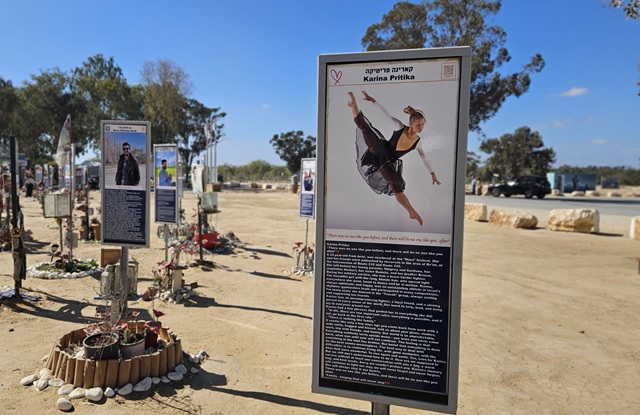
If trees could speak, what stories would they tell? How often must they bear the imprint of human despair, of families that return to sit in silent remembrance, of mothers who trace names on plaques with trembling hands, of children who ask questions their elders dare not answer? How many times must they shudder with the sorrow they cannot dispel? If trees could cry, their tears would fall with every gust of wind, their bark would weep with the memories of each footstep lost to violence. The earth remembers. The trees remember. And so must we.
The tragedy at Nova cannot be viewed in isolation. It forms part of a larger landscape of violence, ideological warfare, and geopolitical strife that has long haunted the region. On the morning of Simchat Torah, thousands of armed militants infiltrated southern Israel from the Gaza Strip. Settlements in the western Negev were attacked without warning. Among them, the Nova festival—an emblem of freedom and youthful exuberance—was desecrated by violence. Hundreds were murdered, dozens kidnapped, and thousands traumatised. In the days that followed, families, artists, and citizens sought ways to honour their dead, to transform spaces of horror into spaces of mourning and remembrance.
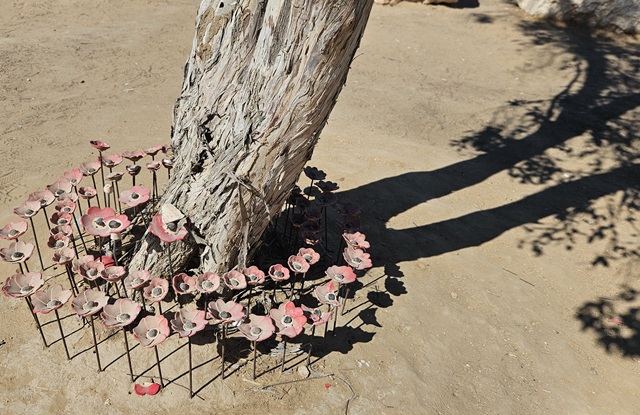
One such profound expression emerged through the artistic initiative “Anemones Before the Rain.” Conceived by artist Yaffa Solomon, this project sought to give form to collective grief through beauty and symbolism. Dozens of thousands of ceramic anemones—each painstakingly handcrafted by volunteers across the country from Dan to Eilat—became vessels of sorrow. Over 15,000 men and women, each carrying personal grief, lent their hands to this act of creation. The red anemones, sculpted from black clay, mirrored the blood spilled on that horrific day. Their journey began at the Dead Sea, the Earth’s lowest point, a metaphor for the profound depth of despair Israel faced from its inception. They were then planted at sites where tragedy struck hardest: Kibbutz Be’eri, Ofakim’s “Circle of Blood,” the remnants of the police station in Sderot, Kerem Shalom, and dozens of other locations across the country.
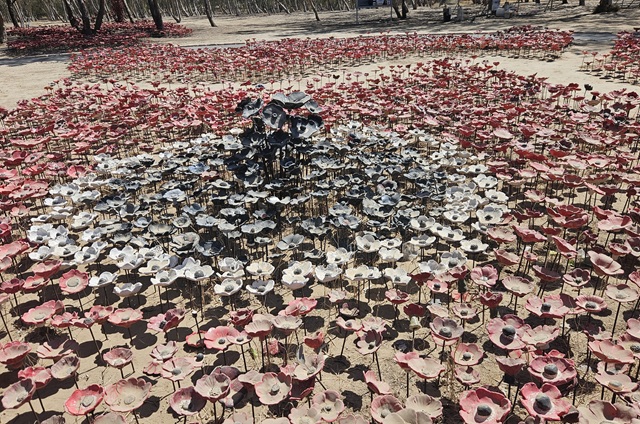
The Nova Memorial Installation, curated by Shlomit Hefer, extended this collective endeavour by weaving together 30,000 ceramic anemones into a sea of red that stretched like a solemn carpet across the grounds. At its centre rose the Star of David—a symbol of unity amid devastation. The paths winding through the sea of flowers invited visitors not merely to witness but to feel, to walk among symbols of empathy, resilience, and renewal. As rain arrives, real anemones bloom among the ceramic flowers—nature’s own healing brush, a testament to endurance and hope even after unbearable loss.
This convergence of artistic expression and collective memory is not only a tribute but an act of defiance against the obliteration of humanity. It aligns with Hannah Arendt’s observation that the banality of evil allows horrific acts to be perpetrated by ordinary people—individuals swept into ideological narratives that numb their conscience. The attackers at Nova did not erupt in rage but carried out their assault with cold precision, a horrifying reminder of how systematic cruelty can masquerade as routine violence. Arendt’s warning that evil often hides in plain sight resonates deeply in this context. The perpetrators were not aberrations but products of environments steeped in hate, manipulation, and despair.
The question this memorial poses is not merely one of justice but of memory and responsibility. How does a society grieve without becoming paralysed by despair? How does it honour the dead without surrendering to bitterness? The ceramic anemones are not relics of pain but conduits of remembrance. They invite mourning without collapse, reflection without resignation. They serve as containers for unprocessed trauma, a collective unconscious where pain is externalised and given shape. The process of crafting and planting becomes an act of catharsis—a shared ritual that transforms helplessness into purposeful grief.
Yet grief, as I experienced at the site, refuses to settle easily. The atmosphere is not one of closure but of ongoing confrontation. The memorial paths, the plaques bearing names, the trees bearing silent witness—all speak of lives interrupted, of hopes crushed mid-flight, of families fractured beyond repair. Even after two years, the landscape remains charged with sorrow, each gust of wind stirring leaves like a restless murmur. The trees do not forget. They are reluctant archivists, pressed into service by nature’s obligation to remember. They absorb, quietly, without complaint, as the bereaved return to whisper into the silence.
The planting of the “Re’im Grove” near the memorial site further exemplifies this conscious act of remembrance. Infrastructure—trails, signage, drinking stations, and private resting places—was built not simply to facilitate visits but to honour the site’s sacredness. The grove, planted in memory of the murdered, stands as both sanctuary and testament, its saplings destined to grow in grief’s shadow.
The biblical lament, “Earth, do not cover my blood; may my cry never be laid to rest” (Book of Job 16:18), seems carved into every stone, every leaf at the site. The call is clear: do not let memory be buried. Do not allow the cries of the fallen to be swallowed by time’s indifference. The memorial is a plea for continuity—a refusal to let their deaths become a footnote in history.
Who would forget, then, if these trees could talk? No one. The trees, the land, and those who stand among them share a responsibility to bear witness. Forgetting would be a betrayal—not only of the dead but of the living who remain haunted by absence. Their silence is not emptiness but endurance. Their swaying branches carry the weight of grief as surely as the hearts of those who visit.
The question is no longer who will forget—but rather, who among us will listen.










