by Our Foreign Affairs Editor
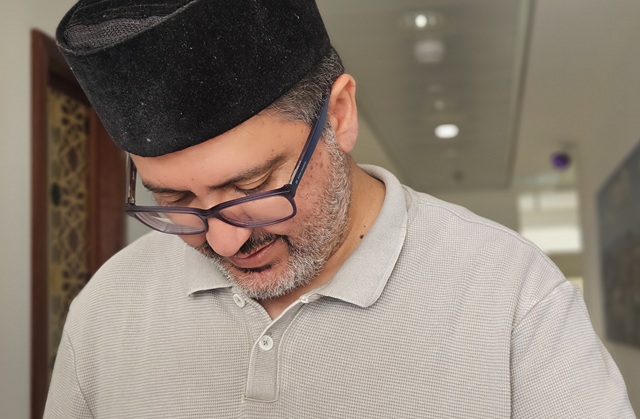
He welcomed us with a charming smile, and with a deep sense of humour, he began by asking a simple yet profound question: “Why do we pray?” The question, though open, immediately drew everyone into reflection. It was not just about ritual or obligation, but about purpose, meaning, and the human connection to God. Muad Oudeh, the General Secretary of the Ahmadiyya Muslim Community in Israel, has a rare ability to combine intellect, humour, and spiritual insight, challenging his audience to think deeply about faith, morality, and the ways in which religion is practiced and misinterpreted.
“Jihad means effort, hard work, struggles, but no war, no killing, no attacking. That’s the Arabic language,” he explained. “So how is the Islamic law or Islamic teachings? We go to the Qur’an and see how God mentioned this concept. Jihad is mentioned 41 times in the Qur’an, but never as a way of attacking or killing people.” He emphasised repeatedly that the common perception of jihad as violent struggle is a distortion, often exploited by extremists. Instead, he insisted, the true meaning revolves around personal effort, moral discipline, and spreading goodness.
He illustrated this with practical guidance: “Do your jihad with the Qur’an, to convince others from the Qur’an, do your debate, your dialogue only from the Qur’an. Do not use any other tool to spread the word of God. Spread the word of God in kindness and care and discuss issues in a respectful manner. This is the way to spread the word of God.” In his view, dialogue, patience, and moral clarity are far more powerful tools than violence or coercion.
Muad then turned to the challenge of dealing with conflict. “Good and evil are not alike. Always repel or face evil with good. And the person you have conflict with or dispute with, treat him or her as your best friend. The question is this: are we doing this today? Do you treat the people you have dispute with or conflict with as your best friend? The answer is what? We don’t. Why don’t we do that? Moral? Painful for my ego. You can’t forget. Ego, pride, excuses… All excuses. I tell you why we don’t do that. I might say something harsh, but don’t get hurt. We don’t do that because we have no faith in God. We don’t trust God. We just believe in God.” His words were delivered with a mixture of frustration and sorrow, reflecting the moral failures he observed in society.
To make this point tangible, he drew a vivid analogy between spiritual guidance and medicine. “When we are sick, where do we go? To the doctor? And he or she gives us medicine or a prescription. We take this prescription to the pharmacy. We buy the pills, take the pills, and by the grace of God, or the doctor, we get better. True? Even if this medicine is not good for my body, I will take it. Why? Trust. Now, imagine I tell you, you must take antibiotics for a week before I fix your teeth. At first, it’s uncomfortable, painful, even counterintuitive, but you do it because you trust the doctor. For me, the doctor is God, and the prescriptions are the holy books: Torah, Bible, Qur’an.”
He explained that divine guidance functions similarly: it may challenge our ego, pride, or immediate desires, but it is intended to heal our moral and spiritual selves. “For me, to treat the person I have a dispute with as my best friend is like taking antibiotics for the ego. But we don’t take it. So we remain sick. And we are a sick society. Morally, religiously, in values. Not as it used to be. We have to go back to God. That’s what God wants us to do.”
Muad shared his own spiritual journey to illustrate the universality of truth across faiths. “When I was in my mid-20s, I was the opposite of religion. I spent two years in a church with a nun, around ten months with a rabbi to learn Judaism, and now I am, in a way, half rabbi, half priest, half imam. One and a half. To see that there is truth in every religion. But today, sadly, we have lost the compass. People do not follow what God truly wants.” His openness to different faiths, combined with a rigorous ethical framework, lent weight to his critique of religious extremism.
He spoke passionately about the distortion of Islam by extremists, highlighting the tragic consequences of misinterpretation. “Our mission today, Ahmadiyya Muslim Community, is to promote true Islamic teachings, based on the Qur’an and the Prophet Muhammad’s teachings. Any interpretation that gives the right to harm people, I don’t take it. I don’t believe God gave me the right to hurt anyone because they are different. Yet, today, people justify violence with religion. They twist words, take verses out of context, and create disasters. They tell young people that if they kill, they will go to heaven and have 72 virgins. This is a misrepresentation. For me, I cry about it. It hurts my religion.”
He explained the critical importance of context in interpreting holy texts. “If you take only two words out of context, you can create disaster. When the Qur’an says to ‘kill yourself,’ it does not mean physically harming oneself. It refers to killing desires, ego, and worldly attachments to become closer to God. But extremists take these words literally, and that is how destruction happens.” His precision and moral clarity highlighted the difference between true religious teaching and the misuse of religion for personal or political agendas.
Muad also addressed the misapplication of Sharia law in non-Muslim countries. “I do not approve. Sharia law does not apply here, or in Sri Lanka, or anywhere where Muslims are a minority. Islam does not allow you to impose it on others. It can only be applied if 100% of the population is Muslim. Otherwise, it creates injustice. Religion cannot be used as a tool to dominate others or to impose unfair rules.” He emphasised justice and fairness as central to Islam, explaining that morality must guide any religious practice.
Interfaith coexistence was another key theme, particularly in Haifa. “Haifa, for me, represents how normal human beings should live. Jews, Muslims, Christians, Baha’is – we live in harmony and peace for a very long time. We care about the city. We are proud Haifanian people. Most of the Ahmadiyya community in Israel live here, about 90% of us, in the town of Kebabir. The town was established in 1850 by my great-grandfather, and today, 70 to 80% of the town is my family. We live together. We respect each other. We are not fighting. That is real holiness – peace, coexistence, and respect.”
He also spoke about the persecution of Ahmadiyyas and the misunderstandings surrounding their beliefs. “The founder believed the Mahdi has arrived. Some Muslims do not accept this. But we do not claim a new prophet after Muhammad. Our purpose is to purify and correct wrong interpretations, not to claim novelty. We are committed to peace and justice, not coercion or violence. Kafir, in our understanding, refers only to those who physically attack Muslims or seek to harm Islam. Anyone else, regardless of faith, is free to live peacefully.”
Throughout the talk, Muad returned to the theme of moral responsibility and trust in God, blending humour, anecdotes, and philosophical reflection. “Religion is science. If you want to connect with me, do 1, 2, 3, 4. Observe. Experiment. Practice. Miracles exist, yes, but heaven and hell are not physical places. Heaven is a state of goodness and moral perfection. Hell is the suffering caused by evil within ourselves. Religion teaches us to fight the evil inside, not harm others.”
He illustrated the absurdity of misinterpretation with humour: “Some extremists tell young people that they will get 72 virgins in heaven. Why 72? Why sex? This is not Islam. We are taught to be humble, to control desires, and to respect others. Taking religion and turning it into a justification for indulgence or violence is a betrayal of faith. It is cheap, it is wrong, and it harms the religion itself.”
Muad spoke passionately about the responsibilities of the Ahmadiyya community. “We are in more than 220 countries. Every member donates financially to the congregation. We do not accept money from governments or outside sources. All positions, including mine as General Secretary, are voluntary. We are ordinary people doing extraordinary work to spread truth, justice, and compassion.”
His reflections on humanity’s failure to follow moral guidance were sobering. “God, I do not believe, wants us to live in this reality of injustice and conflict. It is not God’s mission. But like a father teaching his child, sometimes we do not listen. Eventually, God lets us choose. But the teachings remain. We have to take them seriously, not twist them to suit our ego or desires.”
Muad Oudeh’s message was clear: true religion is about moral clarity, compassion, and dialogue. Extremism, distortion, and literalist misinterpretation betray the essence of faith. He challenged his audience to trust God, treat those in conflict with kindness, and embrace the discipline required to align actions with moral and spiritual truths. “Any interpretation that gives the right to harm people, to hurt people… I don’t take it. Because I don’t believe that God who created this humanity gave me the right to hurt you because you’re different. I don’t believe in this God.”
His words, rich with humour, humility, and moral authority, lingered long after the talk ended. In a world where religion is often misused to justify division and violence, Muad Oudeh offered a compelling vision of faith rooted in reason, empathy, and justice – a call for believers to live not by the letter of texts twisted for convenience, but by the spirit of love, compassion, and moral courage.