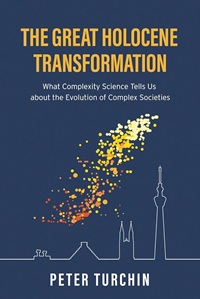
When Hernán Cortés landed in Mexico in 1519, he encountered cities, markets, schools, courts, astronomers, and rulers — institutions strikingly familiar to those he had left behind in Spain. Two civilizations, separated by oceans and millennia, had developed remarkably similar structures. This observation lies at the heart of historian Peter Turchin’s new book, The Great Holocene Transformation, which argues that large-scale societies, from the Aztecs to Europeans, evolved along parallel lines because of shared pressures — especially war.
According to Turchin, more than half of the world’s population in the sixteenth and seventeenth centuries lived in a handful of large societies with strikingly similar political systems. This was not coincidence, he contends, but the outcome of recurrent patterns in human history. His work, rooted in decades of research and the massive Seshat database of archaeological and historical records, seeks to answer what he calls “perhaps the biggest question in historical social science”: how small groups of foragers expanded over 10,000 years into the vast, complex states that dominated the eve of the Industrial Revolution.
The Role of War in Social Growth
Turchin’s central claim is stark: war was the ultimate driver of social complexity. He argues that conflict forced human groups to become “ultrasocial” — bound together in ever-larger collectives capable of surviving in an arms race against rivals. Agriculture and herding were crucial adaptations, enabling societies to sustain bigger populations, but it was persistent warfare that pushed them to centralize, organize hierarchically, and develop bureaucracies.
Religion, in this telling, was not the engine of growth but a by-product, emerging to strengthen cohesion in expanding empires by embedding values of justice, family, and law. This conclusion challenges theories that moralizing religions were the key to large-scale cooperation — a debate that has stirred controversy among cultural historians.
Theories Tested and Retired
Turchin’s analysis dismisses long-standing ideas. Karl Marx’s vision that class conflict drives societies toward complexity, for example, is turned on its head: inequality and internal strife, he argues, actually weaken cohesion and make societies more vulnerable. Similarly, ecological barriers alone cannot explain the rise of empires, though they shaped where conflicts occurred.
Some theories, however, survive largely intact. Economic historian Philip Hoffman’s argument that Europe surged ahead around 1500 due to rapid technological change — from gunpowder to ocean-faring ships — remains persuasive. Turchin adds that this acceleration was itself fueled by pressure from steppe frontiers, where conflict drove innovation.
Data, AI, and the Future of Historical Science
Turchin’s interdisciplinary team draws on archaeology, economics, and computational tools to map these historical dynamics. With vast databases such as Seshat, and the use of artificial intelligence to detect patterns in complex systems, researchers are beginning to see history as governed by feedback loops and nonlinear behaviors — much like ecosystems, markets, or even swarms.
Not all historians are convinced. Many remain wary of attempts to extract “laws” from history, haunted by discredited nineteenth-century theories such as social Darwinism. Turchin acknowledges the resistance but insists that rigorous, data-driven analysis is the way forward, even if it unsettles traditional scholarship.
In one notable case, his team’s conclusion that social complexity predated the rise of moralizing religions sparked fierce pushback. After reanalyzing their data and expanding their models, they stood by the result, though the debate continues.
A Transparent but Controversial Vision
With The Great Holocene Transformation, Turchin offers a sweeping explanation of how humanity’s societies grew from bands of foragers to sprawling empires. His emphasis on war as the “ultimate social technology” is both provocative and unsettling. By making his methods and data explicit, he aims to persuade skeptics — though his reliance on equations and quantitative models may further alienate conventional historians.
Still, the book represents the culmination of two decades of work and a bold attempt to make sense of 10,000 years of human history. Whether or not one accepts his conclusions, Turchin’s vision underscores the growing role of data and computational analysis in rewriting our understanding of the past — and perhaps, in predicting the future of societies.