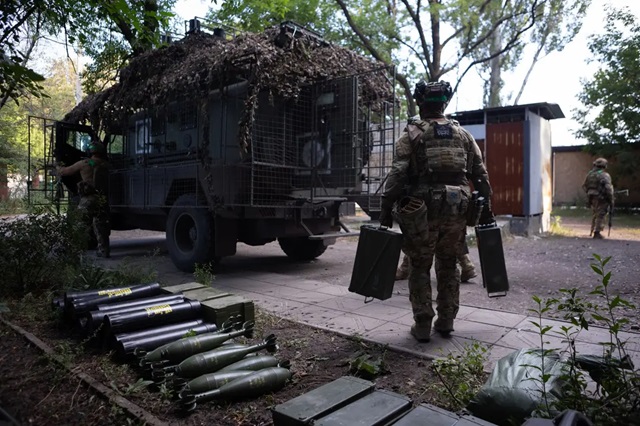
Ukraine has defied expectations and is effectively winning its war against Russia, according to historian, philosopher, and author Yuval Noah Harari writing in the Financial Times. Harari’s analysis highlights how Ukraine’s resilience, tactical ingenuity, and the will of its people have so far neutralized Russia’s vast military advantage.
Even former US President Donald Trump, who in February 2025 had lectured Ukrainian President Volodymyr Zelenskyy to concede to Russian demands, recently acknowledged the country’s progress, stating, “Ukraine, with the support of the European Union, is in a position to fight and WIN.”
When Russia first invaded Ukraine in 2014, Kyiv seemed powerless. Crimea and several regions in eastern Ukraine fell with little resistance. The war escalated dramatically on February 24, 2022, when Russia launched a full-scale assault aimed at subjugating Ukraine and ending its independence. Global observers, and even Western allies, expected Kyiv to fall within days. Plans to evacuate President Zelenskyy and establish a government in exile were reportedly considered—but Zelenskyy refused. “I need ammunition, not a ride,” he famously told American officials.
Ukrainian forces stunned the world by repelling Russia’s assault on Kyiv. By late summer 2022, they had launched a counter-offensive, securing decisive victories in Kharkiv and Kherson, and liberating much of the territory initially lost. Since then, despite minor gains on both sides, the frontline has remained largely static. Russian claims of relentless advancement contrast sharply with reality: since spring 2022, Russian forces have failed to capture any strategically significant city.
By 2025, the human cost for Russia has been staggering. Between 200,000 and 300,000 soldiers have been killed or injured, while Moscow controls only a sliver—approximately 0.6%—of Ukraine’s territory. At the current rate, it would take Russia roughly a century and tens of millions of casualties to occupy the entire country. In fact, Russian-held territory in Ukraine has shrunk compared to August 2022.
The situation has drawn comparisons to the Western Front of World War I, where generals sacrificed tens of thousands of soldiers for minimal territorial gains. Historian Toby Thacker has noted that wartime maps often exaggerated advances through scale rather than substance—a tactic mirrored in Russian reporting of minor “successes.”
Ukraine’s military strategy has emphasized tactical retreats, preserving manpower while allowing Russia to exhaust itself on costly offensives. As retired Australian Major General Mick Ryan recently observed, “Imagine more than three years after invading Iraq in 2003, the US had only captured 20% of the country while sustaining 1 million casualties. Would anyone call that a victory?”
Ukraine’s successes extend beyond land battles. On February 24, 2022, Russia’s Black Sea Fleet had near-total naval dominance. Yet, Ukrainian forces recaptured Snake Island by June 2022, sinking the flagship Moskva and numerous other vessels. By employing innovative drones and missiles, Ukraine neutralized Russian naval superiority and forced the fleet into defensive harbors.
In the air, Russia has failed to achieve dominance. Unlike Israel’s rapid aerial campaign in Iran in June 2025, Russia’s air force has suffered crippling losses, including strategic bomber strikes in June. Ukrainian drone strikes have also demonstrated remarkable precision, targeting Russian airfields and oil refineries hundreds of kilometers from the front.
Remarkably, these victories have been achieved without direct military intervention from outside forces. While NATO countries have provided weapons and logistical support, only North Korea has sent troops to fight alongside Russia. Restrictions on sophisticated weaponry and some operational limits remain in place, meaning Ukraine’s victories at Kyiv, Kharkiv, and Kherson were won with relatively limited equipment. Harari argues that with full support from the start, Ukraine might have concluded the war years earlier.
The conflict’s weakest point lies not on the battlefield but in perception. Russian propaganda aims to weaken Western resolve, encouraging the US and European nations to withdraw support. Harari warns that succumbing to these narratives would not only endanger Ukraine but also undermine NATO credibility and Europe’s own security.
Europe now faces a stark reality: should Russia strike the continent and the US remain neutral, Ukraine’s 1 million experienced soldiers would be the most formidable fighting force standing between Russian troops and European capitals. Poland, Germany, and France each maintain armies of roughly 200,000 largely untested troops, making Ukraine’s battle-hardened forces a critical strategic asset.
Ukraine’s innovations, particularly in drone warfare and data-driven military strategy, have positioned the country as a global leader in modern combat techniques. Harari notes that this may explain shifting attitudes in Washington, with leaders increasingly supporting Ukraine’s resilience and capabilities.
Ultimately, Harari emphasizes that war is a continuation of politics by other means. Russia has failed in its primary objective: the destruction of Ukraine as a nation. President Vladimir Putin’s long-held claim that Ukraine is not a “real” nation has been disproven on the battlefield. Millions of Ukrainians have demonstrated an unwavering commitment to independence, forging a national identity strengthened by the memory of invasion and sacrifice.
“Nations are not built from land or blood alone,” Harari writes. “They are made of stories, images, and collective memories. No matter how the war unfolds, the Ukrainian spirit will endure for generations.”