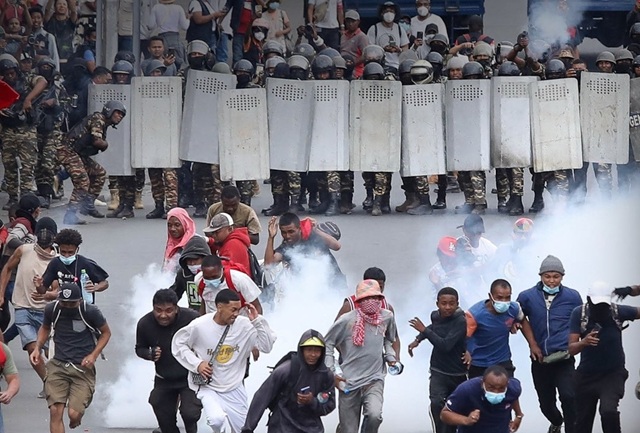
On October 6, President Andry Rajoelina appointed Army General Ruphin Fortunat Zafisambo as prime minister, replacing Christian Ntsay (2018-September 29, 2025), to quell escalating mass protests in cities like Antananarivo, Toliara, and Antsiranana in Madagascar. President Rajoelina dissolved the government on September 29, 2025, sacking Prime Minister Christian Ntsay and removing the Energy Minister on September 26, 2025, in response to the protests.
The protests crystallized on September 25, 2025, with severe water and power outages lasting up to 12 hours daily. The unrest stemmed from chronic failures of Jirama (Jiro sy rano Malagasy), Madagascar’s state-owned electricity and water utility company. Established in 1975, Jirama struggles with underinvestment, outdated infrastructure and corruption allegations, with only one-third of Madagascar’s 30 million people accessing electricity and fewer enjoying reliable water. Jirama has a history of graft, including a 2024 case where the Bureau of Independent Anti-Corruption (Bianco) uncovered overpriced generators bought via a shell company, leading to arrests of executives and consumer representatives for embezzlement and abuse of office. Earlier incidents, such as the 2020 arrests of former directors and 2022 deficits for mismanagement, diverted funds from infrastructure, worsening outages amid low dam levels and dry seasons. These service failures, worsened by funds reportedly siphoned off by elites, ignited the largest protests in 15 years, challenging Rajoelina’s rule since his 2023 re-election.
Earlier, on 15 September 2025, Transparency International, a global non-governmental organisation that promotes government accountability and transparency, organised a small rally known as “Democrasia Mainty” in Ambohijatovo, Antananarivo.
On September 18, 2025, politicians Clémence Raharinirina and Baba Faniry Rakotoarisoa urged citizens to stage mass protests outside the Senate in Anosy, condemning persistent power outages, water shortages, and widespread corruption in public utilities.
According to the United Nations High Commissioner for Human Rights (OHCHR), at least 22 people have been killed and more than 100 injured since the mass demonstrations began.
The protests, spreading to eight cities, were driven by a youth-led, decentralised movement coordinated via the Gen Z Madagascar Facebook page, which amassed over 100,000 followers. Using anime-inspired symbols from One Piece and slogans like “Tsy Manaiky Lembenana” (“We Refuse to Be Trampled”) and “Leo Delestage” (“Fed Up with Load Shedding”), protesters demand Rajoelina’s resignation, institutional reforms, and reliable services. Opposition leaders Raharinirina and Rakotoarisoa rallied students and unions, decrying unequal education access and systemic poverty.
The World Bank estimated that, in 2022, 75 per cent of the country of 30 million lived under the poverty line, and per capita income was down 45 per cent since 1960; and systemic issues like corruption and elite control persist. Only one-third of the population accesses electricity, hindering education and livelihoods. It ranked 177th on the Human Development Index and 130th in the 2025 World Happiness Report (score: 4.157/10). Madagascar faces multidimensional poverty worsened by cyclones, droughts, and sluggish growth (projected at 4.7 per cent for 2025-2027).
Historically, Madagascar’s unrest since independence in 1960 reflects governance failures and economic stagnation. The 1972 student-led protests ousted President Philibert Tsiranana, while the 1991-1993 demonstrations toppled Didier Ratsiraka’s one-party state. The 2001-2002 electoral crisis saw Marc Ravalomanana’s supporters force Ratsiraka into exile. In 2009, Rajoelina, then mayor, led a coup-like takeover against Ravalomanana, with over 130 deaths and economic collapse. Protests in 2018 and 2022 over electoral laws and cost-of-living issues faced repression, underscoring Rajoelina’s authoritarianism.
These protests mark a shift from elite-driven crises to a digitally fueled, leaderless movement. Curfews, looting by unaffiliated gangs, and goons targeting politicians’ properties complicate peaceful efforts, while pro-Rajoelina counter-protests and mediation by the Council of Christian Churches (FFKM) urge restraint. Unlike the 2009 coup that brought Rajoelina to power, these uprising leverages social media and demonstrated systematic institutional failure in Madagascar. The movement’s demands for transparency and reform challenge a system stifled by an unaccountable elite.