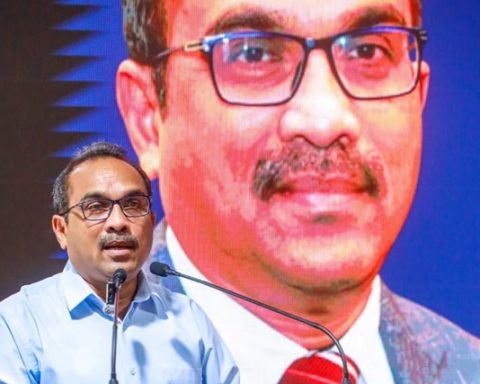
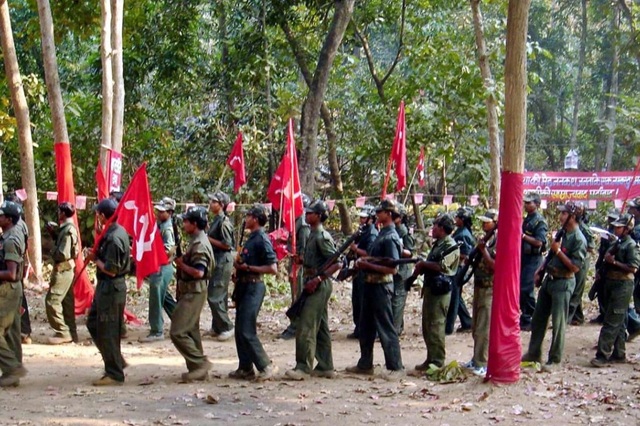
The surrender of Mallojula Venugopal aka Abhay aka Bhupati aka Master aka Sonu (69), a ‘Politburo’, ‘Central Committee (CC)’, and ‘Central Military Commission (CMC)’ member who served as official ‘spokesperson’ of the Communist Party of India-Maoist (CPI-Maoist), on October 15, 2025, in Gadchiroli, Maharashtra, marks a decisive ideological and operational rupture within the CPI-Maoist hierarchy. His exit, accompanied by 60 other cadres, including zonal and divisional committee members, constitutes a major psychological and structural blow to the insurgency. Venugopal , once the party’s principal ideologue, was among the last four surviving Politburo members, and had significant influence over both armed cadres in the Dandakaranya region and sympathisers in urban networks.
This comes just months after the death of Namballa Keshava Rao aka Basavaraju aka Ganganna aka Krishna aka Vijay aka Prakash (70), the ‘general secretary’ of the party (the highest executive post), a ‘Politburo’, a ‘CC’, and a ‘CMC’ member, in May 2025, and follows a series of high-level eliminations, including ‘CC’ members Katta Ramachandra Reddy and Kadari Satyanarayana Reddy, indicating a sustained decapitation strategy by Security Forces (SFs).
Venugopal ‘s surrender was not merely tactical; it was a profound strategic and ideological shift. Once a staunch proponent of armed struggle, Venugopal ‘s transformation began after an internal schism within the CPI-Maoist. His now-public letters advocating the cessation of armed conflict were met with denunciations from the party’s ‘CC’, labelling him a “traitor.” These letters, alongside his wife Vimala Sidam aka Tara’s surrender in January 2025, signalled his waning faith in the revolutionary cause.
The Maharashtra Police facilitated his surrender through the Intelligence Cell and C-60 commandos, under a relatively well-regarded surrender and rehabilitation policy. Key to his decision was an emotional letter from Anil, a former comrade, who detailed the futility of continued violence and the opportunity for reintegration and dignity within the constitutional framework.
Just a day after Venugopal laid down arms, 50 Maoist cadres from Abujhmad surrendered before the Border Security Force (BSF) in Kanker District, Chhattisgarh. The group included senior Dandakaranya Special Zonal Committee (DKSZC) members Rajman Mandavi and Raju Salam, alongside five ‘divisional committee members (DVCMs)’, 21 ‘area committee members (ACMs)’, and 22 party members. A significant number were women (32 of 50), and 39 weapons were surrendered, including AK-47s, INSAS (Indian Small Arms System) assault rifles, a Light Machine Gun (LMG), and a Barrel Grenade Launcher (BGL).
The significance of this mass surrender extends beyond statistics. Abujhmad, or Maad, once the CPI-Maoist’s proclaimed liberated zone, has seen over 100 Maoists neutralised since the launch of the ‘Maad Bachao Abhiyan’ in 2024, symbolising the rollback of militant dominance in the most impenetrable terrain. From an operational perspective, Venugopal ‘s surrender is expected to result in further intelligence yields, particularly about urban sleeper cells and financing channels. His depth of knowledge and ideological stature makes him an invaluable source for deconstructing the Maoist propaganda ecosystem. Intelligence sources have already indicated that at least another 100 cadres are likely to surrender in the Maad-North Bastar belt in the coming months.
Strategically, this development accelerates the erosion of the Maoist command structure. The remnants of the leadership, current ‘general secretary’ Thippari Tirupathi aka Devuji aka Devji aka Deoji aka Sanjiv aka Sanjeev aka Chetan aka Ramesh aka Kumma aka Shankar aka Sheshu aka Jagan aka Sudharshan aka Devanna (60), and Madvi Hidma aka Santosh, the youngest ‘CC’ member of the CPI-Maoist and ‘commander’ of the People’s Liberation Guerrilla Army (PLGA)’s 1st Battalion, lack Venugopal ‘s ideological heft and are predominantly military tacticians. The movement, increasingly fragmented, risks devolving into a disoriented militant survivalist force, devoid of coherent direction or mass support.
The Union Ministry of Home Affairs (UMHA)’s latest figures show that Left-Wing Extremism (LWE) is now confined to just 11 districts, with only three (Bijapur, Sukma, and Narayanpur) considered “most-affected”. This is a stark decline from 126 affected districts in 2013. In 2025 alone, according to SATP, 333 Maoists have been killed, 398 arrested, and 1,351 have surrendered.
The cumulative impact of decimated leadership, enhanced security penetration, and ideological fatigue is evident. With the March 31, 2026 deadline set by Union Home Minister (UHM) Amit Shah to “end Naxalism“, the trajectory of the insurgency points toward terminal decline, though residual violence and splinter activity may persist.
Venugopal ‘s surrender is both symbol and substance: the fall of an ideologue who once shaped revolutionary discourse, now embracing the constitutional path. It is, perhaps, the beginning of the end of the CPI-Maoist as an ideologically coherent and strategically potent insurgent force.