


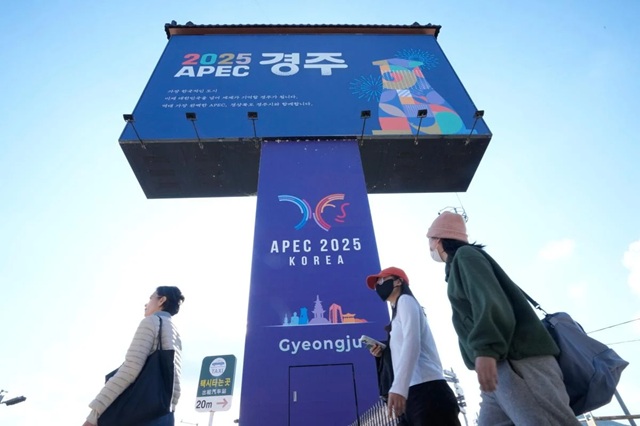
Asia-Pacific leaders concluded the annual APEC summit in South Korea on Saturday with a joint declaration emphasizing the need for resilient and mutually beneficial trade, amid mounting fractures in the global trading system. Rising geopolitical tensions, from U.S. tariffs to Chinese export controls, have pressured trade across the region and challenged the established multilateral order.
As reported by Reuters, the summit unfolded under the backdrop of U.S. President Donald Trump’s recent trade deals with several countries, including China and South Korea, although he departed before the summit formally began. Analysts noted that the declaration notably omitted references to multilateralism or the World Trade Organization, signaling acknowledgment among member states that restoring a free trade system under the old multilateral framework may be increasingly difficult. Heo Yoon, a professor of international trade at Sogang University in Seoul, commented, “We cannot deny anymore that there is a paradigm shift in the global trade order.”
China moved to assert itself as a steady advocate for free and open trade, a role traditionally dominated by the U.S., with President Xi Jinping announcing that China will host APEC in Shenzhen in 2026. Yet, analysts caution that the declaration reflects a careful balancing act, avoiding portraying the U.S. as undermining trade or China as the new guardian of multilateralism. “Few countries believe there can be a new trade order that excludes the U.S.,” Heo said.
The summit also highlighted the complex diplomatic positioning of South Korea under President Lee Jae Myung. Lee, who assumed office in June, hosted both Trump and Xi during the summit period, navigating the delicate balance between Seoul’s security dependence on the U.S. and its economic ties with China. Ahead of his meeting with Xi, Lee emphasized the need for cooperation that benefits both countries and acknowledged that relations between Seoul and Beijing have never been fully normalized.
Key regional issues, including North Korea’s nuclear program, remained on the agenda. Pyongyang dismissed the denuclearization discussions as an unrealistic “pipe dream,” even as U.S., Chinese, and South Korean leaders explored potential avenues for diplomatic engagement.
In addition to trade and security issues, the summit addressed emerging technologies, with Xi proposing a World Artificial Intelligence Cooperation Organization. Declarations on demographic change and AI were adopted, though no regulatory framework for artificial intelligence was discussed.
The outcome of the APEC summit illustrates the evolving dynamics in the Asia-Pacific, as nations navigate competing pressures from Washington and Beijing while seeking to maintain stable trade flows and regional security. According to Reuters, the event highlighted both the fragility and adaptability of the current global trade order, signaling a shift toward pragmatism over strict multilateralism.









