


by Durga Velayudham
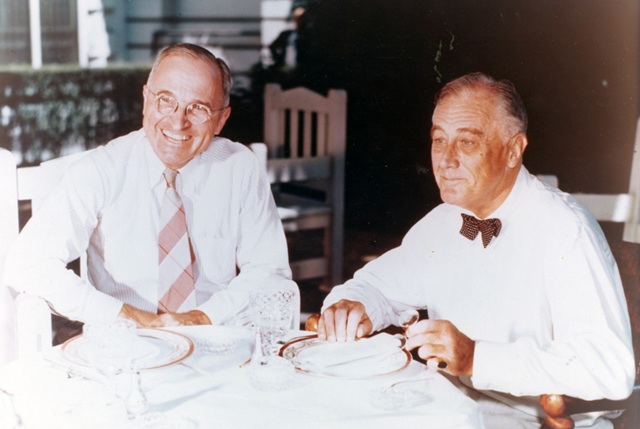
When Harry S. Truman assumed the presidency on April 12, 1945, it was not simply as Roosevelt’s successor: it was as the man left in the wake of FDR’s monumental shadow. What followed in the months after was not merely a transition, but a profound and bitter cleansing of Roosevelt’s confidants. Within just a few months—or, in some cases, within a year—Truman systematically removed or marginalized nearly everyone who had been closest to Roosevelt: senior cabinet members, trusted advisors, civil servants, and veteran White House operatives. His purge, driven by more than mere administrative necessity, revealed a political leader desperate to assert his independence, shield his authority, and erase the specter of a predecessor too big to forget.
At the heart of Truman’s purge lay a deep resentment: he believed Roosevelt’s people mistrusted him, undermined him, and—worst of all—saw him as a placeholder rather than a legitimate president. According to his military aide, General Harry Vaughan, Truman complained bitterly: “They … all think I’m some country bumpkin from Missouri … They don’t respect me, they don’t trust me, and frankly, I don’t trust them either.” In his eyes, their loyalty was not to the office but to Roosevelt himself—to his memory, his legacy, even his ghost. That, for Truman, was unacceptable. This was more than a power grab. It was deeply personal.
The purge began swiftly but thoughtfully. Though some removals came later (like Henry Wallace, who stayed until September 1946), Truman began laying the groundwork almost immediately. Wallace—former Vice President and then Secretary of Commerce—embodied everything Truman distrusted about Roosevelt’s circle: idealism about the Soviet Union, a tendency to invoke Roosevelt’s judgments, and a loyalty to a bygone administration rather than to the new president. Truman saw Wallace’s constant evocation of Roosevelt as a deliberate challenge: a refusal to recognize that power had shifted.
Other key figures were dealt with even more decisively. Frances Perkins, Roosevelt’s long-serving Secretary of Labor and the first woman in an American Cabinet, was asked to step aside by June 1945. Truman made it clear he wanted someone aligned with his priorities, not someone constantly looking back to Roosevelt. When Perkins would remind him of what FDR might have done, Truman snapped: “President Roosevelt is dead … I am the President now.” That blunt declaration stripped away any illusion that Truman would govern as an extension of Roosevelt; he was not caretaker, but captain.
Henry Morgenthau Jr., Roosevelt’s Treasury Secretary and one of his most trusted advisors, was told plainly that his time was up. Truman reportedly said: “You were Roosevelt’s man. You’re not my man. I need people around me who will implement my policies, not spend their time telling me what Roosevelt would have done.” Morgenthau, stunned, had no choice. His resignation, accepted with little empathy, was a tableau of Truman’s brutal calculus: loyalty mattered more than experience, even more than friendship.
Francis Biddle, Roosevelt’s Attorney General, was dismissed in a public humiliation. Truman allowed word of his departure to leak through the press. When Biddle confronted him, Truman’s response left no room for performance: “You were Roosevelt’s attorney general, and I need mine.” No overt criticism of Biddle’s performance; just a cold, almost transactional severing. It was a statement: proximity to Roosevelt, not competence, was now the disqualifier.
One of the most symbolic figures to be purged was Admiral William “Bill” Leahy—Roosevelt’s Chief of Staff and closest military advisor. During Roosevelt’s presidency, Leahy had carried significant institutional weight. But Truman gradually marginalized him: shutting him out of vital postwar planning sessions, making key decisions without consulting him, and eventually stripping him of real influence. Leahy, in his private reflections, later wrote that Truman “made clear that he did not want advice from anyone associated with President Roosevelt … He seems to view us all as obstacles rather than assets.” Leahy’s removal was less about policy disagreement and more about symbolism: closeness to Roosevelt had become a political liability.
Beyond these marquee removals, Truman set his sights on career civil servants. Officials who had served Roosevelt with loyalty and skill—names often unknown to the public—were reassigned, pressured to retire, or relocated to obscurity. Edward Stettinius Jr., who had been Roosevelt’s Secretary of State in the final months, was replaced by Truman ally James F. Byrnes. Harry Hopkins, FDR’s most trusted personal emissary, quietly left, citing health. Sam Rosenman, Roosevelt’s speechwriter and counsel, resigned when Truman made it clear he was no longer welcome. The message was unmistakable: if your political heart still beat to Roosevelt’s rhythm, your days in the Oval Office or its orbit were numbered.
Why did Truman go to such lengths? The publicly stated justification was simple: he needed a team loyal to him. But privately, the motives ran deeper and more bitter. From his vantage, Roosevelt loyalists had been complicit in keeping him in the dark while FDR’s health deteriorated. In his private reflections, Truman criticized how Roosevelt had allowed things to “sprawl … and then tried to control and manipulate the jumble … in complicated ways,” a style he believed had left dangerous ideological residue in his administration. He feared not just incompetence, but sabotage: that some of those holdovers were actively plotting to guide, constrain, or even dominate his presidency from the shadows.
These suspicions were not entirely unfounded, in Truman’s mind. He believed some holdovers were meeting privately, plotting how to influence him, preserve Roosevelt’s policies, and even engineer pressure via the media or Eleanor Roosevelt herself. According to his aides, he demanded a full list of people in FDR’s inner circle—everyone who “had his ear … everyone who met with him regularly.” Then came his directive: “I want them out. … They’re finished.” Whatever risks he incurred by purging experience, he believed they were outweighed by the danger of a rival power center loyal to someone already gone.
His private writings amplify just how personal the purge was. In his memoirs and personal papers (as collected in Off the Record: The Private Papers of Harry S. Truman), Truman reflected bitterly on what he saw as lingering New Deal dogma among his staff. He wondered aloud why “people must stick in the old regime’s ways” and whether the “old New Dealers” would ever accept his leadership. That distrust was ideological: this was not merely a generational shift, but a battle for the soul of governance. More bluntly, he insisted, “I do not know any better … I consider myself ‘the Boss,’ no matter what.” For Truman, the presidency was not just an office; it was his personal dominion, and he would brook no rival to his command.
The purge came at a cost. Roosevelt had governed for more than a decade; his aides held not only institutional memory but diplomatic connections, informal understandings, and unspoken leverage in global affairs. By ousting them so thoroughly, Truman discarded that reservoir of wisdom. In the fraught early months of his presidency, when the world was reeling from war’s end, he opted not for continuity but for control. Mistakes were inevitable; lessons that veterans of FDR’s regime could have offered may have been lost.
Moreover, the purge set a dangerous precedent. It framed bureaucratic loyalty in intensely personal terms: service to one man—Roosevelt—was now a liability. Truman’s logic suggested that the highest virtue in government officials was not expertise or institutional commitment, but a personal bond with the president. That kind of loyalty test is deeply corrosive: it risks turning government into a locus of personality, rather than principle.
Truman, for his part, seemed unshaken. When later asked why he had removed so many Roosevelt loyalists, he offered a devastatingly simple explanation: “I couldn’t trust them. They were loyal to a dead man, not to me … They thought I was inadequate and tried to manipulate me. So I got rid of them … Simple as that.” Whether this exact phrasing reflects his published or private record (it appears in retrospective accounts and oral histories more than in his own early diaries), it captures the spirit of his resolve.
In his private papers, the bitterness is even more raw. He wrote of firing yet more of “Roosevelt people” and described their shocked expressions—“like they thought they were entitled to stay forever just because Roosevelt had liked them.” He insisted, with fierce independence, “this is my administration now … Roosevelt left me nothing but problems and people who think I’m not smart enough … Well, I’m solving them my way.” Such personal dominion, expressed with such emotional weight, shows how deeply Truman viewed the presidency as his to define—and whom he would allow to remain under his watch.
Truman was not blind to the perils of dissent, and he was not merely purging for power: he was purging out of fear. His private reflections suggest he saw any institutional base for a rival ideology—even if loyal, competent, and patriotic—as a threat. He believed that continuity with Roosevelt’s circle might mean a perpetual whispering campaign, bureaucratic undermining, or ideological sabotage. By dismantling it, he asserted control, but he also crippled a system of shared understanding that he might one day have needed.
There is a tragic irony in all this. By casting off Roosevelt’s loyalists so completely, Truman may have weakened his own ability to govern wisely. He rejected people who had navigated him through the war, worked with foreign leaders, and understood the complex world FDR had helped shape. In replacing them, he chose loyalty over wisdom, personal trust over institutional memory. That decision carried real costs—for policy, diplomacy, and governance.
Yet from Truman’s vantage, the cost was justified. He believed that to have governed under the shadow of the past was not just to risk paralysis—it was to risk betrayal. In his mind, those who remained loyal to Roosevelt might never serve him fully. He needed a clean slate, a government built on his terms, populated with people whose first allegiance was to him, not to a ghost.
Truman’s purge also foreshadowed broader political trends. His fear of disloyalty was not an isolated paranoia but part of a pattern: in 1946, he established the Temporary Commission on Employee Loyalty, which laid the groundwork for Executive Order 9835 in 1947—putting in place a formal federal loyalty program. The logic was consistent: in the aftermath of total war, partisan transition, and global uncertainty, loyalty tests became a mechanism not just for control, but for survival. It was a world in which the personal and the political were inseparable—and Truman was determined his government would reflect that.
In the end, Truman’s purge of Roosevelt’s circle was one of the boldest, most controversial acts of his early presidency. It was not just a staffing decision: it was a declaration of independence from the Roosevelt legacy. It was a deeply personal act of political violence, one rooted in insecurity and resentment as much as authority. And it left a complicated legacy: on one hand, it established Truman’s control and autonomy; on the other, it hollowed out a well of institutional knowledge and trust.
Was it necessary? That depends on whom you ask. From the vantage of raw power, Truman’s solution was elegant: cut away the parts that threatened to outlive you. But from the vantage of governance, it was reckless: because in politics, unlike business, the wisdom of experience can be just as valuable as the certainty of loyalty.
Truman believed he was building a presidency of his own making—and he purged to make sure that no one could still serve FDR from within his own administration. But in doing so, he also discarded the living memory of Roosevelt’s stewardship, weakening his capacity to draw on the experience of a bygone era. His purge stands as a testament to the bitter truth that in politics, the past is not always an ally—and that absolute authority often demands the erasure of legacy.









