“Nothing happens. Nobody comes, nobody goes. It’s awful.” ~ Samuel Beckett, Waiting for Godot
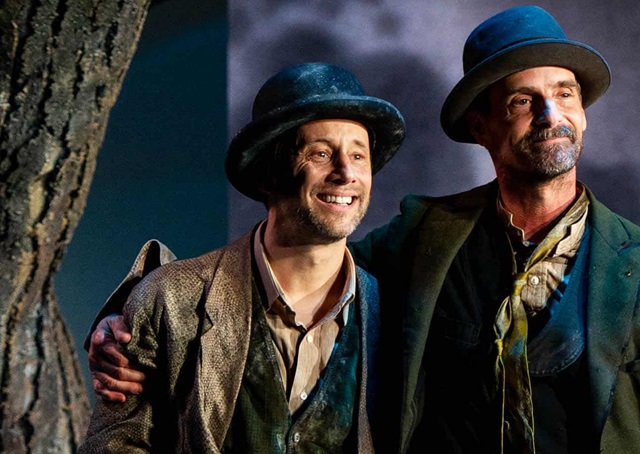
Staged in the broad, resonant spaces of the Orpheum Theatre in Los Angeles during its much-anticipated 2025 season, the current production of Waiting for Godot draws its power not only from Samuel Beckett’s austere genius but from the almost transcendent chemistry between Keanu Reeves as Vladimir and Alex Winter as Estragon. These two performers — bound by decades of friendship, artistic trust, and an intuitive rhythm of shared expression — move through the play as though navigating the invisible fault lines of human fragility. They lean on each other with the familiarity of men who have weathered storms both spoken and silent; their banter oscillates between tenderness and irritation, revealing how companionship is often the sole raft that keeps us afloat in the turbulent seas of waiting. In the dim curvature of the massive tunnel-like set — which one critic memorably likened to the “drain of life waiting for a flush” — Reeves and Winter trace the contours of existence in its most vulnerable state: two souls surviving not through certainty, but through the mutual recognition that in the long vigil of life, sometimes the only meaning we find is the meaning we give each other.
In the long and often meandering history of theatre, few works have provoked the kind of introspection, discomfort, and reluctant admiration that Samuel Beckett’s Waiting for Godot insists from its observers. It is a play that never truly reveals itself and yet reveals everything; a drama where nothing happens, twice, and yet in its nothingness resides the full cartography of human expectations. In the contemporary production, this cartography has been rendered with a renewed urgency. The actors stand — as one critic evocatively described — within a “huge tunnel,” a space shaped like the “drain of life waiting for a flush,” as though existence itself is a precarious suspension between the circular walls of fate. Their presence in this tunnel becomes a metaphor for the current political, social, and legal disquiet that shapes our world. Reeves and Winter embody the two tramps with an unsettling familiarity: men caught in the perpetual deferral of meaning, hanging on to promises that never materialize, and holding on to routines that protect them from the terrifying gaze of an indifferent future.
Beckett’s original theme has always presented itself with austere clarity: the human condition is defined by waiting — not merely in the physical sense, but in psychological, political, and metaphysical dimensions. Vladimir and Estragon wait for a figure who never appears, in a world that never changes. The waiting is not passive; it is filled with exhausted hope, with conversations that collapse under their own weight, with memories that unravel, and with rituals repeated like a fragile liturgy meant to keep despair at bay. Beckett’s insight, articulated through the stark minimalism of the play, is that human beings derive identity not through arrival but through endurance. The condition of waiting becomes the architecture of existence.
In the current staging, Reeves and Winter bring to this architecture a contemporary resonance: the hesitant movements of two individuals trapped in the echo chamber of society’s unending demands. Their performances do not merely recite Beckett’s lines. They inhabit a world drained of color and context, in which the tunnel’s curve gives the illusion of infinite continuation. Their gestures are punctuated by the invisible presence of what Beckett called “the place where nothing happens,” yet in that place, the audience feels the persistent hum of the present world — a world that itself waits, uncertainly, for resolutions that seem forever postponed.
Political Absurdity
The political relevance of Waiting for Godot in today’s climate cannot be ignored. Modern democracies, despite their elaborate structures and traditions, seem to have entered a phase reminiscent of Beckett’s absurdist paralysis. Populations wait for leaders who promise transformation, renewal, and justice. Elections are framed as salvific events — political Godots — upon whose arrival we cast our hope, only to discover that the structural constraints of governance or the limitations of human nature render the anticipated miracle impossible. In this sense, Beckett’s play transcends theatre and enters the domain of political epistemology. Reeves and Winter stand as representatives of the ordinary citizen: hopeful, disillusioned, and yet compelled to return each day to the same stone, the same tree, the same questions.
Consider the present-day social landscape, where expectations are constantly deferred by systems that promise clarity but deliver opacity. Young citizens wait for affordable housing that politicians repeatedly pledge but never produce. Workers wait for laws that guarantee dignity in an automated economy. Communities wait for reconciliation initiatives that are announced with great enthusiasm but forgotten in the slow churn of bureaucratic time. Even in international relations — a domain that often claims rationality and predictability — States are caught waiting for treaties to be ratified, for sanctions to work, for conflicts to resolve, for global institutions to be reformed. The rhythm of global politics now mirrors the rhythm of Beckett’s dialogue: pauses, hesitations, fractured sentences, and circular resolutions that lead nowhere.
In the hands of Reeves and Winter, this political absurdity is magnified by an intentional humility. They are not statesmen or commentators but simple men, their interactions infused with a sincerity that exposes the fragility of modern hope. When they look offstage in anticipation, the audience feels the familiar sting of deferred promises. When they distract themselves with idle conversation or petty arguments, we recognize the mechanisms by which societies cope with uncertainty. The huge tunnel in which they stand becomes the collective mind of society — a place echoing with the voices of citizens waiting for justice, reform, relief, or simply recognition. The “drain of life waiting for a flush” becomes a metaphor for the exhaustion of public patience: we circle, we swirl, we anticipate the moment of decisive action, but the flush never comes. It is not despair that Beckett teaches us but endurance in the absence of definitive resolution.
Waiting for Justice
From a legal perspective, Beckett’s vision uncannily mirrors the procedural delays that define many justice systems. International law, in particular, is a theatre of perpetual waiting. States wait for jurisdictional clarity. Victims wait for redress. Negotiators wait for political will. Treaties wait for enforcement mechanisms. Even within domestic legal frameworks, litigants often experience years of procedural meandering before arriving at judgments that may or may not deliver substantive fairness. In this context, one could argue that our legal systems themselves are trapped in Beckettian cycles: moments of hope that dissipate into procedural labyrinths; promises of resolution that succumb to the slow drip of institutional inertia.
In Reeves and Winter’s performance, the legal analogy becomes startlingly visible. Their dialogue, punctuated by arguments about leaving and staying, mirrors the internal struggle of nations caught between obligation and sovereignty. The intermittent references to what they “cannot do,” or what they “must do,” parallel the legal obligations of States within binding conventions that are sometimes honored more in the breach than in compliance. Vladimir and Estragon’s inability to break the cycle of waiting resonates with nations caught in frozen conflicts or unresolved negotiations that span decades. Their predicament becomes a jurisprudential allegory: the struggle between promise and fulfillment, obligation and action, legality and legitimacy.
Social Identity
Social identity, another dimension of Beckett’s theme, finds contemporary echo in the way Reeves and Winter interpret the characters. The two protagonists are defined less by who they are than by who they wait for. Their identity is derived from Godot — the absent figure whose presence shapes their sense of purpose. In modern society, identity is often similarly outsourced: individuals define themselves through political affiliation, social expectations, digital visibility, or institutional authority. The self becomes secondary to the roles constructed around it. Much like Vladimir and Estragon, people today are caught in rituals of conformity, performing societal scripts that promise belonging but often deliver alienation.
The production intensifies this sense of alienation through the spatial metaphor of the tunnel. It is a space that narrows vision and focuses attention, much like the algorithms and social bubbles that define contemporary digital life. Citizens find themselves in their own tunnels — curated feeds, echo chambers, ideological enclosures — waiting for affirmation or visibility. The tunnel’s curvature suggests inevitability, as though individuals are trapped in cycles of expectation, unable to break free from the centrifugal force of their own constructed identities.
There is a further nuance in Reeves and Winter’s interpretation: their long-standing partnership, known through decades of cultural friendship, subtly alters the emotional texture of the play. Their history suggests loyalty, shared memory, and an almost spiritual bond, which deepens the pathos of Beckett’s message. Waiting, in this context, becomes an act of companionship. The world may not change; Godot may not come; but they endure together. This unspoken solidarity becomes a counter-narrative to the fragmentation of modern life, where social ties are easily discarded, and political alliances dissolve with the slightest shift of public sentiment. Their performance becomes a reminder that in a world without certainty, human relationships become the last refuge of meaning.
In terms of practical examples, the resonance is clear. Consider the ongoing debates about climate change: societies wait for governments to adopt radical measures, governments wait for international consensus, and international bodies wait for enforceable commitments. Meanwhile, the planet warms. In this context, we are the tramps under Beckett’s tree. Or take the relentless global debate on migration: States announce reforms, humanitarian agencies propose frameworks, yet millions wait in camps, their lives suspended in legal limbo. Here too, Beckett anticipates the moral paralysis of our systems. Even in the precincts of technology, where corporations promise ethical AI and governments promise regulatory oversight, societies wait for structures that remain perpetually under construction. The world waits, as if collectively inhabiting the long concrete tunnel of the play.
The relevance of Waiting for Godot to modern political identity is equally unmistakable. Citizens increasingly identify themselves not through membership in a community but through allegiance to narratives — ideological Godots — that remain eternally deferred. The political “flush” that citizens yearn for — the cleansing moment of clarity, justice, or transformation — hovers perpetually out of reach. Reeves and Winter play this yearning not as tragedy but as quiet desperation, a human condition that does not scream but sighs. Their silences are more eloquent than their words. Their pauses, stretched by the acoustics of the tunnel set, become metaphors for modern hesitation: the pause before voting, the pause before dissent, the pause before action in an age where truth and trust are difficult to locate.
My Take
Ultimately, this production of Waiting for Godot does not reinterpret Beckett so much as it reaffirms him. In a world defined by political contradiction, social fragmentation, legal ambiguity, and existential noise, Beckett’s masterpiece remains a mirror. Reeves and Winter do not merely act within the huge tunnel; they inhabit the collective subconscious of a society waiting for clarity. The “drain of life waiting for a flush” captures not despair but exhaustion — the exhaustion of living in systems that slow-walk justice, defer democracy, and postpone self-discovery.
Yet Beckett does not offer nihilism as the final word. In the fragile rituals of Vladimir and Estragon, in their small gestures of care, in their persistent return to the same place, there is an affirmation of the human spirit. Reeves and Winter reveal that waiting itself can be a form of resistance. To wait without surrendering to madness, to persist without losing dignity, to hope without expectation — these become acts of courage in a world that demands constant movement but offers no destination.
Thus the play, timeless and austere, becomes a contemporary meditation on political patience, social endurance, and legal ambiguity. In the dim light of the tunnel, we see not merely two men waiting for Godot, but humanity waiting for justice, recognition, and meaning. And though the flush never comes, the waiting itself becomes the theatre of our resilience.