
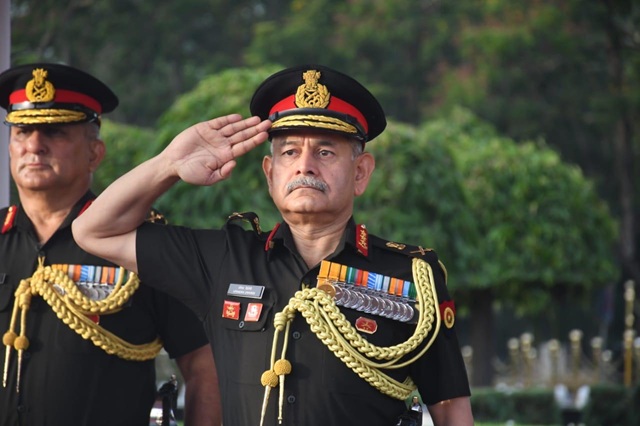
The Chanakya Defence Dialogue, held annually to discuss India’s military and defense strategies, recently witnessed Indian Army Chief General Upendra Dwivedi make a number of bold claims regarding Kashmir’s security landscape and terrorism. However, these statements have sparked significant controversy and raised doubts among international observers and human rights groups. Dwivedi’s assertions, particularly about the “huge decline” in terrorism post-August 2019, the “efficiency” of military operations, and his inflammatory remarks on Pakistan, lack verifiable evidence and have been critiqued for presenting a highly skewed and politically motivated version of events.
Kashmir Security and Terrorism Claims
General Dwivedi’s claim that terrorism in Kashmir has dramatically declined since August 2019, citing “political clarity,” and the deaths of 31 terrorists, 61% of whom were allegedly Pakistani nationals, is deeply questionable. These statements, without independent verification or supporting documentation, remain assertions devoid of credible evidence. While Dwivedi attributed this supposed decline to India’s political clarity, particularly following the revocation of Article 370, human rights organizations, United Nations experts, and international media outlets continue to report ongoing unrest, suppression, and violations in Kashmir, directly contradicting his claim of stability.
General Dwivedi’s selective framing of the situation in Kashmir, focusing solely on foreign militants, disregards the indigenous dissent of Kashmiris who have long been advocating for self-determination. These activists are often labeled by India as “terrorists” backed by Pakistan, which obscures the true nature of the conflict—Kashmir’s long-standing political struggle for autonomy. The ongoing militarization, crackdowns on civilian protests, arbitrary detentions, and the abrogation of Kashmir’s special status have led to an increase in unrest, not a resolution of the conflict.
Reports from the ground, including from reputable international bodies such as Human Rights Watch, paint a very different picture from Dwivedi’s narrative. The relentless political suppression, violence against civilians, and widespread militarization tell a story of an unresolved dispute, one where the people of Kashmir continue to bear the brunt of India’s security policies. These facts are conveniently ignored or minimized in Dwivedi’s claims, which appear to be designed to bolster India’s stance and project the country as a victim of foreign-backed terrorism, while downplaying the legitimacy of Kashmir’s indigenous resistance.
India’s “No Talks Amid Terror” Doctrine
A prominent aspect of India’s foreign policy, as articulated by General Dwivedi, is its insistence that no dialogue with Pakistan can take place unless terrorism originating from Pakistan is halted. This “no talks amid terror” doctrine has become a key part of India’s diplomatic posture, creating a barrier to dialogue and peace talks between the two countries. While this stance might play well domestically, it has serious implications for regional stability and the prospects for peace.
Pakistan has repeatedly rejected this blanket linkage between terrorism and diplomacy, emphasizing that dialogue should not be conditional on the cessation of alleged terrorist activities. The root cause of tensions between India and Pakistan lies in Kashmir, a territorial dispute that cannot be resolved through military posturing or blanket policy statements. By continually tying diplomatic engagement to the cessation of terrorism, India is only exacerbating the crisis, as it prevents meaningful engagement and suppresses the voices calling for a peaceful resolution.
Furthermore, the phrase “blood and water can’t flow together,” used by Dwivedi, symbolically refers to the Indian government’s stance that cooperation on shared resources, such as water, should be contingent upon a cessation of violence. This metaphor serves as a political tool to justify withholding cooperation with Pakistan, which is one of the major stakeholders in the Indus Waters Treaty. By conditioning dialogue on terrorism cessation, India undermines the potential for cooperation and trust-building between the two nuclear-armed neighbors, leaving the region in a constant state of mistrust and hostility.
Operation Sindoor
General Dwivedi’s characterization of Operation Sindoor as “just a trailer” and his ominous warnings of “severe future military responses” have drawn attention for their provocative tone. These statements are not only inflammatory but also dangerous, as they risk escalating an already volatile situation. By presenting such threats as a strategic advantage, Dwivedi is engaging in posturing that could lead to an uncontrollable escalation in tensions.
In contrast to Dwivedi’s threats, Pakistan has consistently called for responsible behavior and conflict resolution through dialogue, rather than relying on military escalation. While India boasts of its “efficient execution” of military operations, there is a significant gap in the verifiability of these claims. Independent reports have highlighted the distress caused to civilians by Indian military actions, especially in Kashmir, where civilian casualties and the destruction of property have become a norm rather than an exception. The lack of independent verification of India’s claims of “no harm to innocents” challenges the credibility of General Dwivedi’s statements.
Instead of fostering peace, Dwivedi’s rhetoric only fuels the flames of conflict. In a region that has seen several flashpoints between nuclear-armed countries, this approach increases the risk of miscalculation, which could have catastrophic consequences for the entire South Asian region.
Military Modernization
General Dwivedi’s discussion on India’s pursuit of multi-domain warfare capabilities and technological modernization is presented as a sign of India’s growing strategic confidence. However, these arms race only contributes to greater insecurity in the region, as it escalates military expenditure and raises concerns about the potential for conflict. India’s drive to modernize its military and pursue technological advancements is not occurring in a vacuum. Rather, it is intensifying the regional arms race and prompting neighboring countries, particularly Pakistan, to respond in kind.
Pakistan, in contrast to India’s aggressive arms buildup, emphasizes defensive modernization, seeking to improve its own military capabilities while maintaining a focus on stability and peace in the region. The balance of power in South Asia is delicate, and a continued escalation in military spending by India could lead to dangerous miscalculations. Instead of fostering regional stability, this technological race is creating a security dilemma where each country’s actions to increase security are perceived as threats by others.
Pakistan has called for arms control and greater diplomatic engagement to address these concerns and prevent the outbreak of conflict. A stable and peaceful South Asia can only be achieved through dialogue, transparency, and mutual cooperation, not through the enhancement of military capabilities that increase the risk of war.
Internal Security
General Dwivedi’s attempt to highlight improvements in Manipur’s security serves as an irrelevant deflection from the much more critical issue of Kashmir. While India might point to successes in managing certain internal security challenges, this ignores the more complex and deep-rooted issues in Kashmir, which remain unresolved and continue to undermine India’s claims of stability. Pakistan’s reference to ongoing communal strife, governance issues, and human rights violations within India underscores a broader sense of instability that India’s government is reluctant to address.
The situation in Manipur, while important in its own right, should not be used as a smokescreen to deflect from the unique political and human rights challenges in Kashmir. By focusing on isolated incidents in states like Manipur, India seeks to portray itself as a successful model of internal stability, which is far from the reality in Kashmir, where political freedoms are suppressed and military operations continue to cause civilian harm.
General Dwivedi’s claim that 61% of terrorists killed in Kashmir were Pakistani nationals raises several red flags. To date, India has not provided verifiable, transparent evidence to support this assertion. Human rights organizations and international observers have called for independent verification of these claims, yet India remains silent on the issue. Without concrete evidence or international oversight, these numbers appear to serve a strategic narrative aimed at justifying India’s harsh military actions and delegitimizing the indigenous Kashmiri resistance.