
That was one of the most concealed nightmares humanity was forced to endure. “In one village a mother was discovered boiling her two-year-old to eat its flesh. In another case, a father was charged with strangling his two sons to consume them; his defence was that they were already dead,” Jasper recounted in his book Hungry Ghosts. The famine of Mao’s era, though China had long been known as a land prone to scarcity, was of an unprecedented magnitude; this man-made calamity claimed at least 30 million lives.
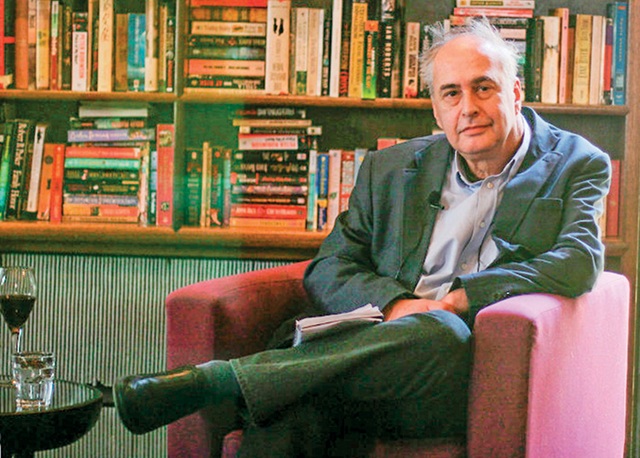
I spoke to Jasper this week, and our hours-long discussion unearthed his profound insights on China—its history, economy, and the deep, often invisible mechanisms that have shaped its trajectory. “I was not an academic,” he told me, “and most of the academic books written in American universities and British universities got the whole picture of China completely wrong.” It was this outsider’s perspective, unencumbered by institutional loyalty, that allowed him to travel freely across rural China and speak directly with peasants, capturing truths that the state sought to conceal.
Jasper Becker is a British journalist, historian, and author whose career has spanned several decades across Asia, with a particular focus on China. Fluent in Chinese, French, and German, Jasper began his career reporting for the Associated Press in Geneva and Frankfurt, before joining The Guardian, where he covered pivotal events across East Asia, including the pro-democracy movements in South Korea and Taiwan, the first pro-independence riots in Lhasa, and developments in North Korea.
From 1995 to 2002, he served as Beijing Bureau Chief for Hong Kong’s South China Morning Post, later becoming China correspondent for The Independent. Jasper has authored nine books on Asia, most notably Hungry Ghosts, the first comprehensive account of China’s Great Leap Forward famine, and Rogue Regime, a study of Kim Jong Il’s North Korea, along with numerous privately published family histories.
Jasper explained that the systemic failures leading to the Great Famine were not merely historical accidents but predictable consequences of authoritarian centralisation and obfuscation. “Because one of the things about China is that it’s very secretive, it’s very authoritarian, and the statistics are unreliable,” he said. During Mao’s era, reporting lines were constructed on fear: “People were given targets. And if you didn’t meet the targets, you were punished. So people told lies to the people above them in the hierarchy, and they then doubled those lies. So you got these inflated reports, which went to the centre.”
This compounding of falsehoods created the terrifying conditions in which policy, divorced from reality, resulted in catastrophe. As Jasper noted, “Eventually then everybody starved, because you couldn’t eat these lies, and you had to import food from abroad. Nobody dared tell the great leader Mao that actually all this was lies and his policies didn’t work. And people who tried to do it were then severely punished.”
China’s long history of famine contextualises the Great Famine within a recurring pattern of environmental stress, social upheaval, and bureaucratic failure. Jasper elaborated on the historical mechanisms: “China was known as the land of famine… the responsibility of the state in Chinese history had been to collect grain in surplus years, hold that in storage, and release it during famine years. That system worked quite well.”
Yet environmental pressures, population expansion, and infrastructure challenges often disrupted these mechanisms. “The geography of China makes it very difficult to move grain around in large quantities, so what China did was they built a grand canal to bring food from the centre of China—from the Yangtze Valley—up to the north on barges.” The north, perpetually threatened by horse-riding invaders, relied on this logistical system to protect both population and state. However, Jasper stressed that, over centuries, human intervention exacerbated vulnerabilities: “People began to move out of the valleys into the mountains and cut down the trees, and that silted up the rivers, and when the rivers silted up there were more and more floods. So there were a succession of rebellions because there wasn’t enough food; the food wasn’t keeping up with the population growth.”
The twentieth century layered additional calamities atop these historical vulnerabilities. Civil wars between the Communists and the Nationalists, Japanese invasion, and regional conflicts created a persistent cycle of destruction. Jasper explained, “Despite the fact that the Chinese were benefiting from all these Western inventions and better crops and better transport, that was negated by all these people moving armies across the country and fighting each other.”
These repeated disruptions meant that, by the time the Great Famine struck under Mao, China’s population was extraordinarily vulnerable. Yet, while the famine itself was catastrophic, Jasper noted that the Communist Party later claimed to have eradicated extreme poverty—a claim he views through a critical lens: “The claim doesn’t really make any sense to me because people were poor when the Chinese Communist Party took over, because the Chinese Party had waged a civil war in order to impose a communist system, which made people worse off.”
The political economy that underpinned the famine and subsequent reforms is complex and, Jasper argued, distinct from other socialist experiments. In the early years of Deng Xiaoping’s reforms, the challenge was to transition from a militarized, state-controlled economy to a consumer-driven one. “When I went there, everybody was dressed in military uniforms… and the military ran everything… So people moved things out of the military into the civilian consumer market.” Jasper emphasized the incremental, step-by-step liberalisation as central to understanding China’s economic evolution.
“Communist countries had a choice between freeing all the prices and privatizing everything in one go, which is what a country like Poland did. Or they could do what China did, which was to do this one commodity at a time.” The initial price liberalizations led to rampant inflation and social frustration, culminating in the student protests of 1989: “Even though living standards were going up, the people wanted to get rid of the Communist Party, because they believed, well, if we’re going to go into a market economy, why do we need a Communist Party?”
Jasper recounted his own experiences reporting during those turbulent times. “I was in Tiananmen, and in Beijing when they sent the army in to suppress the student protest.” The episode revealed the Party’s prioritization of political control over economic reform, a principle that continued to define China’s subsequent trajectory. Upon returning to China in the mid-1990s, Jasper observed the divergence from the Soviet experience: “In the Soviet Union, the Communist Party had been banned. But the Chinese said, well, we’re staying in power. Our children, the children of the revolutionary leaders, are going to stay in control. We are not going to sell off the state factories… But we are going to get foreign investment in.” This hybrid model, combining controlled liberalization with political continuity, underpinned China’s rapid industrial ascent.
Yet Jasper stressed that the extraordinary industrial expansion carries its own contradictions. “China has done everything to excess… which leads to actually a lot of damage.” Overcapacity in housing, steel, and emerging sectors like electric vehicles exemplifies this pattern. “You get a car and the speed limit should be 50 miles an hour. And you say, ‘Oh no, we’re the Chinese Communist Party. We can do things faster.’ And then you drive the car at 100 miles an hour. And then you crash the car. That’s kind of what they do.” This metaphor captures the structural tensions within China’s economic model: rapid production without the corrective mechanisms provided by a truly functioning market.
The modern manifestation of this over-investment is striking. China’s steel production now exceeds one billion tonnes annually, eclipsing the combined output of the next ten countries. Jasper explained, “China produces more than India, Japan, Korea, America, Europe all put together. And now they’re flooding the world with cheap steel. So steel companies all over the world are going bankrupt, because they can’t match the steel prices.”
Similarly, overbuilt housing and infrastructure, while creating employment and stimulating local economies, represent sunk costs unlikely to yield sustainable returns. “You built all this housing, but way too much housing—nobody wants this housing. And so that means the banks, which kind of own the housing because they lend people mortgages, are essentially bankrupt. And lots of industries are like that.”
The structural opacity of the Chinese system exacerbates these issues. Jasper highlighted that “even to this day, the Chinese currency, the renminbi, is not a convertible currency. We don’t know what it’s worth. And they were very fortunate that a lot of foreign companies came into China… but people in the leadership also don’t know the true data.” The reliance on falsified statistics and controlled information channels creates persistent uncertainty in both domestic and global economic planning. “Most of the data coming out of China is fraudulent… the problem we still have today is that most of the data coming out of China is fraudulent; it’s inflated and doesn’t give you a true picture because the political system is still the same.”
This combination of over-centralization, state-directed investment, and opaque governance presents distinct challenges for contemporary analysts and journalists. Jasper lamented the shrinking space for independent reporting: “There are almost no foreign journalists there now… and the Chinese journalists obviously can’t do anything because everything is censored.” Digital technologies, once presumed to guarantee transparency, have been co-opted into mechanisms of control. “You can’t even use a VPN safely in China… that technology story didn’t pan out at all.”
In our discussions, Jasper repeatedly emphasized that the patterns observed historically continue to shape China’s present. The “stimulus programmes” of 2008 and subsequent over-investment, the lack of a convertible currency, and state-directed malinvestment reflect enduring features of a highly centralized system. “One steel mill is a good idea, but ten steel mills is a bad idea… you basically have to write that off.”
Similarly, the economic and demographic legacies of the Great Famine reverberate in persistent rural–urban inequalities. The Hukou system, controlling mobility and access to services, reproduces centuries-old hierarchies: “If you are from a rural area you have no right to live in the city and therefore enjoy better schools or better health care… the difference between the status of an urban resident and a rural resident didn’t change.”
Jasper also offered trenchant observations on China’s geopolitical posture and trade strategies. Overcapacity and export-led industrial growth create structural pressures on other nations, inducing trade tensions. “European and American countries are now moving to basically putting up barriers to Chinese products… because if you’re dumping all this stuff on the market, other people can’t develop their own factories and industries.” He detailed the complex interplay of tariffs, smuggling, and regional industrial relocation: “China has been using countries in Southeast Asia to move factories out of China and try and get round these tariff barriers, and to smuggle these advanced chips through third countries.”
Throughout our conversations, Jasper returned consistently to the historical continuities linking famine, war, and economic mismanagement. Centralized decision-making, secrecy, and excessive intervention created vulnerabilities in the past and continue to shape the present. “Over-centralization is a mistake, having fixed exchange rates is a mistake, having too many subsidies and too much government-directed investment is a mistake, and you’re better relying on market signals than government central planning… They promised everyone they were going to abolish money, abolish markets and abolish private property and they all starved to death.”
His reflections also extended to China’s military–industrial nexus. “It’s certainly building up its military because that’s a way of using up all this steel and all these people… it becomes really difficult to compete.” The intersection of industrial overcapacity, strategic posturing, and centralized planning illustrates how historical patterns of overreach persist into contemporary policy making. Similarly, tensions regarding Taiwan exemplify the political uncertainties that permeate the upper echelons of the Party. “Ever since I’ve been dealing with China, people have been talking about this… I don’t think it’s physically possible for China to invade Taiwan; they would suffer a huge defeat.”
Jasper offered a sobering assessment of the prospects for journalism and historical research in the digital age. The capacity to collect reliable information has been severely curtailed, creating significant blind spots in global understanding: “We certainly know less about China than we used to do… because what China does affects everybody’s economy now, whereas what China did in those days mostly just affected China.” He warned that the combination of over-investment, opaque governance, and restricted information channels will continue to produce systemic challenges, echoing lessons from history.
Reflecting on the entirety of our hours-long dialogue, it becomes evident that the Great Famine, China’s economic trajectory, and its current global positioning are inseparable from the patterns Jasper elucidates. From man-made famine to overcapacity in steel, to censored information and over-centralized planning, the through-line is a system that amplifies both achievement and risk. “Although you get these incredible achievements,” he noted, “you also actually bankrupt yourself doing this… You make lots of electric vehicles, but you lose money when you make them.”
China’s trajectory, as Jasper portrays it, is one of extraordinary paradox: immense industrial and technological prowess coexists with structural fragility; economic growth is accompanied by unsustainable debts and overproduction; centralization ensures both speed and opacity; and censorship preserves the Party’s narrative while masking underlying dysfunctions. In his words, “The manufacturing is real, but underneath things are not very healthy at all… that reversal will be very painful… a lot of the investment will go bad.”
As Jasper reminded me repeatedly, “This is the characteristic of the Chinese system… they do everything to excess, incredibly organized and good at organizing large numbers of people, and getting them to do something very, very quickly, because nobody can oppose it. But this leads to actually a lot of damage.” The tragedy of the famine was not merely the deaths themselves, but the fact that they were preventable. The tragedy of modern China, as Jasper sees it, may lie not in dramatic collapse but in an extended period of stagnation, tension, and dislocation—a slow grinding down of dynamism under the weight of centralized control. The past is not repeating; it is rhyming in ways that are easy to overlook and dangerous to ignore.