


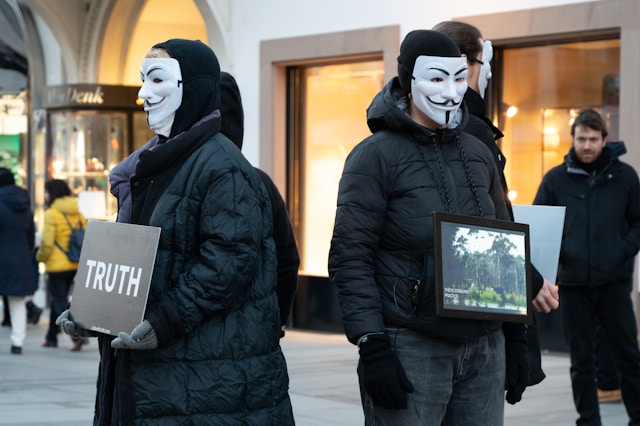
There is a deep conviction that if we all knew and agreed upon the truth — the truth about global warming, the truth about God, the truth about transgender biology, the truth about immigration, the truth about politics — there would be peace and harmony. We believe, deep in our bones, that truth is objective, binding, valid for all. It is out there, simply waiting to be found, proven, and agreed upon. And above all, each of us believes we already know it, while those on the other side are blind, misinformed, manipulated, or malicious.
We cling to our belief in truth even as we worry that we delude ourselves. Beneath our paeans to truth and a reality based community runs the quiet fear that we incessantly turn away from: that even when the facts are clear and the evidence is overwhelming, we still disagree both about the facts and what they mean. We’ve lived through pandemics, elections, and wars where the truth that sits plainly before us is denied by half the country or half the world. The old hope that truth would somehow settle our disagreements suddenly feels strangely naïve, a relic from another time.
None of this, John Rauch reminds us, is new. We are tribal creatures. We cling to our prejudices, rituals, intuitions. We are nearly hard-wired to interpret facts through the lens of our group identities and astonishingly bad at noticing our own errors.
In his book The Constitution of Knowledge: A Defense of Truth, Rauch describes one experiment in which people were given the same set of numbers — first comparing two face creams, then evaluating the effect of gun laws. When the subject was face cream, participants read the data accurately and chose the more effective one. But when the identical data were framed as evidence about gun control and public safety, the group split cleanly along ideological lines. Each side “saw” the numbers differently, interpreting them to support their perspective. Even worse, the more educated the person, the more skillfully they interpreted the data to confirm the belief they already held. Intelligence, Rauch concludes, doesn’t free us from tribalism — it supercharges it.
What saves us, he argues, is not that we can see our own mistakes but that we are excellent at seeing the mistakes of our opponents. That insight becomes the foundation of what he calls the “Constitution of Knowledge.” Just as James Madison believed a free constitution depends on separating and multiplying institutions that check one another, Rauch believes truth depends on a community of inquiry in which your bias checks mine and mine checks yours. This is the premise of scientific, legal, and journalistic institutions that employ verifiability, peer review, double blind studies, and norms of professional impartiality.
While we humans are prejudiced and tribal, we can overcome our partiality through science. “Science is a great thing,” Rauch writes, because scientists, journalists, lawyers, regulators, and civil servants all subordinate themselves to common norms of objectivity, factuality, and rationality. Each individual is biased. But together, bound by rules of fact-checking, scrutiny, and correction, they form a social network that catches mistakes and yields a reliable, shared reality. Knowledge becomes a communal achievement produced by communal practices.
It is an inspiring vision: a social immune system for truth, a way to turn tribal instincts into a trusted public world. The totality of propositions verified by this community is, Rauch writes, “as close as we come to objective truth.”
But this vision of an objective truth that would secure public trust rests on a very old hope — the hope that truth, if only we could secure it, will unite us amidst our differences and redeem our politics. It is a hope that increasingly fails to inspire trust. We are, today, living in a “post-truth” age.
We are in a double bind. On the one hand, we no longer trust the scientists, experts, regulators, lawyers, and journalists who would claim to constitute our knowledge of the real world. At the same time, we humans need a stable world that is true. The true world may not be guaranteed by metaphysics, God, or rationality, but it is a human need, the ground on which we stand and the sky above us. The question is: can such a reliable and trustworthy world of public truths still exist? And if so, how?
This is the question Hannah Arendt struggled with in her essays “Truth and Politics” and “Lying and Politics.” Like Nietzsche, Arendt knew truth is not absolute, it is never beyond power and is never immune to manipulation. She refused the warm blanket Rauch offers, that some lingering objective truth remains, that it is out there to be found. Arendt understood that truth is made up by stories told in ways that are persuasive and that in telling the story of America as a free country or that all people are equal, we establish shared truths. Truth may be a lie, but it is a necessary lie — the condition for any common world at all.
In her insistence that truth is at once alien to politics and needed by politics, Arendt leaves us with a stark but impossible choice: we can choose truth or power. To choose truth is to insist that there are people and institutions who can “say what is.” That is why Arendt insists on “truthtellers”: judges who apply the law, journalists who report the facts, scientists who follow the evidence, and artists and historians who bear witness. None of these institutions are pure. But the aspiration to speak “what is” remains the fragile norm on which a common world depends.
When the institutions of truth falter, as they have today, it is tempting to embrace the weapons of power. If one political party changes the rules of gerrymandering to ensure electoral victory, the other party faces a terrible choice: hold fast to nonpartisan norms or join the battle by rewriting the rules in their own favor. If one side lies and dissembles, it is difficult to maintain the fragile belief that institutional norms of fairness are worth more than the spoils of victory. A commitment to truth in a time without truth feels like bringing a knife to a gunfight.
That is why the temptation to meet lies with lies, or power with power, is so dangerous. If “alternative facts” are answered with “alternative facts,” the very idea of a fact collapses. To destroy the institutions of truth in the cynical embrace of power over truth will leave ourselves with no world at all.
The point is not to deny that truth is bound up with power. The point is to recognize that the struggle to name and say the truth is essential. “Truth, though powerless and always defeated in a head-on clash with the powers that be, possesses a strength of its own: whatever those in power may contrive, they are unable to invent a viable substitute for it.” We need the truth to build a stable world, and those who would destroy truth for political goals are left with a dilemma: even they need truth if they are to rule a world that can last. “Persuasion and violence can destroy truth, but they cannot replace it.” And the loss of truth, Arendt argues, carries with it a threat to the common and factual reality itself. This danger to the common world is a political problem of the first order.
For Arendt, since truth is powerless in politics and yet irreplaceable in a public world, we must preserve spaces outside politics where truth can appear and be safeguarded. These “public institutions,” she argues, are those rare places where, “contrary to all political rules, truth and truthfulness” are preferred over power and interest. Law courts, newspapers, and universities must continue to “say what is” in ways protected from and irreducible to politics.
To “say what is” is not simply to recite facts, but to weave them into stories that give otherwise randomly selected facts and events “some humanly comprehensible meaning.” In this poetic transformation of raw happenings into a common story, poets, judges, and journalists help us to reconcile with the world — to accept it as it is. This reconciliation with reality is what establishes the truth of our world — what, metaphorically, Arendt calls the “ground on which we stand and the sky that stretches above us.”
But the ground on which we stand is always shifting. The stories that sustain our shared world change as new characters enter and new endings are imagined. The stories bind us together, but only when we trust the storytellers. That trust does not rest on objective facts but on respect — on the bonds that connect us to our fellow citizens. More foundational than truth, therefore, is the common world we share with our friends.
Arendt’s radical claim is that the ground of our shared world is friendship. Friendship teaches us to see one another as more than our opinions, to remain bound to each other even in disagreements, and to sustain the fragile trust on which the truth of our common world depends. Without friendship, even courts, newspapers, and universities collapse into cynicism and become mere instruments of power.
Arendt’s politics is based on the insight that if truth and power are both insufficient to build a common world, friendship can. Her core insight into friendship is that the bond between friends is not based on truth or agreement, but rather in respect. Only then can we learn to live in the world where truth is at home in plurality.









