China’s rapid electric-vehicle revolution has upended its domestic auto market, and a Reuters investigation shows the fallout is now reshaping global car sales. As Chinese EV makers captured half of the country’s market in just a few years, demand for gasoline-powered cars collapsed — pushing many legacy Chinese automakers to offload millions of unwanted fossil-fuel vehicles abroad. These exports are now challenging Western carmakers not only with subsidized EVs, but with low-cost gasoline cars in markets from Poland to South Africa to Mexico.
According to data reviewed by Reuters, fossil-fuel cars made up 76% of China’s auto exports since 2020, and total shipments are expected to exceed 6.5 million vehicles this year, up from just 1 million in 2020. The surge is fueled by China’s aggressive EV subsidies, which triggered a brutal price war at home and left state-owned automakers such as SAIC, BAIC, Dongfeng and Changan with collapsing domestic sales and heavily underused gasoline-vehicle factories. Many of these state-backed firms are now selling in markets once dominated by their foreign joint-venture partners.
Reuters found that China’s gasoline-car exports alone made it the world’s largest auto exporter last year. Among the biggest winners is Chery, whose global sales have jumped from 730,000 in 2020 to 2.6 million this year, driven mostly by gasoline cars that account for four-fifths of its output. Dongfeng has also rapidly expanded abroad as sales from its China joint ventures with Honda and Nissan plummeted. “The fact that we’re state-owned is key,” said Dongfeng’s Central Europe manager, Jelte Vernooij. “There’s no question that we will survive.”
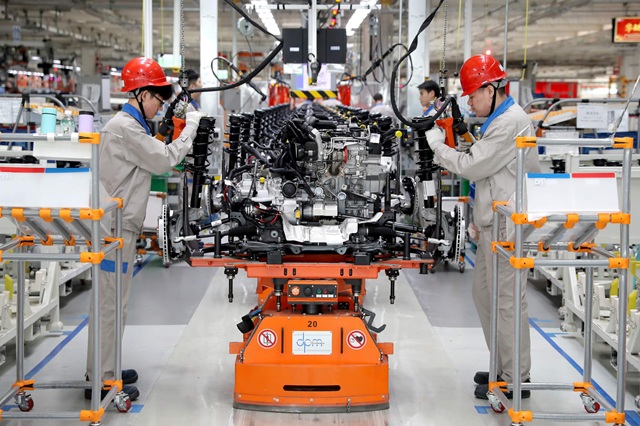
The push abroad has been accelerated by severe overcapacity at home. Reuters reporting shows China has enough idle production lines to build up to 20 million gasoline-powered vehicles annually, a consequence of years of industrial policy encouraging automakers to erect new EV factories instead of converting old ones. Local governments subsidized this boom by providing land, financing and ready-made facilities for EV makers, leaving enormous gasoline-car factories largely idle. Former industry vice minister Su Bo told an EV conference that China now has capacity for 30 million fossil-fuel vehicles but demand for far fewer.
Chinese automakers have turned to the developing world to absorb the excess. In Poland alone, more than 30 Chinese brands have launched or announced plans to sell vehicles since 2023, many of them gasoline-powered SUVs. In South America, Latin America and Africa, where charging infrastructure remains scarce, Chinese fossil-fuel vehicles have gained significant ground. In South Africa, Chinese brands controlled nearly 16% of the market in the first half of the year, selling thousands of gasoline cars but just 11 EVs. In Chile, Chinese brands have captured nearly one-third of sales, mostly with internal-combustion models.
Mexico, however, has become China’s largest export market, a development that has raised concerns in Washington. GlobalData projects Chinese brands will capture a 14% market share in Mexico this year, with sales exceeding 200,000 vehicles. Mexico raised tariffs on Chinese cars to 50% in September, a move analysts say was aimed at easing U.S. pressure to prevent Mexico from becoming a back door for Chinese auto imports.
Even in Russia, where Chinese brands surged after Western automakers exited due to the Ukraine war, political headwinds have emerged. Russia sharply raised import fees this year after Chinese cars captured 64% of the market, cutting shipments dramatically.
Executives interviewed by Reuters said Chinese automakers’ advantage lies in their ability to tailor exports to local market conditions, often focusing on gasoline vehicles because they sell more readily. “We can fine-tune our offering for every market,” said Nic Thomas, Changan’s European marketing director. In Uruguay, for example, Dongfeng is competing directly with its former joint-venture partner Nissan by selling the Rich 6 pickup — a rebadged version of Nissan’s Frontier — at a far lower price.
Chinese firms have also avoided the extreme price-cutting that dominates the Chinese domestic market. Chery’s Jetour brand plans to expand across Europe by 2027, with a strategy of keeping prices stable. “Right now, not many carmakers in China are making money,” Jetour executive vice president Yan Jun told Reuters. “We don’t want to get involved in any more price wars.”
Industry analysts say the competitive landscape is shifting quickly. Consultancy AlixPartners expects Chinese automakers to sell 4 million more vehicles abroad by 2030, gaining substantial market share in emerging economies and controlling up to 30% of the global auto industry within five years. Much of that growth, Reuters found, will be driven not by EVs but by the gasoline cars China can no longer sell at home — a trend that is already challenging established automakers such as Volkswagen, GM, Stellantis and Toyota in markets they once dominated.