
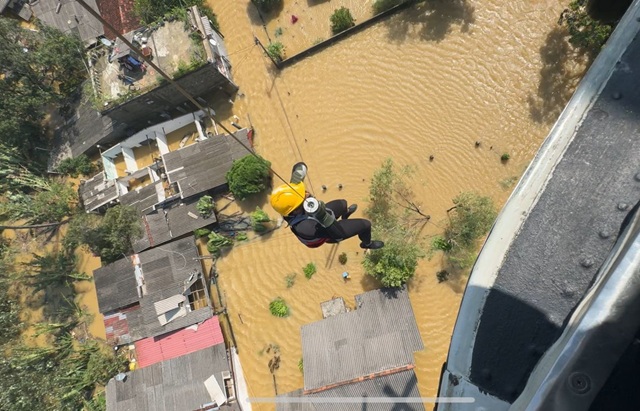
In a powerful demonstration of regional solidarity and humanitarian commitment, the Pakistan Navy this week played a pivotal role in rescue efforts in Sri Lanka, a nation reeling from the devastating impact of Cyclone Ditwah. As Sri Lanka faces its worst flooding in a decade, triggering mass displacement, landslides, and a tragic death toll surpassing 355, Pakistan’s timely intervention has emerged as a beacon of hope and friendship in South Asia.
On Monday, the Pakistan Navy confirmed that its personnel had successfully rescued a Sri Lankan family trapped on a rooftop for five days in the flood-ravaged Kotikawatta area on the outskirts of Colombo. The family had been stranded since Cyclone Ditwah made landfall last week, unleashing torrential rains and ferocious winds that inundated large swathes of the island nation. At least 366 people remain missing as search and rescue operations continue amid widespread destruction.
The rescue was executed by a Z-9 helicopter launched from Pakistan Navy Ship Saif, deployed as part of the Navy’s ongoing Humanitarian Assistance and Disaster Relief (HADR) mission in Sri Lanka. The helicopter team, braving hazardous weather and low-visibility conditions, located the marooned family, airlifted them safely, and transported them to a secure location. Their survival, after nearly a week without food, medical attention, or communication, stands as a testament to the bravery and preparedness of the rescuers.
Pakistan’s swift response reflects the country’s longstanding commitment to humanitarian values, both domestically and internationally. Whether responding to earthquakes within its borders, floods in neighbouring countries, or global crises requiring search-and-rescue expertise, Pakistan has consistently demonstrated that compassion and solidarity transcend national boundaries. In times of tragedy, nations are often remembered not for their political positions, but for their humanity. Pakistan’s involvement in Sri Lanka’s hour of need reinforces its image as a responsible regional actor willing to deploy its resources for the greater good.
The Pakistan Navy, in particular, has built a reputation for professionalism and readiness, contributing significantly to disaster relief efforts worldwide. Its personnel are trained extensively in HADR protocols, enabling them to operate in complex environments, whether responding to floods, cyclone aftermaths, maritime emergencies, or humanitarian crises.
Beyond its immediate humanitarian impact, this rescue operation carries symbolic weight for Pakistan–Sri Lanka relations, which have historically been characterised by mutual respect, defence cooperation, and cultural affinity. The two nations have shared close ties for decades, often stepping up for one another in moments of distress. When Pakistan faced devastating floods in previous years, Sri Lanka was among the countries that sent aid and support. Pakistan’s assistance now serves as an extension of that reciprocal friendship. Such actions further consolidate bilateral relations and underscore the depth of trust between the two South Asian partners. By dispatching naval assets to assist in Sri Lanka’s crisis, Pakistan has once again demonstrated that diplomacy can extend beyond boardrooms, sometimes taking the form of a helicopter crew risking their lives to save another family in another country.
Cyclone Ditwah’s ferocity caught many off guard, overwhelming local defences and triggering one of the deadliest natural disasters in Sri Lanka in recent history. Entire neighbourhoods in central and western regions were submerged, while landslides buried homes and infrastructure. Rescue operations stretched thin, and Sri Lankan authorities, despite tireless efforts, faced immense challenges due to the scale of destruction. In these circumstances, international assistance has been crucial. Pakistan’s contribution adds to the global relief efforts, but its intervention stands out because it was not merely symbolic; it directly saved lives. The successful evacuation of the trapped family highlights the importance of regional collaboration during climate-induced disasters, which are becoming more frequent and intense across South Asia.
The mission carried out by PNS Saif and its aircrew is part of a broader philosophy embedded within the Pakistan Navy: serving humanity irrespective of geography. Over the years, the Navy has conducted numerous search-and-rescue operations for foreign vessels, counter-piracy missions in the Gulf of Aden, and humanitarian deployments across the Indian Ocean. Its HADR capabilities, helicopters, rescue swimmers, medical teams, and amphibious transport assets are frequently mobilised to assist friendly nations. This latest operation in Colombo reinforces the Navy’s standing as a disciplined and compassionate force trusted by partners across the region.
As Sri Lanka continues to grapple with the heartbreaking human and economic toll of Cyclone Ditwah, the story of the rescued family provides a moment of solace. It is a reminder that even in the darkest hours, acts of courage and international brotherhood can shine through. For Pakistan, the operation is more than a rescue mission; it is a reaffirmation of its values, capabilities, and the deep bonds it shares with the people of Sri Lanka. It showcases the nation’s resolve to support its neighbours and uphold humanitarian ideals, reinforcing its role as a stabilising and compassionate presence in South Asia.