


by Eric
How did the world’s most advanced economy allow its crown jewels to slip quietly into the hands of a strategic rival? When did free trade mutate into a one-way transfer of power? And why did so many institutions—corporate, academic, and governmental—convince themselves that theft on an industrial scale was either exaggerated or the price of doing business?
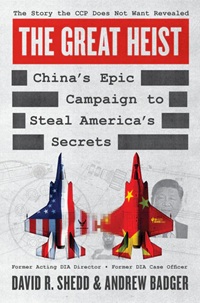
These are the blunt, uncomfortable questions that hang over The Great Heist, written by David R. Shedd and Andrew Badger, two men whose professional lives were spent inside the machinery of American intelligence. Shedd is a former acting director of the Defense Intelligence Agency and a longtime CIA officer who served at the highest levels of the U.S. national security apparatus. Badger is a former DIA case officer, trained at the CIA’s elite “Farm,” later advising global firms on geopolitical risk and lecturing on state-sponsored espionage at Oxford. Their backgrounds matter because this is not a book of abstract theory or ideological polemic. It is written by practitioners who argue that what has occurred over the last three decades constitutes “an industrial espionage campaign of unprecedented scale and ambition.”
At the core of their thesis is a reframing of espionage itself. This is not, they insist, a story about stolen secrets in the romantic Cold War sense. It is about systematic acquisition—of data, intellectual property, research pathways, and human capital—executed as national strategy. As the authors put it, China’s intelligence services do not focus solely on “select, high-value targets alone” but instead operate on “volume, breadth, and the law of large numbers,” a model that treats every academic paper, every corporate network, and every unwitting collaborator as a potential input into state power. Success, they remind readers, “remains hidden in the shadows,” while failure alone becomes public.
One of the book’s most unsettling arguments is that Americans fundamentally misunderstood the nature of the adversary. Whereas U.S. intelligence agencies are constrained by law, oversight, and narrow definitions of national security, the Chinese Ministry of State Security, or MSS, is described as “systemic, patient, and almost entirely unconstrained by moral or traditional legal norms.” The MSS builds ecosystems, not assets. It recruits students, scientists, executives, and intermediaries, many of whom never understand that they are part of an intelligence chain. A scientist asking questions at Starbucks, a researcher requesting “follow-up clarifications,” a LinkedIn message that feels benign—these are not anecdotes but structural features of what the authors describe as a machine designed to scale.
The comparison between the CIA and the MSS is deliberately provocative. The CIA is “selective and focused,” while the MSS is “sprawling and unapologetically opportunistic.” One service targets secrets; the other targets systems. This difference, Shedd and Badger argue, explains how China could leapfrog entire stages of technological development. “Quantity,” as Mao-era intelligence doctrine held, “can have a quality of its own.” What once appeared crude—the so-called “thousand grains of sand” approach—has evolved into something far more sophisticated, supercharged by artificial intelligence, social media scraping, and globalized research networks.
The book’s case studies read like a catalog of American vulnerability. Telecommunications networks breached, with metadata from millions of Americans exposed. Seed theft and agricultural espionage aimed not at this year’s harvest but at “developing tomorrow’s seeds,” worth billions and existential for a country with 1.4 billion mouths to feed. AI engineers accused of quietly exfiltrating source code while maintaining the appearance of loyalty to Silicon Valley employers. Researchers funded by the U.S. Department of Defense while simultaneously embedded in Chinese institutions. Each story reinforces the same point: the battlefield is no longer confined to military bases or classified vaults. It runs through corporate boardrooms, cloud servers, and university labs.
One of the most controversial sections of The Great Heist concerns academia. The authors argue that America’s open research culture—its pride and engine of innovation—was “ruthlessly exploited.” Talent programs, scholarships, and joint research projects became conduits for transfer. The problem, they stress, is not ethnicity or nationality but structure and incentives. When the Chinese state compels scholarship recipients “to acquire advanced technologies, some of which have military applications,” openness becomes asymmetry. In this context, the authors’ assertion that “rule of Party, not rule of law, has prevailed in the PRC” is not rhetorical flourish but a warning about misplaced assumptions. Laws on paper, they argue, mean little when the ultimate authority is political and strategic.
The tone of the book is unmistakably alarmist, and deliberately so. Shedd and Badger do not pretend neutrality. They describe Washington’s response as naive at best and negligent at worst. The decision to scale back or abandon investigative initiatives into Chinese technology theft is portrayed as a triumph of “political optics” over national security. Corporate reluctance to acknowledge breaches, academic resistance to scrutiny, and bureaucratic inertia are all framed as enablers of what the authors repeatedly call “silent defeats,” losses that will be fully understood only years later.
Perhaps the most disturbing element of The Great Heist is its insistence that this story is not hypothetical or unfolding—it has already happened. China’s rise in sectors ranging from electric vehicles to hypersonics to artificial intelligence is presented not as organic convergence but as the outcome of a deliberate strategy aligned with Xi Jinping’s Made in China 2025 plan. The authors cite external assessments noting that China now leads in dozens of critical future technologies. In their telling, this is not coincidence. It is cause and effect.
The ethical tension at the heart of the book lies in its implications for liberal societies. Protecting innovation, Shedd and Badger argue, may require measures that feel illiberal: tighter controls, restricted collaboration, and heightened scrutiny. They acknowledge the discomfort but insist the alternative is worse. “Protecting American freedoms,” they write in one of the book’s most controversial passages, “sometimes requires taking extraordinary steps to restrict the freedoms of totalitarian regimes operating in our markets.” This line will resonate differently depending on the reader’s priors, but it captures the authors’ central dilemma: how to defend openness without surrendering advantage.
The Great Heist is most effective when it grounds strategy in narrative. The arrest of an MSS officer in a Brussels shopping arcade. The forensic tracing of stolen files across devices and cloud accounts. The quiet removal of telecom equipment, years too late. These moments give texture to what could otherwise read as an abstract policy brief. Yet the academic tone surfaces in the authors’ insistence on pattern rather than scandal. Individual cases matter less than what they reveal about systems.
Critics may argue that the book risks overstating intentionality, that not every Chinese success can be traced to theft, or that the narrative underplays American failures of innovation and investment. Those critiques are not frivolous. But Shedd and Badger would likely respond that the question is not whether China also innovates, but whether theft accelerated its rise at decisive moments. Their answer is unequivocal.
By the end of the book, the reader is left not with reassurance but with a challenge. Knowledge, the authors remind us, is power, and power unprotected will be taken. The story they tell is less about China alone than about a failure to adapt mental models forged in a different era. Espionage is no longer exceptional; it is embedded. Competition is no longer bounded; it is total. The uncomfortable implication is that the United States must rethink what national security means in a world where “code, data, algorithms, and AI model weights” are as consequential as missiles.
The Great Heist does not pretend to offer easy solutions. What it offers instead is a stark reframing: that the decisive contests of the twenty-first century are already underway, largely invisible, and often enabled by our own assumptions. Whether one agrees with every conclusion or not, the book succeeds in forcing a reckoning. If innovation is the high ground, the authors ask implicitly, how long can a nation afford to leave it undefended?











